Organizin & Decidin

ntallen

Member
Joined
Jun 17, 2022
Messages
53
City
Lancaster, PA
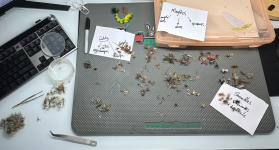
Each year I empty my boxes and try to decide on a plan. Usually, it starts like this with gross organization by type. Then, I refine each pile into its varieties, species, whatever.

Ultimately, it comes down to grouping bugs by type and keeping life stages well-collected. I'll store off-season stuff in big boxes until needed...

My questions: how discerning are you guys when rejecting old ties? How about box organization strategies: what do you do and how does it work for you?

I tend to keep too many on me and get disorganized pretty quickly. Using slim compartment boxes for dries has helped me be more intentional about what I bring, but that's as far as I've gotten.
 

Attachments

  • bugs.png
    bugs.png
    1.3 MB · Views: 31
...My questions: how discerning are you guys when rejecting old ties? How about box organization strategies: what do you do and how does it work for you?

I tend to keep too many on me and get disorganized pretty quickly. Using slim compartment boxes for dries has helped me be more intentional about what I bring, but that's as far as I've gotten.


I carry trout flies until I lose them, give them away or decide they are panfish flies.... The lesson I finally learned in this regard is when creating an experimental fly, DON'T tie a dozen in three sizes. 😳

As far as strategies go, when fish I at places where i expect a lot of hatches, I carry more specific flies organized by season with overlap where necessary. I only carry those flies at the appropriate places and/or during the appropriate season.

I also have flies in a separate box that I always have with me like caddis, midges, BWO's, generic nymphs, dry flies, wet flies, a few streamers and terrestrials. Total number of boxes carried: 2 or three.

When I fish small streams, I carry the same flies all year in a single box with compartments for dries and foam for wets, filled with mostly attractor patterns, a streamer or two and terrestrials.

A couple of things that helped me get organized & downsized:

I DRAMATICALLY reduced the number of EACH fly I carry. Instead of carrying six or twelve size 16 tan EWC caddis, I may carry 4 when fishing a place with hatches and only 2 or 3 in my small stream box. In addition, I only carry a single size of every terrestrial I use so it's only size 16 beetles, size 20 ants, etc.​
​
I do have a stash back at the car in case I run into a blizzard hatch and I lose the three flies in my box, but so far after decades of this discipline, it has never happened.​
​
I only use generic patterns so NO "Bob's Booyah Bugs" for me. I tie only parachutes and thorax dry flies in a few different sizes and colors to represent EVERY mayfly I encounter & I use EWC to represent all caddis & stone flies. Generic nymphs, midges, and terrestrials round out the mix.​

I realize going this route may not appeal to folks that are afraid to be without a dozen size 17 Green Drakes in September... just in case. 😉

But I can honestly say for me, it has worked out just fine...
 
I protect against the hoard by:
- Breaking a fly off over trying to retrieve it. Usually safer and easier
- Chucking beat up flies
- Only tying what I need
- Outfitting family, friends and strangers with flies
- Tying only what I need
- I fish every fly I tie before tying another.

I don’t love to tie flies, it’s more that I really hate buying them. Like Bamboozle, everything is generic and when I tie them it’s simply a brown one or cream one or whatever color in size 16, generally speaking. I don’t need to know anything about entomology. I don’t even need to know fly pattern names. I simply look at bugs and pick one thats close. I’ve been out of commission for months and haven’t tied one fly because I haven’t been fishing and I haven’t been losing any. I cull my flies by not adding to the problem. The 10,000 unassembled flies I have is what I find difficult to organize.
 
At the end of every fishing season - usually mid to late Nov for me - I go through all of my boxes.

Remove all beat up flies, and put them in a retie container.
With the price of hooks these days, I think its worth it to reuse them.
Unless they're rusty or bent - then I toss them.
Many of them just need a simple repair - rewinding a hackle, replacing a broken tail, etc.

Then I do an inventory of each pattern and size.
And make of list of what I need to tie for next year - which is usually done over the winter.
Although since I've retired, we've usually been going to Florida in Jan.
And I try to get most tying done in late fall now
 
Dear ntallen,

What is this concept of organization that you speak of? 😉

I'd still be fishing the Hendrickson Comparadun my buddy Whitey gave me 35 years ago if it hadn't fallen off my fly patch. It was a pinkish-gray fish slimed fuzzball that accounted for many 100's of fish before it was lost. It worked in every stream I ever fished it!

Regards,

Tim Murphy 🙂
 
...I don’t need to know anything about entomology. I don’t even need to know fly pattern names. I simply look at bugs and pick one thats close...

I gave up on entomology in favor of the "eeny, meeny, miny, moe" color & size matching system decades ago when I discovered the bugs weren't reading my copies of "Hatches" and discovering someone changed their name behind their backs and they weren't hatching on the day I had the properly named flies in my boxes.
 
I carry trout flies until I lose them, give them away or decide they are panfish flies.... The lesson I finally learned in this regard is when creating an experimental fly, DON'T tie a dozen in three sizes. 😳

As far as strategies go, when fish I at places where i expect a lot of hatches, I carry more specific flies organized by season with overlap where necessary. I only carry those flies at the appropriate places and/or during the appropriate season.

I also have flies in a separate box that I always have with me like caddis, midges, BWO's, generic nymphs, dry flies, wet flies, a few streamers and terrestrials. Total number of boxes carried: 2 or three.

When I fish small streams, I carry the same flies all year in a single box with compartments for dries and foam for wets, filled with mostly attractor patterns, a streamer or two and terrestrials.

A couple of things that helped me get organized & downsized:

I DRAMATICALLY reduced the number of EACH fly I carry. Instead of carrying six or twelve size 16 tan EWC caddis, I may carry 4 when fishing a place with hatches and only 2 or 3 in my small stream box. In addition, I only carry a single size of every terrestrial I use so it's only size 16 beetles, size 20 ants, etc.​
​
I do have a stash back at the car in case I run into a blizzard hatch and I lose the three flies in my box, but so far after decades of this discipline, it has never happened.​
​
I only use generic patterns so NO "Bob's Booyah Bugs" for me. I tie only parachutes and thorax dry flies in a few different sizes and colors to represent EVERY mayfly I encounter & I use EWC to represent all caddis & stone flies. Generic nymphs, midges, and terrestrials round out the mix.​

I realize going this route may not appeal to folks that are afraid to be without a dozen size 17 Green Drakes in September... just in case. 😉

But I can honestly say for me, it has worked out just fine...
Dave Hughes “Handbook of Hatches” was instrumental in my upbringing with some similar logic - be argued that you could rule the dry fly world with a few EHC and Griffith’s Gnats - and the (then) world of nymphs with some Gold ribbed Hare’s Ears, Pheasant Tails, and Zug Bugs - turns out he was right back then and so are you today - it’s about knowing the hatch you’re fishing and/or presenting a fly that suggests the appearance and mimics the actions of a particular insect - I HAVE a ton of flies - but only USE a few - and can fish out of an Altoids tin any time (but where’s the fun in that?) I don’t need a deadly dozen - more like five confidence flies for me which have performed well in every location I have used them:
IMG_8189.jpeg
IMG_6537.jpeg
P1270002.jpeg
IMG_6780.jpeg
8BA03FAD-042E-4F7F-8C30-EB31AF85DF69.jpeg
 
...It’s about knowing the hatch you’re fishing and/or presenting a fly that suggests the appearance and mimics the actions of a particular insect...

Almost to an angler, most agree that even though they look the part, ultra realistic flies tied to exactly match all aspects of a specific insect are no more and sometimes less effective than a fly that looks like a "bug."

That consensus is good enough for me. 😉
 
Almost to an angler, most agree that even though they look the part, ultra realistic flies tied to exactly match all aspects of a specific insect are no more and sometimes less effective than a fly that looks like a "bug."

That consensus is good enough for me. 😉
Some of us go to a lot of trouble for the skunk 😂
IMG_2842.jpeg
 
At the end of every fishing season - usually mid to late Nov for me - I go through all of my boxes.

Remove all beat up flies, and put them in a retie container.
With the price of hooks these days, I think its worth it to reuse them.
Unless they're rusty or bent - then I toss them.
Many of them just need a simple repair - rewinding a hackle, replacing a broken tail, etc.

Then I do an inventory of each pattern and size.
And make of list of what I need to tie for next year - which is usually done over the winter.
Although since I've retired, we've usually been going to Florida in Jan.
And I try to get most tying done in late fall now
I do the Exacto knife reset to outright abominations - or pitch the “meh” flies into the bluegill box where they’ll be loved at a future date with fish who want them … pic is a “euro type beadhead” which caught ZERO Trout after several sessions
IMG_1903.jpeg
 
Some of us go to a lot of trouble for the skunk 😂View attachment 1641254452

I don't know what your body is made of, but there is/was another theory out there that the hardness of the extended body of some creations like the infamous porcupine quill "Coffin Fly" touted by Marinaro had a lot to do with ineffectiveness and missed or lost fish.

FWIW - Many years ago I whipped up a parachute version of a Green Drake spinner using 1/8" diameter soft cylindrical foam for the extended body.

It's a killer pattern so maybe there is something to the softness thing...
 
A friend ties a Green Drake spinner with small diameter parachute cord. He omits the tail and said it works well even in slow frog water.
 
Back
Top