Big Springs

Paul6.5

Active member
Joined
Oct 23, 2023
Messages
117
City
SEPA
I only discovered Big Spring Creek a few years ago, and it’s been an intriguing stream for me ever since. It’s one of the few places I have fished that has a good population of wild rainbows, and spotting a few fish in the 18-inch-plus range certainly keeps me coming back.

I headed over the other day because I’m still recovering from quadriceps tendon repair surgery back in May, and the creek offers some relatively easy wading. After a couple hours of catching my usual 4"–9" wild rainbows, I pulled out my camp chair and enjoyed a hoagie and a cigar before heading home.

While I was sitting there, a local fellow came over and started telling me how much worse the creek has been since the restoration. I mostly listened and offered a few “Oh yeah?” and “That’s too bad” responses. I didn’t want to argue, especially since I never fished it before the work was done and had nothing to compare it with.

But the conversation left me curious. To my untrained eyes, the creek looks healthy, and I’ve enjoyed the fishing. I also realize that catching fish doesn’t tell the whole story.

For those who knew Big Spring before the restoration, do you think it’s worse off today? If so, in what ways—habitat, insect life, trout numbers or size, or something else?

I’m asking sincerely. I’ve only gotten to know the creek as it is now, and I’d be interested in hearing from people who have a longer history with it.
 
I've never fished it, always wanted to, but I feel like I have to say that you are the first person I have ever heard, both on this forum and in person, that had a positve tone when talking about fishing it.
 
When I first fished Big Springs after the "restoration," the first thing I said was. "This reminds me of Little Lehigh," (Section 08, Former Heritage Waters) in regards to the number of people fishing and the ease of getting in close & personal.

Take that for what it is worth depending on your opinion of the Little Lehigh... 😉
 
I only discovered Big Spring Creek a few years ago, and it’s been an intriguing stream for me ever since. It’s one of the few places I have fished that has a good population of wild rainbows, and spotting a few fish in the 18-inch-plus range certainly keeps me coming back.

I headed over the other day because I’m still recovering from quadriceps tendon repair surgery back in May, and the creek offers some relatively easy wading. After a couple hours of catching my usual 4"–9" wild rainbows, I pulled out my camp chair and enjoyed a hoagie and a cigar before heading home.

While I was sitting there, a local fellow came over and started telling me how much worse the creek has been since the restoration. I mostly listened and offered a few “Oh yeah?” and “That’s too bad” responses. I didn’t want to argue, especially since I never fished it before the work was done and had nothing to compare it with.

But the conversation left me curious. To my untrained eyes, the creek looks healthy, and I’ve enjoyed the fishing. I also realize that catching fish doesn’t tell the whole story.

For those who knew Big Spring before the restoration, do you think it’s worse off today? If so, in what ways—habitat, insect life, trout numbers or size, or something else?

I’m asking sincerely. I’ve only gotten to know the creek as it is now, and I’d be interested in hearing from people who have a longer history with it.
Absolutely better post restoration if you are looking for a population of wild ST and RT that is spread out and in decent numbers over a much longer distance. I electrofished the entire special reg area many times back in the 1970’s and 1980’s and then did so once after the restoration had taken hold for a few years and it wasn’t even close from my perspective. Give me the “restored” stream.

Everyone has their preferences though. The “ditch” area directly below the spring source was a mix of wild trout and hatchery escapees of various sizes in the “old days.” Many people liked that high density of fish, including large fish. The exchange, however, was that there was a very low density population throughout the rest of the special reg area except in the riffle below the “dam” at the tail end of the ditch, under the bridge immediately below that area, and in the riffle immediately down from the bridge. The the rest of the special reg area, other than at and under the fish barrier when it existed, was largely dead water as far as I was concerned. There were few fish elsewhere and a few stacked up rainbows, perhaps numbering 4-6, at the occasional short spots where water velocity momentarily picked up. You could also find an occasional trophy BT, but that was it.
 
Last edited:
Which restoration?
The one after the hatchery closed?

The restoration post hatchery is hands down better.

Phase 1 of the one done in the 2010s?
Phase 2 of the one done in the 2010s?

The biologist report from 2015 was pretty clear it was much better post restoration.
That is, for brook trout.


Some people think the trophy rainbow fishery got ruined. Yeah it isnt as good for large trophy rainbows but they are still there but the brook trout numbers exploded.

Or the one they just did?

I cant speak for that one.

Sorry guys but brook trout should take precedent, especially in Big Spring of all places. Im sure a blog somewhere calls that elitist, or snobbery or some other silly name but it isnt about fishing preference. Its about preserving our native trout species first, which is of greatest conservation need.
 
Last edited:
I've never fished it, always wanted to, but I feel like I have to say that you are the first person I have ever heard, both on this forum and in person, that had a positve tone when talking about fishing it.
Im kind of surprised you say that? I have always spoken positive about Big Spring, especially about fishing it. Absolutely love that stream.
 
Which restoration?
The one after the hatchery closed?

The restoration post hatchery is hands down better.

Phase 1 of the one done in the 2010s?
Phase 2 of the one done in the 2010s?

The biologist report from 2015 was pretty clear it was much better post restoration.
That is, for brook trout.


Some people think the trophy rainbow fishery got ruined. Yeah it isnt as good for large trophy rainbows but they are still there but the brook trout numbers exploded.

Or the one they just did?

I cant speak for that one.

Sorry guys but brook trout should take precedent, especially in Big Spring of all places. Im sure a blog somewhere calls that elitist, or snobbery or some other silly name but it isnt about fishing preference. Its about preserving our native trout species first, which is of greatest conservation need.
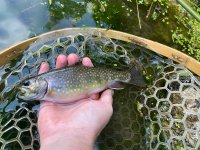
Not sure since I only first discovered in 2019ish. but I have enjoyed that gin clear ice cold water since my first visit. I 100% agree about the Brook Trout over all others but I sure do love catching a wild rainbow and seeing some of those big boys.
 
IMG_0647.jpegIMG_0611.jpeg
I love big spring. Never experienced it before the restoration but as of now it’s full of fat, healthy wild fish everywhere you look. The big rainbows are still in there. The real concern is not whether or not the fish are still as big or plentiful, it’s the development in the area and the potential to completely lose what we have
 
Every Spring season the number of poachers goes up in the fly area and it is not uncommon to find a dozen or so filleted carcasses of 20”+ Rainbows stashed under bushes or thrown up on a bank across the road - the sheer numbers of fish have indeed stabilized over the years to where the fish are much more evenly distributed over longer distances of creek - as stated, the development of the area, road runoff, pesticides leaching into the groundwater, and less volume of water with increased well drilling are the main detractors - hatches are not really reliable as in the days of Schwiebert’s “Nymphs” passage on Baetis hatches - the biggest food source is probably cress bugs/scud and midges. I was dismayed when the PAFBC stocked “wild” Brookies from a North Carolina strain instead of using the few remaining natives left after the Hatchery was removed - tricky business but overall, Big Spring has fared better than ALL the other CV Spring creeks in the long run
 
I love that stream. Too young to remember it in the 70s, but I've never had any complaints. HOWEVER-for as long as I can remember, whenever the stream is mentioned someone SOMEWHERE *just has to* chime in about how "they" ruined it...
 
Yeah you are right, I guess I shouldn't have been so absolute with my statement.
Hey dudeman

I’m with you I have fished there at least 3 times and from 4-5 different spots back in 2020 and never seen any fish including the ditch and out from the parking lot, i believe there used be a little dam or stone pile i used to stand on.
 
I love that stream. Too young to remember it in the 70s, but I've never had any complaints. HOWEVER-for as long as I can remember, whenever the stream is mentioned someone SOMEWHERE *just has to* chime in about how "they" ruined it...
Well - don’t we all have a part in ruining all the waters we fish - where “we” become “them”?
🤑
 
Every Spring season the number of poachers goes up in the fly area and it is not uncommon to find a dozen or so filleted carcasses of 20”+ Rainbows stashed under bushes or thrown up on a bank across the road - the sheer numbers of fish have indeed stabilized over the years to where the fish are much more evenly distributed over longer distances of creek - as stated, the development of the area, road runoff, pesticides leaching into the groundwater, and less volume of water with increased well drilling are the main detractors - hatches are not really reliable as in the days of Schwiebert’s “Nymphs” passage on Baetis hatches - the biggest food source is probably cress bugs/scud and midges.
Interesting. Is it just rainbows? Or are there brookies being fileted too?
 
There's a great divide in opinions about both Big Spring and the [now gone] Allenberry fly section on the Yellow Breeches, as well as Falling Springs over in Chambersburg, Fishermen's Paradise on Spring Creek near State College, and a few others.

Suffice to say in the 1970s well into the 1980s, the fly-only sections of these streams were heavily stocked not only by the state but also by clubs that maintained cooperative hatcheries. The cooperative hatcheries (a program that continues to thrive) in particular stocked some real bruisers. These are the streams where I learned to fly fish and as a boy I was mesmerized by the sheer number of trout.

But, on a certain level, it was like fishing in a hatchery. Arguably, on Paradise and Little Lehigh in particular, it was literally fishing in a section of a hatchery.

There was something of a change in attitude away from a preference for stocked fish and in favor of wild ones in the late 1980s. That ethos began prevail in the 1990s, resulting in a shift in favor of having fly-only, no-kill regulations largely on wild trout streams. I am among those who grew tired of fishing for stocked trout and my dad and I largely shifted away from it starting in the late 1980s when we discovered some decent wild trout streams.

But we didn't entirely leave the meat holes behind. After a morning of being skunked on the Letort -- where we sometimes had wonderful catching experiences -- we would head over to catch some easy trout in the Allenberry and Run.

One of the things that made the massive stocking program of that era possible was the ultra-modern (for its time) hatchery on Big Spring. Though it's physical footprint was relatively small, it produced roughly a million fish per year, a significant percentage of the total.

But it also produced substantial waste and the only way Big Spring could survive as a trout stream is for all of the hatchery water (all of the flow from the creek) to be processed at a full-on wastewater treatment plant. At some point, the WWTP failed, resulting in the remaining wild brook trout in the stream, a population that had survived since the last ice age, being wiped out. For the old timers, this was a repeat of the destruction of the Cedar Run brook trout population over in the Mechanicsburg - Camp Hill area.

In addition, PCBs started to turn up in Big Spring hatchery fish. Shortly thereafter, the hatchery was closed down.

There was a major effort on the part of the state to re-introduce wild brook trout to the creek and it has proven successful.

And, very importantly, a bunch of fly fishing enthusiasts from the area, including Norm Shires, whose son and grandsons are still big time fly anglers in the are, undertook to restore the part of the creek downstream from the so-called ditch area. Back in the 1930s, or possibly earlier, most of Big Spring downstream from the ditch had been a series of commercial fish hatcheries. When those ventures went out of business, the troughs remained and the creek had become a wide mud flat with very little holding water for trout. The restoration project restored the channel, resulting in very good trout water throughout the fly section.

A note here: I had stopped fishing Big Spring around 1984 or so because the ditch was the only place to fish and you had to wait in line for a chance to make a few casts. I'd have never gone back, except a friend dragged me there because he was so impressed with the restoration process.

The short version of this story is that if the good old days for you are the heavily stocked era spanning the 1970s and 1980s, then the fishing has deteriorated substantially. If, however, you have a preference for fishing for wild trout where you never know what you're going to catch but there's always a shot at a bruiser, then the good old days are right now on Big Spring. It is one of the few places where you can get a wild trout trifecta.

Unfortunately, development in that southcentral limestone region has really put a hurting on the limestone springs of the Letort, and Falling Springs in particular. Though Big Spring's flow has been largely unaffected to date, there are a lot of development plans for that fairly small aquifer area and it could well end up losing its water to residential wells, concrete pads that prevent aquifer regeneration and the latest big user of well water, massive data centers.
 

Latest Forum Posts

USGS Stream Gauges

Back
Top