Tobyhanna Creek public access

Plenty of Keystone Select Waters with big stockers, where potential trespass isn't an issue.

My orthopedic surgeon owes me a trip there after he tore my bicep a few years back. I will remind him Tuesday when he is repairing a tendon in my forearm. lol
 
I don't think anyone was arrested in either the Little Juniata or Lehigh River case.

Police are reluctant to arrest anyone in these cases, because it is not known whether the person is breaking the law or not.

On the Little Juniata River, a few years before the court case, there was a "fish in" below the village of Spruce Creek. Several fishermen fished the posted stretch. A state policeman watched the whole thing but did not arrest anyone. And for good reason. It was not clear whether or not they were breaking the law.

At that point the navigability status of the LIttle Juniata was unknown.

At this point, the navigability of Tobyhanna Creek is unknown.
The Little Juniata river case was kinda unique
The "club" had put a cable across the river.
And were attempting to stop people from even floating through - and basically, stopping passage through the gorge below.
Since you can only access at Spruce Creek, or Baree
Something had to be done about it

PA Fish and Boat, along with Alan Bright from spruce creek outfitters, teamed up to fight it in court
And a lawyer from Pittsburgh - who was a fly fisherman - even volunteered his services to the cause, if I'm recalling correctly.
 
Can anyone tell me about these, I assume "bridges" in the dream mile club? Could they be navigated under in a kayak? Any insights appreciated. If I can pass through these waters on a boat, which I believe I can, I would hate to have to get out to port around them, thus creating an opportunity for tresspassing.

This thread and discussion intrigued me. I found this (boring) YouTube video of drone footage of the section I believe you are asking about. I think the red bridge you could float a kayak under, the other looks to me like you would have to portage over. Good Luck and I hope this helps.
 
Can anyone tell me about these, I assume "bridges" in the dream mile club? Could they be navigated under in a kayak? Any insights appreciated. If I can pass through these waters on a boat, which I believe I can, I would hate to have to get out to port around them, thus creating an opportunity for tresspassing.
You could try asking them for info.I found this address and phone number.
PO Box 738,Pocono Lake,Pa,18347 (570)646-8828.Found this on the web not sure how accurate it is.It's worth a try.Good Luck
 
Hi Everyone,

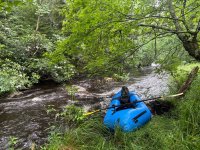
I joined this forum because this topic is of interest and very intriguing to me. Although I now live in Colorado most of the time, I grew up in the Poconos and continue to live there on and off. I have been infatuated with the waterways and streams in the Poconos for as long as I can remember. I canoed the upper Toby (from the bridge through the game lands off 423) several times at flood stage with my best friend as a kid (and as an adult), portaging around Warnertown falls each time. In the past few years, I got interested in packrafting after accompanying my twin sons on a boy scout packrafting trip in Montana. I subsequently bought my own packraft and became obsessed with figuring out which creeks in the Poconos could be packrafted (presumably more than you can canoe, and also with somewhat more marginal water conditions) and have since been ticking some off each time I happen to be around and we get a bunch of rain. I have since packrafted more of the Toby through the game lands, starting higher at route 611. I also did the Tunkhannock this past summer during a July storm cycle from the bridge near Pocono Raceway near the outflow of Long Pond and rafted the Toby through Austin Blakeslee preserve to Rte. 940, pulling out there because I didn't want to argue with Dream Mile folks.

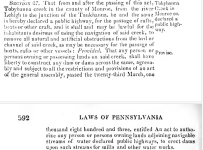
I have actually done some research on the public nature of the Tobyhanna Creek and even pulled the applicable legal proceedings entitled "General assembly of the Commonwealth of Pennsylvania - Passed at the session of 1837-38", which couldn't be more clear. The Tobyhanna Creek was declared by the legislature as a "public highway" between the confluence of the Lehigh and the confluence of the Tunkhanna (Tunkhannock) Creek. This includes the entirety of the Dream Mile fishing club. I have attached this excerpt, but I have acquired this entire book, which Google was kind enough to scan from a rough hard copy.

Later case law associated with the Upper Lehigh River case seems to also indicate that the public nature of the Toby would apply to the entirety of the Tobyhanna Creek even above the Tunkhannock confluence because the court stated in their findings that if one portion of a creek or river is declared public/navigable, then the entire creek is public from its headwaters to its confluence. All of this is somewhat moot for boating, because you can in fact legally float any waterway in the PA commonwealth as long as you enter and exit from land that you are legally allowed to be on, but the implications for wading and fishing are much larger. I suspect that the dream mile folks may yell at you but would never take an "offender" to court in fear of losing the case, which is pretty likely.

There is a fantastic book out there by Gary Gentile if you are interested in the navigability of creeks in the Poconos. It is very much worth the $20.

https://www.amazon.com/dp/1883056500?lv=shuf&channelId=500&plpRedirect=mhFallback

Very few people put watercrafts on creeks in the Poconos outside of the Lehigh below the Frances E Walter. If you are interested in exploring more of the waterways in our beautiful part of the state and want some company, reach out (via DM). It would be fun to have someone to adventure with the next time we get a bunch of rain and I happen to be in the Poconos! I haven't done the upper Lehigh yet, and would love to do the whole thing from Goldsborough to the Bear Creek preserve and maybe hike out from there instead of floating to the FEW dam. I am also intrigued about Bear Creek, amongst others.
 

Attachments

  • Toby_Creek.png
    Toby_Creek.png
    173.1 KB · Views: 20
  • packraft.jpeg
    packraft.jpeg
    437.9 KB · Views: 20
Last edited:
Hi Everyone,

I joined this forum because this topic is of interest and very intriguing to me. Although I now live in Colorado most of the time, I grew up in the Poconos and continue to live there on and off. I have been infatuated with the waterways and streams in the Poconos for as long as I can remember. I canoed the upper Toby (from the bridge through the game lands off 423) several times at flood stage with my best friend as a kid (and as an adult), portaging around Warnertown falls each time. In the past few years, I got interested in packrafting after accompanying my twin sons on a boy scout packrafting trip in Montana. I subsequently bought my own packraft and became obsessed with figuring out which creeks in the Poconos could be packrafted (presumably more than you can canoe, and also with somewhat more marginal water conditions) and have since been ticking some off each time I happen to be around and we get a bunch of rain. I have since packrafted more of the Toby through the game lands, starting higher at route 611. I also did the Tunkhannock this past summer during a July storm cycle from the bridge near Pocono Raceway near the outflow of Long Pond and rafted the Toby through Austin Blakeslee preserve to Rte. 940, pulling out there because I didn't want to argue with Dream Mile folks.

I have actually done some research on the public nature of the Tobyhanna Creek and even pulled the applicable legal proceedings entitled "General assembly of the Commonwealth of Pennsylvania - Passed at the session of 1837-38", which couldn't be more clear. The Tobyhanna Creek was declared by the legislature as a "public highway" between the confluence of the Lehigh and the confluence of the Tunkhanna (Tunkhannock) Creek. This includes the entirety of the Dream Mile fishing club. I have attached this excerpt, but I have acquired this entire book, which Google was kind enough to scan from a rough hard copy.

Later case law associated with the Upper Lehigh River case seems to also indicate that the public nature of the Toby would apply to the entirety of the Tobyhanna Creek even above the Tunkhannock confluence because the court stated in their findings that if one portion of a creek or river is declared public/navigable, then the entire creek is public from its headwaters to its confluence. All of this is somewhat moot for boating, because you can in fact legally float any waterway in the PA commonwealth as long as you enter and exit from land that you are legally allowed to be on, but the implications for wading and fishing are much larger. I suspect that the dream mile folks may yell at you but would never take an "offender" to court in fear of losing the case, which is pretty likely.

There is a fantastic book out there by Gary Gentile if you are interested in the navigability of creeks in the Poconos. It is very much worth the $20.

https://www.amazon.com/dp/1883056500?lv=shuf&channelId=500&plpRedirect=mhFallback

Very few people put watercrafts on creeks in the Poconos outside of the Lehigh below the Frances E Walter. If you are interested in exploring more of the waterways in our beautiful part of the state and want some company, reach out (via DM). It would be fun to have someone to adventure with the next time we get a bunch of rain and I happen to be in the Poconos! I haven't done the upper Lehigh yet, and would love to do the whole thing from Goldsborough to the Bear Creek preserve and maybe hike out from there instead of floating to the FEW dam. I am also intrigued about Bear Creek, amongst others.
Wow that is quiet a find actually
 
Public access to the water is never a matter of applying logic and reason to existing laws. There are a variety of social and economic reasons for this (mainly because wealthy entities are often the owners of valuable water adjacent land), so pretty much every case ends up being considered separately.

Public access to the Chesapeake Bay in Maryland, for example, is a hot mess. I can fish from a boat and cast my lure under your dock on private property, but I cannot stand between the high tide - low tide lines on the shoreline of private property. And street ends are generally considered public property, providing public access to the tidal Bay. Except when they're considered private property, for whatever legitimate or illegitimate reasons.

I had a front row seat to watch a dispute between Florida Rock, which had a gravel mining operation near a colonial era public landing, and the community, which was trying to use the public landing to shut down the gravel mine. Ultimately, the community used the public landing and some ancient Indian burial sites in the area and managed to shoo Florida Rock away. But in that case it was Goliath vs. Goliath, since the community consisted of very well connected waterfront property owners who pooled their resources to hire some very high powered lawyers.

In the Tobyhanna case, it should be straightforward if the creek at any point in history had been designated navigable. But it won't happen without a court fight comparable to the nearby battle royale over the Lehigh upriver from Francis Walter Lake (see Lehigh Falls Fishing Club 1337 vs. Andrejewski). The appeals court (final) decision is a pretty easy read, though boring. It declared the section of river navigable, and the fishing club packed up and left.

Meanwhile, in New York, there's the matter of the Salmon River, which had been considered navigable, but was then ruled to be not open to the public for fishing. At all. (See Douglaston Manor vs. Bahrakis) The New York court reached into some pretty obscure areas to find legal justification to support the owners of Douglaston Manor in excluding public access from the navigable waterway. In this case, it's worth noting that Douglaston Manor was established by H. Douglas Barclay, who was in the New York Senate when the Salmon River hatchery was being considered by the legislature. Once he knew the hatchery was going to be built, he bought property and easements along the river with the intention of establishing a private fishery made possible by fish stocked using public money. His venture was, and continues to be, financially successful, in large part because he prevailed in the Douglaston Manor vs. case. In that case, it was Goliath (Douglaston) vs. David, but David got crushed.

By way of footnote, Sen. Barclay ended up being close friends with Prez George Bush I (H.W.), and served as his ambassador to El Salvador. His son, William A. Barclay, who is also one of his heirs, served in the New York Assembly from 2003 through the end of his current term. He is also one of the family members who owns Barclay Outdoors - Douglaston Salmon Run.

Bottom line: You want to fish the Dream Mile on the Tobyhanna? Buy a membership or spend a like amount or more fighting in court to have the area declared open to public fishing by virtue of being navigable. And if you go to court, you may end up losing the fight.

Justice often sides with the person who has the biggest lawyers with the biggest fees.

And if the Dream Mile goes away, all those stocked trout will go away too, so it's appeal as a forbidden fruit fishery may be diminished.

I'd like to say there's another, more idealistic, answer, but it's really all about money.

 
In the Lehigh River case, the Appellant, John Andrejewski simply started fishing the river and refused to leave based on his opinion of the navigability of the river. He didn't bring suit against the club. The club could have simply quietly let one man fish while generally maintaining the status quo, but they chose not to. The Lehigh Falls fishing club instead brought the lawsuit, which ultimately played out in the courts. My strong opinion is that the Dream Mile fishing club would hoot and holler at you but would never actually bring a lawsuit against someone who walked in from Austin Blakeslee preserve along the riverbed to fish simply because of the implications of potentially losing the case. They would be even less likely to go after someone who simply floated through on a raft or kayak at high water, since the rafter/kayaker is much less likely to return on a regular basis. The Dream Mile also has the benefit and knowledge of what happened in the Lehigh River case, and my guess is that they would much rather deal with an occasional "unauthorized" user of "their" stretch of river than lose everything in court with a formal declaration of the navigability of the river. Declaration of the navigability of the Tobyhanna Creek by the courts could also impact other property owners along the Tobyhanna Creek.
 
Public access to the water is never a matter of applying logic and reason to existing laws.

I'd like to say there's another, more idealistic, answer, but it's really all about money.

Many people will like how that sounds. But I don't think the facts support it.

In both the Lehigh River and the Little Juniata River cases, the public won, against wealthy adversaries.

The public won because people were willing to ACT, to dispute it in court. The public won the court case because the judge applied logic and reason to the law.
 
Last edited:
In the Lehigh River case, the Appellant, John Andrejewski simply started fishing the river and refused to leave based on his opinion of the navigability of the river. He didn't bring suit against the club. The club could have simply quietly let one man fish while generally maintaining the status quo, but they chose not to. The Lehigh Falls fishing club instead brought the lawsuit, which ultimately played out in the courts. My strong opinion is that the Dream Mile fishing club would hoot and holler at you but would never actually bring a lawsuit against someone who walked in from Austin Blakeslee preserve along the riverbed to fish simply because of the implications of potentially losing the case. They would be even less likely to go after someone who simply floated through on a raft or kayak at high water, since the rafter/kayaker is much less likely to return on a regular basis. The Dream Mile also has the benefit and knowledge of what happened in the Lehigh River case, and my guess is that they would much rather deal with an occasional "unauthorized" user of "their" stretch of river than lose everything in court with a formal declaration of the navigability of the river. Declaration of the navigability of the Tobyhanna Creek by the courts could also impact other property owners along the Tobyhanna Creek.
This is very much like the corner crossing situation ie hunting in the western states. One wealthy landowner pressed the issue took it to court and lost.
 
Back
Top