Posting results for the other tackle tinkerers interested in how this went. I was able to meet up with
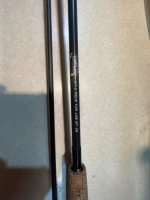
@Streammagic237 earlier this week and took a look at the damage. The rod was a custom build on a carbon Cortland blank that wasn't model-marked but felt very light in the hand. Looked like the original builder knew what they were doing: built on the blank spine like I would have done, nice thread work and epoxy over single foot guides that to my eye were sized and selected with distance casting in mind. The rod had a few miles on it no doubt and I'm guessing many wouldn't have invested the time/effort but SM237 and I were having the conversation at a Dunkin' close to both of us clearly because of the sentimental value the rod had with its owner. I was happy to give it a go.
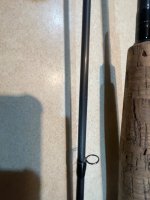
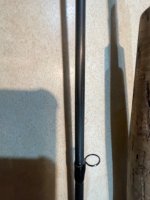
The rod had a series of lateral cracks running around the blank just above the last (7th) guide on the top section - about 6-1/2 inches up from the female ferrule.
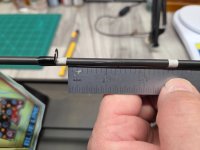
Although the blank was cracked all along its radius, it was still in tact and the damage was close enough to the ferrule opening, it was easy to stent the damaged area and overwrap it without having to cut the blank. I used a cut piece of a fiberglass fly rod blank for the stent. I like using fiberglass for stents when I can because it's generally a bit softer and more forgiving that carbon. In the end, it's probably not noticeable one way or the other but knowing there's a lil' bit 'o honey in there just warms the soul -- any Lami Honey fans out there or are they all over at FFR?
🙂
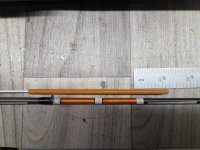
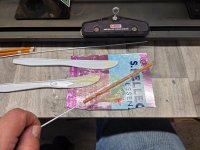
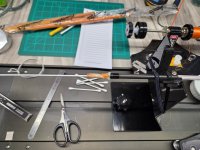
Note the temporary orange supporting wraps. It's absolutely essential to add supporting wraps before fitting the stent to prevent any deformation (or ballooning out) of the broken section while you're setting it in place.
Based on the ID of the fly rod blank and the ID of the stent, a straightened wire hanger was an effective ram for the stent.
It's extremely important to clean the ID of the ferrule further in than you would expect the lower section to seat with DN alcohol. Once cured, any leftover epoxy inside the ferrule - even the slightest bit - will prevent a proper fit and will likely lead to a break at the ferrule eventually, if not immediately.
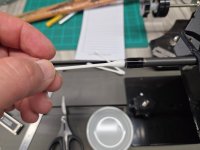
After the stent was fully cured, I cut off the supporting overwraps as well as the adjacent guide and cleaned the outer surface of the blank. I reset the guide, rewrapped it, overwrapped the cracks, and epoxied the thread.
The guide was wrapped in black (Fuji A-NOCP 001) to match the others and I transitioned directly to a BC Gray (Fuji A-ULTRA 023) for the overwrap to match the blank.
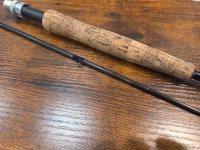
Once cured, I carefully wet sanded the overwrapped epoxy with 1500 grit paper just to take the shine off it. The result was a near perfect match to the blank.
Here's the important stuff: I sized the stent so that it extended 1-1/8" above and below the damage and overwrapped 1/2" past the cracks in the blank.