Really good video about arm position when FFing:


I learned to cast while keeping a book under my arm from my Dad who learned it from George Harvey - any fighter knows that you can transfer energy more efficiently with your arms close to your body - you can punch (or cast) using ADDED core/leg strength instead of relying solely on arm/shoulder strength - think of how a batter steps into the swing for added power - it’s all part of coordinated motion and efficient energy transfer - am I a great caster? - not really - Lefty could fling a whole 90 foot fly line with his bare hand - I simply fish areas where a 100 foot cast isn’t required (stealthy wading is…) When I taught fly casting, I concentrated on form, line management in the air and the water, and of course accuracy - IE, when guiding on “Clark’s”Creek 30 years ago, fly placement was a 3 dimensional affair (roll-pitch-yaw) - cast to the correct distance, IN the feeding lane, UNDER the Hemlock branch - such are the ramblings of a has been - good video though!Really good video about arm position when FFing:


I don't believe Joe has ever hid that he taught to cast to catch fish, not to look graceful.Just have to share.
I feel this is the proper post for the following:
I just saw a Joe Humphrey's Facebook reel of his presentation at the 2026 Lancaster Fly Fishing Show.
Unfortunately, I couldn't make it to the Show, but I was not pleased with Joe's demonstration and crowd teaching of how to cast.
What he demonstrated is good for "Euro nymphing". Or any flipping a line a short distance, but it isn't fly casting.
Fly casting is casting a fly line. The physics of moving a line. A cord. The same as the electric cord from the sweeper in the house.
Straighten the line and then apply the little amount of energy required to pull it and let it move in the direction desired.
It's fly casting.
It's fun.
The technique Joe has promoted for years is short distance flipping. He did it when he taught his nymph fishing technique. (A type of a "tuck cast".)
What he told the crowd to do - bend the wrist up and back and then punch it forward with the thumb and a squeeze of the handle - is a simple means for flipping a mostly leader and weighted rig a short distance.
It's really not fly casting.
It's what is used mostly with a long rod and a short line.
Physics of moving a cord - a flyline - is different.
A "tuck cast", a "curve cast", a "crash cast", a "double haul", a "roll cast" (not really a good cast for first technique in learning fly casting) and other types of casts are performed by handling a fly line.
Fly casting is handling a fly line.
The leader and tippet are secondary and only needed for managing the tip of the fly line and eventually for modifying to present flies and to actually fish.
Learning the physics of moving the line is fun. That's the casting. It doesn't require much energy at all. Most people use too much if not way too much energy to do it.
Flipping the wrist for a back cast is not good.
Fly casting is not bending the wrist backward to flip the leader up in the air and behind and then to flip-punch it forward and use a thumb press and a hand squeeze on the cork grip to make it hit the water at a spot.
Bow and arrow casts are fun and necessary only under really rare conditions. In that manner, they are similar to what Joe was teaching at the Lancaster demonstration - a specific technique for specific situations with a specific rig.
I just bought a couple of Lee Wulff's Fly-Os for casting around the house. And maybe lend to someone really interested in the fun of casting.
It's nice to have one again.
The Fly-Os are fun. They very much demonstrate how little energy is needed to cast.
A straightened line requires little power to send it in a direction and little movement to stop the pull and let the curve unroll where you want it to go.
Joe's techniques are good for flipping long leaders (or even just monofilament line) in order to punch a mini-bobber and bead head (mini-jig) setup, but it is not good for casting dries, wets or longer distance tuck casts with nymphs or other heavy flies.
A late friend of mine (Mark Antolosky) taught casting at Lee and Joan Wulff's Catskill flyfishing teaching operation when it first started in 1979. He and I first met when he was a teaching assistant for Joe when Joe was selected to teach the flyfishing classes offered through the Penn State College physical education offerings. George Harvey got Penn State to add flyfishing to the classes offered by the Phys Ed department in order to teach a physical activity that could last through late in life. Tennis and any of the other activities do not.
The activity was to be the emphasis of the class. Not the teacher.
When he reached retirement, George had selected Joe who was a wrestling coach nearby and taught Joe how to flyfish at the degree necessary to take over to teach. Casting wasn't his top skill. No one has every skill at the top of the crowd.
Mark and I became close friends quickly and besties soon after. We flyfished together a lot from small brookie creeks to larger waters - such as Penns.
For 10 years he and Lee Wulff took trips to fish the lower Yellowstone together.
Fly casting is a sport in and of itself.
It is not flipping a line with a "jig and bobber" setup.
That technique has its benefit, but it is not any good for actual fly casting.
Don't confuse fishing with a flyrod fly to be fly casting. Don't let it be the core of fly fishing. They really are different. Fly casting is working with a fly line.
The technique Joe was teaching the crowd is good for stocked trout in open water with very little overhead tree branches or bank materials. It doesn't do well for handling fly lines.
Joe always has had a great teacher personality. But what he teaches/taught isn't necessarily what needs to be learned for fly casting.
Learn from others. Lefty Kreh, Joan Wulff, others. Go cast just by itself. Learn for yourself how to handle the line and the physics you need.
Recommend practicing fly casting year-round and anywhere, not just on the water.
Fish later.
It will be much more fun.
Guaranteed.


Heritage Angler introduced me to Joe at a presentation at a store in Allentown. He then convinced him to take me out to the parking lot and teach me how to cast.
It was the first time I'd ever met Ed, and obviously Joe.
I miss you Ed. And I still use the technique's Joe taught me to "squeeze" and to "tap the button" when casting.
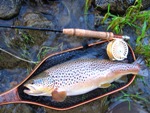
It is rare that I see references to Coplay Creek on any forum. Hokendauqua park is a block from my home of forty-five years. At one time you could count on catching holdover stocked trout. Today that isn't the case, as the creek runs warm in summer as it sometimes runs dry due to sinkholes upstream of the park.It might ruffle even more feathers amongst the purists, but Ed is the one who taught and turned me on to Tenkara one day on Coplay Creek up in Hockedauqua Park.
I miss Ed too...
I remember noticing the same thing at the show in 2025.Just have to share.
I feel this is the proper post for the following:
I just saw a Joe Humphrey's Facebook reel of his presentation at the 2026 Lancaster Fly Fishing Show.
Unfortunately, I couldn't make it to the Show, but I was not pleased with Joe's demonstration and crowd teaching of how to cast.
What he demonstrated is good for "Euro nymphing". Or any flipping a line a short distance, but it isn't fly casting.
Fly casting is casting a fly line. The physics of moving a line. A cord. The same as the electric cord from the sweeper in the house.
Straighten the line and then apply the little amount of energy required to pull it and let it move in the direction desired.
It's fly casting.
It's fun.
The technique Joe has promoted for years is short distance flipping. He did it when he taught his nymph fishing technique. (A type of a "tuck cast".)
What he told the crowd to do - bend the wrist up and back and then punch it forward with the thumb and a squeeze of the handle - is a simple means for flipping a mostly leader and weighted rig a short distance.
It's really not fly casting.
It's what is used mostly with a long rod and a short line.
Physics of moving a cord - a fly line - is different.
A "tuck cast", a "curve cast", a "crash cast", a "double haul", a "roll cast" (not really a good cast for first technique in learning fly casting) and other types of casts are performed by handling a fly line.
Fly casting is handling a fly line.
The leader and tippet are secondary and only needed for managing the tip of the fly line and eventually for modifying to present flies and to actually fish.
Learning the physics of moving the line is fun. That's the casting. It doesn't require much energy at all. Most people use too much if not way too much energy to do it.
Flipping the wrist for a back cast is not good.
Fly casting is not bending the wrist backward to flip the leader up in the air and behind and then to flip-punch it forward and use a thumb press and a hand squeeze on the cork grip to make it hit the water at a spot.
Bow and arrow casts are fun and necessary only under really rare conditions. In that manner, they are similar to what Joe was teaching at the Lancaster demonstration - a specific technique for specific situations with a specific rig.
I just bought a couple of Lee Wulff's Fly-Os for casting around the house. And maybe lend to someone really interested in the fun of casting.
It's nice to have one again.
The Fly-Os are fun. They very much demonstrate how little energy is needed to cast.
A straightened line requires little power to send it in a direction and little movement to stop the pull and let the curve unroll where you want it to go.
A late friend of mine (Mark Antolosky) taught casting at Lee and Joan Wulff's Catskill flyfishing teaching operation when it first started in 1979. He and I first met when he was a teaching assistant for Joe when Joe was selected to teach the flyfishing classes offered through the Penn State College physical education offerings. George Harvey got Penn State to add flyfishing to the classes offered by the Phys Ed department in order to teach a physical activity that could last through late in life. Tennis and any of the other activities do not.
The activity was to be the emphasis of the class. Not the teacher.
When he reached retirement, George had selected Joe who was a wrestling coach nearby and taught Joe how to flyfish at the degree necessary to take over to teach. Casting wasn't his top skill. No one has every skill at the top of the crowd.
Mark and I became close friends quickly and besties soon after. We flyfished together a lot from small brookie creeks to larger waters - such as Penns.
For 10 years he and Lee Wulff took trips to fish the lower Yellowstone together.
Fly casting is a sport in and of itself.
It is not flipping a line with a "jig and bobber" setup.
That technique has its benefit, but it is not any good for actual fly casting.
Learn from others. Lefty Kreh, Joan Wulff, others. Go cast just by itself. Learn for yourself how to handle the line and the physics you need.
Recommend practicing fly casting year-round and anywhere, not just on the water.
Fish later.
It will be much more fun.
Guaranteed.
And its once Class B wild brown trout population has diminished based on electrofishing survey work. The results of the last survey that I’m aware of and attended were pretty pathetic although I still reliably catch them hook and line in one specific one-third mile stretch. There apparently is another isolated population well upstream near Schnecksville.It is rare that I see references to Coplay Creek on any forum. Hokendauqua park is a block from my home of forty-five years. At one time you could count on catching holdover stocked trout. Today that isn't the case, as the creek runs warm in summer as it sometimes runs dry due to sinkholes upstream of the park.
That’s what I do. I don’t know what any of the casting names given to casting mean. Some I can figure out like the bow and arrow. Tuck, crash, roll, double overhaul, blah blah blah, I have mostly no idea and I do not google them to learn them in my backyard. I’m surely not paying someone to teach them to me. Instead I just go out and put the fly where I want it however I can with no concern about poetry in motion, what it looks like or physics. Sometimes I catch fish and sometimes I don’t but I never stress over either outcome. Being a simpleton has its advantages.I don't believe Joe has ever hid that he taught to cast to catch fish, not to look graceful.
Joe's casting technique for small streams/short casts in large water is effective, but limited.The "thumb squeeze" is good not just for short casts, it also useful for medium and longer casts.
IMHO, it's just part of normal fly casting.
Way back in the day, people said "don't break the wrist" i.e. keep the wrist locked. But they also recommended practicing casting holding a book against your body with your elbow. Both things restrict movement, limiting your casting ability.
On the forward cast, you start with your arm and rod behind you, after making the backcast, and as your arm moves forward it is accelerating (gaining speed). With the "thumb squeeze" you break the wrist, rotating your hand forward. It's a "kicker" at the end of the casting stroke that creates additional acceleration that creates great line speed.
So, the casting power is coming not only from the movement of the arm, but also from the movement of the wrist.
Think about a baseball player throwing the ball, or a tennis player hitting the ball, or a basketball player shooting a long shot.
They don't keep the wrist locked. You get much more speed if you incorporate the wrist movement.