Allenberry Resort To Host Discussion on Yellow Breeches & Stream Bred Trout

How is the physical habitat in the Allenberry stretch, now that the milldam has been removed?

The mill dam was not removed, so the water slows above it, with lots of sediment.

The work that was done was to add boulder and timber structures below the dam. Believe the theory was to reduce stream width and increase velocity, which should then cut a deeper channel.

I would be hard pressed to describe the changes as positive.
 
Nothing good has ocurred with the Breeches "stream imporvements". The Run totally destroyed is a prime example.
 
How is the physical habitat in the Allenberry stretch, now that the milldam has been removed?
I was referring to the Children’s Lake dam restoration - and the subsequent lake drawdown which dumped tons of lake silt, sand, and gravel into the run and downstream into the main stem of the Breeches - that discharge settled into a hardpack conglomerate from the mouth of the run downstream for a couple hundred yards resulting in forage base destruction of darters, crayfish, and insect larvae in that specific area - apparently I haven’t been clear with the dozens times I’ve mentioned it these last couple of years
 
The mill dam was not removed, so the water slows above it, with lots of sediment.

The work that was done was to add boulder and timber structures below the dam. Believe the theory was to reduce stream width and increase velocity, which should then cut a deeper channel.

I would be hard pressed to describe the changes as positive.
Agreed! I can’t understand why that’s so hard to fathom for anyone who has fished there before and after - they should be well aware …
 
Last edited:
I was referring to the Children’s Lake dam restoration - and the subsequent lake drawdown which dumped tons of lake silt, sand, and gravel into the run and downstream into the main stem of the Breeches - that discharge settled into a hardpack conglomerate from the mouth of the run downstream for a couple hundred yards resulting in forage base destruction of darters, crayfish, and insect larvae in that specific area - apparently I haven’t been clear with the dozens times I’ve mentioned it these last couple of years
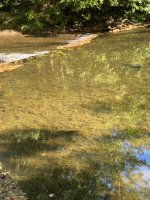
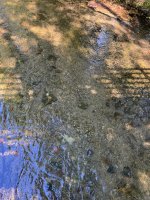
Hate to flog the dead horse but - here are two pics from yesterday - one of the Breeches just downstream of the stone arch bridge - with a normal somewhat silty stream bed - and the run taken from the AT footbridge - notice the complete lack of structure, the holes and undercuts gone from the banks and the 6” deep water flowing over a concrete like stream bed - this is in the entire length of the run and a few hundred yards downstream in the main stem of the Breeches (I didn’t want to trespass just to get a shot) - it’s truly difficult to re-visit a destroyed area where I learned so much about presentation to feeding trout back in the late 70’s into the early 80’s - BTW, I saw NO trout in any section of the run
 

Attachments

  • IMG_5127.jpeg
    IMG_5127.jpeg
    574.5 KB · Views: 77
  • IMG_5125.jpeg
    IMG_5125.jpeg
    702.2 KB · Views: 77
If someone intentionally set out to destroy the run and make it devoid of fish, I am not sure what they could have done differently that would of been more effective.

The fact that the outcome is the result of, I am sure, good intentions, is just utterly inexcusable. A second grader with ADHD could have created a better result.
 
I agree with JG63. I first fished stretches of the Yellow Breeches around 1977 as a mid twenties bait fisherman who didn’t know what he was doing. I lived in Lemoyne at the time. Fished the fly fishing only section first in 1993 as I took up fly fishing. I fished the Ditch down to the Allenberry. One of my best friends lived in Lewisberry so over the next twenty or so years ,I got to stay at his house and fish the Yellow Breeches. I fished there in May, July, September, October and November. I had some great days in that section, learned a lot and credit fishing that stream for honing my skills. I like to fish and where I live I have to drive a couple hours to fish over wild trout which we do but not so much anymore. I don’t kill any fish at all, stocked or wild. Anyways, at 74 I’ve seen a lot of things come and go. I’m just glad I got to fish the Yellow Breeches when I did and I’m sad to see it go. It was a magical place for me as I learned to fly fish.
 
After my last post , a couple things came to my memory. Once, well over twenty years ago, I saw Herb Weigl of Cold Spring Anglers fishing in The Ditch about twenty yards down from the outflow pipe. He was catching fish consistently right at his feet. As far as natural reproduction and stocking goes on that section, there was one time when it was decided not to stock the catch and release area. Now I can’t recall when it was but it was well over twenty years ago( I haven’t fished there in about 12 years) and I can’t recall if it was spring or fall. I do recall that the pool of The Ditch above the wooden bridge was devoid of trout. I can’t recall how many trout were in the main stem. I do recall that after that, they resumed stocking.
 
How many wild trout are in the Breeches now?

Have surveys been done in recent years?
My surveys completed with my fly rod suggest quite a lot from the hatchery all the way down to the children’s lake. I doubt any survey will ever be published because it would mean a good chunk of the stream would be class A and so ends the stocking. I’m ok with it though because 99% of the breeches flows through private land which is open to fishing because of the stocking. And there is the rub.
 
My surveys completed with my fly rod suggest quite a lot from the hatchery all the way down to the children’s lake. I doubt any survey will ever be published because it would mean a good chunk of the stream would be class A and so ends the stocking. I’m ok with it though because 99% of the breeches flows through private land which is open to fishing because of the stocking. And there is the rub.
Well, they could always just make it class A stocked catch and release browns and harvestable rainbows. 🤷🏾‍♂️
 
Dear troutbert,

Don't let the limestone geology of Centre County affect your thinking. While the streams of the Cumberland Valley definitely flow through limestone geology, the difference is that the valleys are VERY WIDE in Cumberland County.

There realistically is literally ZERO opportunity for extensive housing development to occur on the streams you mentioned. I realize that Spring Creek has changed much over the last 25 years, but the stream corridor itself has been largely undisturbed. If you waded Spring Creek from the bridge in Lemont coming into town to the Paradise, the stream bank is essentially what it was when I graduated PSU in 1982. Rockview has been a great insulator. Penns and the Little J are pretty much not realistic areas for any development except for the odd home or cabin.

In contrast, the Cumberland Valley yearly sees several hundred, maybe even thousands of acres of former farmland converted to warehouses, homes and townhomes, and the bad word Data Centers. Everything coming off those developments finds its way to the streams. There are still 10's of thousands of flat farmland acres left in the Cumberland Valley to be destroyed.

Regards,

Tim Murphy 🙂

The Little Lehigh Creek watershed is exactly as you describe above, and yet it maintains a decent wild population from source (of the contributing spring) to mouth. Many, many years ago a friend and I fished a couple of miles below Allenberry. We didn't catch any, but we spooked a couple of sizable trout that acted wild to me. Back to Troutberth's question, I can't tell you if surveys have been done there in any recent memory, but I bet Mike knows.
 
Back
Top