Wonder why the feeshin’ ain’t what it wuz…

Just read an article (404 Media) about a Texas farmer, who in 1999 donated (nominal fee$10) his farm property of 87 acres to the city, with the condition in the deed that it would be used for community parkland.
Well, in 2025 the land was sold for $10M to a data center developer, who has won several legal battles against nearby residents who are trying to stop the massive construction project. They are planning to take their case to an appeals court. Even with the best intentions, it seems the all mighty dollar almost always wins out.
That is disgusting.
 
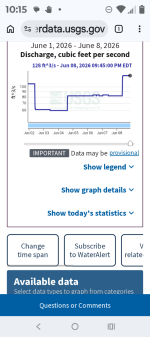
Yes I know it's sterile directly below the dam,not much bug activity up top and gets progressively better as you go down stream,I've seen crayfish and small minnows up top and I know people who've caught walleye and the outflow, despite that I've never caught a bass or walleye trout fishing except for below Bindigo Park about half way to the Mill,you could be right about the flows it just drives me crazy the wild up and downs
 
Why o why
 

Attachments

  • Screenshot_20260608-221525.Chrome.png
    Screenshot_20260608-221525.Chrome.png
    161.6 KB · Views: 29
reminder: the Army corp developed the system for flood control and not maintaining fishing. Water releases occur for many reasons outside of rain events. They have minimal flows to follow. The gauges exist for this purpose
 
Just read an article (404 Media) about a Texas farmer, who in 1999 donated (nominal fee$10) his farm property of 87 acres to the city, with the condition in the deed that it would be used for community parkland.
Well, in 2025 the land was sold for $10M to a data center developer, who has won several legal battles against nearby residents who are trying to stop the massive construction project. They are planning to take their case to an appeals court. Even with the best intentions, it seems the all mighty dollar almost always wins out.

It sort of reminds me how the City of Philthadelphia STOLE the Barnes Collection from Lower Merion Township and even had the will of Dr. Albert C. Barnes overturned in court!!

Beware of governments deciding what is best for YOU because it's always about what is best for them...
 
It sort of reminds me how the City of Philthadelphia STOLE the Barnes Collection from Lower Merion Township and even had the will of Dr. Albert C. Barnes overturned in court!!

Beware of governments deciding what is best for YOU because it's always about what is best for them...
And in PA we have a state that wants to sell the Rockview property.
 
In SE Pa, as delineated by the Area 6 fisheries management area, the fishing isn’t what it was because it’s a lot better. It’s a much shorter list of fisheries that have gone downhill in the past 50 yrs in the region than a list of fisheries that have improved. Most notable declines have been in American shad abundance, bluegill length distributions, SMB abundance in the lower half of the Schuylkill R, two formerly limestone Class A ST populations, two freestone ST populations, a popular white crappie population (collapsed), YP quality in two state park lakes, walleye abundance in two state park lakes, and declines in stocked trout stream private property access.
 
Last edited:
Why do you think traditional tillage is better than no till, regarding trout streams and in general?
I think that the no till methods destroy a lot of life in the soil from the bottom to the top of the food chain - it does not renew anything - just supplements the nitrates needed for certain crop growth and high yield. The Amish have tilled the same ground in MANY locations for generations and have renewed that ground with natural manure, crop rotation, and TURNING over the soil every year to ensure lesser runoff than a field which resembles a parking lot - why do they not need nitrates, chemical fertilizer etc? Because they manage the land with old methods that work - one of the main reasons I rail on and on about no-till hazards is the leaching of these chemicals and “liquid” manure directly into our waters and in some cases, soaking into the ground water these last 50 years - if you drip enough pesticide onto a known spot it will eventually soak into the aquifer - especially with 50 years of precipitation aiding the process - but of course, my opinion is just that - an opinion because I don’t have a Masters in (insert your discipline accusation here) and am therefore a moot point as anecdotal evidence is clearly not in accordance with the approved scientific method

 
I know of one particular SE Pa stream that has a much improved wild brown trout population after stocking was halted more than a decade ago. Not Valley! 🙂
 
Last edited:
I know of one particular SE Pa stream that has a much improved wild brown trout population after stocking was halted more than a decade ago.
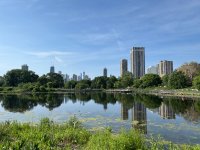
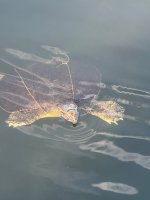
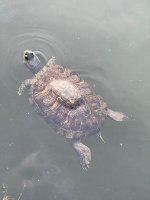
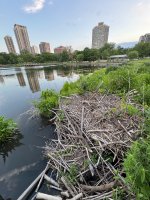
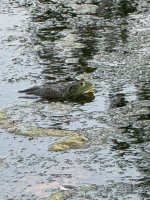
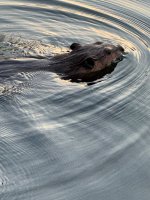
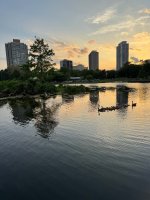
That’s a simple one to answer: “there ain’t nae feesh ‘n ‘at crick!” An answer given by thousands of anglers “cuz they daen’t stawk it nae more” one that points to a known fact - the anglers who don’t handle fish properly or just wantonly kill fish and anglers by sheer numbers are exceptionally hard on ecosystems - this pond in Lincoln Park Chicago is LOADED with bigger than your hand size Bluegills currently guarding eggs in the shallows, has a beaver population, and even soft shell turtles - all in town(!) the answer? NO FISHING or disturbing wildlife is allowed, and the surrounding ground only has native wildflowers and vegetation - leave them alone and everything will flourish according to their niche - we humans are 100% the cause of any decline in naturally occurring numbers of anything - and we put faith in our enlightened conservation methods which are more of a speed bump than a fix of the messes we’ve caused…
 

Attachments

  • IMG_4359.jpeg
    IMG_4359.jpeg
    403.9 KB · Views: 17
  • IMG_4357.jpeg
    IMG_4357.jpeg
    233.8 KB · Views: 11
  • IMG_4348.jpeg
    IMG_4348.jpeg
    292.6 KB · Views: 12
  • IMG_4298.jpeg
    IMG_4298.jpeg
    559.4 KB · Views: 14
  • IMG_4296.jpeg
    IMG_4296.jpeg
    525.6 KB · Views: 16
  • IMG_4293.jpeg
    IMG_4293.jpeg
    437.5 KB · Views: 14
  • IMG_4290.jpeg
    IMG_4290.jpeg
    328.4 KB · Views: 19
I know of one particular SE Pa stream that has a much improved wild brown trout population after stocking was halted more than a decade ago. Not Valley! 🙂
Correct…not Valley because of the three long established sampling sites in Valley’s stocked (formerly stocked) section, one was already Class A when stocking was terminated and the other two were well on the way to Class A when stocking was terminated. I think they were already B’s if I recall correctly, but nevertheless they were headed to Class A. In fact, a review of the data from the 1976 or 1977 period suggests that it was the stocked brown trout reproduction that allowed the stream to bounce back after all but a few trout (a literal handful at the combined sampling sites) were gone from the stocked section at that time. Had stocking been the problem, the paucity of any trout would have continued as long as stocking continued. I also don’t doubt that as conditions in Valley improved any excess production of wild BT in Ltl Valley would have contributed to Valley’s population recovery as well.
 
Last edited:
Speaking of Valley, does anyone remember back in the 70's, when they used to have a trout fishing tournament/barbecue on Valley, where they stocked a bunch of nice size trout? Many of them were several pounds with metal tags that would earn you various prizes. If I recall, some were even cash prizes? I don't remember who actually sponsored this outing, but as a kid, I do recall it being a lot of fun!
 
I think that the no till methods destroy a lot of life in the soil from the bottom to the top of the food chain - it does not renew anything - just supplements the nitrates needed for certain crop growth and high yield. The Amish have tilled the same ground in MANY locations for generations and have renewed that ground with natural manure, crop rotation, and TURNING over the soil every year to ensure lesser runoff than a field which resembles a parking lot - why do they not need nitrates, chemical fertilizer etc? Because they manage the land with old methods that work - one of the main reasons I rail on and on about no-till hazards is the leaching of these chemicals and “liquid” manure directly into our waters and in some cases, soaking into the ground water these last 50 years - if you drip enough pesticide onto a known spot it will eventually soak into the aquifer - especially with 50 years of precipitation aiding the process - but of course, my opinion is just that - an opinion because I don’t have a Masters in (insert your discipline accusation here) and am therefore a moot point as anecdotal evidence is clearly not in accordance with the approved scientific method
Amish don't need to meet the efficency demands of the modern world. If our farmers didn't use pesticides, herbicides and fertilizers the crops they farm would be unaffordable to buyers.
 
I see Amish out spraying frequently. I don’t think the most are all organic.
 
It sort of reminds me how the City of Philthadelphia STOLE the Barnes Collection from Lower Merion Township and even had the will of Dr. Albert C. Barnes overturned in court!!

Beware of governments deciding what is best for YOU because it's always about what is best for them...
The Barnes Foundation was 5 mins from where I live. I remember that art heist well. Wasn't it done under the guise that the collection would be more viewabl/accessable to the public being in Philly?
 
I see Amish out spraying frequently. I don’t think the most are all organic.
Correct. There are some Amish who farm organically, but they are a minority.

Amish commonly use herbicides, pesticides, and chemical fertilizers.
 
To maximize benefits of no till, cover crops are needed. Some use of multi species cover crops or forage mixes are greatly improving infiltration rates. No till corn/ bean rotations without cover crops that rely on heavy annual fertilizer and herbicide inputs do not realize the same soil health benefits of notill with cover crops.
 
Back
Top