The_Sasquatch
Well-known member
I love fishing the Tully this time of year....for carp!

FCP wrote:
Yes, the Tully temps are marginal. Yes, the flows at times are not ideal. Yes, it is a low gradient stream that does not look like a typical PA mountain trout stream. Yes, some sections lack optimal cover. But for Southeastern Pennsylvania the Tulpehocken is a large stream that has significant number of holdovers and provides a good year round trout sport fishery. I do agree that when the temps get marginal one should not fish. When the temps drop you will find significant numbers of trout are still there. The PFBC’s electrofishing studies reveal substantial numbers of holdover trout.
When the Tully was stocked with fingerlings the presence of holdover trout was obvious. Your electrofishing studies revealed the number of holderovers.
Section 5 – 1200 foot section – Fingerlings with NO Tackle Restrictions
5 studies between 1981 and 1984 (between 1980 and 1984 bait was allowed)
Number of Trout – 7 to 31 trout
Number of Trout greater than 12 inches (holdovers) 3 to 15
Section 5 – 1200 foot section – Fingerlings with DHALO regulations
5 studies between 1985 and 1993
Number of Trout – 134 to 195 trout
Number of Trout greater than 12 inches (holdovers) 20 to 58
20 to 58 holdovers in a 1200 foot section of stream – what more do you want.
When it is hot and dry most trout fisheries get stressed especially in Southeastern Pennsylvania.
afishinado wrote:
I have fished the Tully for a long time and was happy with the fingerling stocking program, but these surveys are from 20 -30 years ago.
Perhaps Mike can give us a more up-to-date assessment of the fingerling survival rate. I'm not sure if the water quality, temp, and/or habitat has degraded, but the Tully fishing / fingerling survival rate had declined in recent years making it more suitable for a put-and take fishery, stocking adult trout in the spring and fall. :-(

Mike wrote:
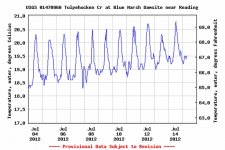
jdaddy - A possibility: nearly chronic exposure to water temperatures from 67.5 deg F to 71 deg F in the Tully from mid-June through early July with no night time relief may have been the culprit for some of the larger browns. Perhaps a little surprising at those temps, but a possibility to consider given the substantial number of days of exposure and the more vulnerable segment (larger fish) of the population that was involved according to the original post.
A slight correction in your statistics: The Corps begins bottom releases when the water temp hits 68 deg F for three mornings in a row at 8 AM. Sixty-eight degrees is the trigger value, not seventy.


Mike wrote:
Where else have the distressed fish been seen? The original post said Reber's bridge area (I assume upstream from the bridge, since the downstream left bank is cooled by Plum Ck.). Are there other locations where these larger browns have been seen in distress?
Also, has anyone checked the stream temp with a good thermometer vs that of the gauge? Perhaps the gauge's temperature recording devise is producing inaccurate readings and the stream is warmer than indicated. Just a thought.
FCP wrote:
I was surprised at the continued reports about stressed trout on the Tully. So yesterday I went out to check the stream. I did not fish but just checked conditions. I was at Poacher’s Pool, Papermill Flat, Reber’s Bridge, Gauging Station and the Stilling Basin. I did not see anything usually. No dead fish. No stressed fish. The fish were acting normally with an occasional fish rising. I spoke to a three fishermen who also did not see anything usual. In fact they reported that the trout they caught looked healthy and in good shape
I also contacted some friends who are Tully regulars. One who is a fixture on Tully and spends more time fishing it than anyone I know. He was aware of this PAFF post. He states that he has also spoken to others and no one including himself has seen or mentioned having seen distressed trout or any other species for that matter. All the fish he has caught seem to be in good condition.
It appears that whatever is happening is not a systemic problem on the Tulpehocken. At the most it may involve just a few fish that may be the result of some fishermen overplaying a large trout. I am concerned about making a mountain out of a molehill.