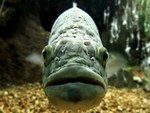
Tulpehocken Creek, Berks County?, 7/3/2012

jdaddy - A possibility: nearly chronic exposure to water temperatures from 67.5 deg F to 71 deg F in the Tully from mid-June through early July with no night time relief may have been the culprit for some of the larger browns. Perhaps a little surprising at those temps, but a possibility to consider given the substantial number of days of exposure and the more vulnerable segment (larger fish) of the population that was involved according to the original post.

A slight correction in your statistics: The Corps begins bottom releases when the water temp hits 68 deg F for three mornings in a row at 8 AM. Sixty-eight degrees is the trigger value, not seventy.
 
FCP wrote:
Yes, the Tully temps are marginal. Yes, the flows at times are not ideal. Yes, it is a low gradient stream that does not look like a typical PA mountain trout stream. Yes, some sections lack optimal cover. But for Southeastern Pennsylvania the Tulpehocken is a large stream that has significant number of holdovers and provides a good year round trout sport fishery. I do agree that when the temps get marginal one should not fish. When the temps drop you will find significant numbers of trout are still there. The PFBC’s electrofishing studies reveal substantial numbers of holdover trout.

When the Tully was stocked with fingerlings the presence of holdover trout was obvious. Your electrofishing studies revealed the number of holderovers.

Section 5 – 1200 foot section – Fingerlings with NO Tackle Restrictions
5 studies between 1981 and 1984 (between 1980 and 1984 bait was allowed)
Number of Trout – 7 to 31 trout
Number of Trout greater than 12 inches (holdovers) 3 to 15

Section 5 – 1200 foot section – Fingerlings with DHALO regulations
5 studies between 1985 and 1993
Number of Trout – 134 to 195 trout
Number of Trout greater than 12 inches (holdovers) 20 to 58

20 to 58 holdovers in a 1200 foot section of stream – what more do you want.

When it is hot and dry most trout fisheries get stressed especially in Southeastern Pennsylvania.

FCP,

Great info. I have fished the Tully for a long time and was happy with the fingerling stocking program, but these surveys are from 20 -30 years ago.

Perhaps Mike can give us a more up-to-date assessment of the fingerling survival rate. I'm not sure if the water quality, temp, and/or habitat has degraded, but the Tully fishing / fingerling survival rate had declined in recent years making it more suitable for a put-and take fishery, stocking adult trout in the spring and fall. :-(

 
afishinado wrote:
I have fished the Tully for a long time and was happy with the fingerling stocking program, but these surveys are from 20 -30 years ago.

Perhaps Mike can give us a more up-to-date assessment of the fingerling survival rate. I'm not sure if the water quality, temp, and/or habitat has degraded, but the Tully fishing / fingerling survival rate had declined in recent years making it more suitable for a put-and take fishery, stocking adult trout in the spring and fall. :-(

Yep. The agency considered the fingerling program as an unqualified success in the 80s. The studies at the time also revealed noticeably better survival by rainbow fingerlings in the Tully than browns. Over the years, however, things changed. I'm not sure why. The adoption of an adult trout program was revealed by surveys to be welcome by anglers.
Look at the reports and discussion about the Tully here on Paff earlier this year. There were a lot of happy fishermen.
My personal opinion (I'm not a Tully regular) is that fingerlings ought to be stocked on a limited basis in the fall. Nevertheless, based on the conditions seen in recent years, I seriously doubt that that section can ever be more than a predominately adult stocked trout section.
 
I'm fairly certain that the upstream sinkholes, habitat loss, farms and everything else under the sun above the lake is causing the lower ends decline.

The upper stream could be a fantastic fishery given some love.
 
Mike wrote:
jdaddy - A possibility: nearly chronic exposure to water temperatures from 67.5 deg F to 71 deg F in the Tully from mid-June through early July with no night time relief may have been the culprit for some of the larger browns. Perhaps a little surprising at those temps, but a possibility to consider given the substantial number of days of exposure and the more vulnerable segment (larger fish) of the population that was involved according to the original post.

A slight correction in your statistics: The Corps begins bottom releases when the water temp hits 68 deg F for three mornings in a row at 8 AM. Sixty-eight degrees is the trigger value, not seventy.

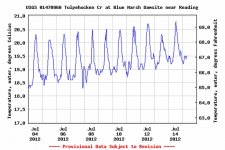
Several anglers I've talked to observed the same thing in the past week as the OP - some fish going belly up (mostly brown trout from their reports) along with fish "gasping" in the shallows. The temps are "good?" - below 70* (see below).

Mike stated above there is a cumulative effect with prolonged higher temperatures. It appears, at times, even temps below 70* can cause trout to struggle.

I guess there are a lot of factors at play: the actual water temperature, the length of exposure, the species and even strain of fish, the water quality, the overall health of the fish going into the stress period, as well as the water types available in the stream, i.e., riffles, runs, waterfalls, etc., add oxygen to the water, whereas long slow pools do not.

Long and short....70 is not a magic number.
 

Attachments

  • Tully temps.JPG
    Tully temps.JPG
    157.8 KB · Views: 3
Disolved oxygen meters are much more affordable (and easier to carry around) than they used to be. This would perhaps make a good monitoring tool for a TU associated with this tailwater fishery, though some consultation with experts familiar with the latest tech would be advisable before purchase and use. If it also has pH and conductivity, so much the better, though pH can be sampled in other ways with little effort or expense.
 
Where else have the distressed fish been seen? The original post said Reber's bridge area (I assume upstream from the bridge, since the downstream left bank is cooled by Plum Ck.). Are there other locations where these larger browns have been seen in distress?

Also, has anyone checked the stream temp with a good thermometer vs that of the gauge? Perhaps the gauge's temperature recording devise is producing inaccurate readings and the stream is warmer than indicated. Just a thought.
 
Mike wrote:
Where else have the distressed fish been seen? The original post said Reber's bridge area (I assume upstream from the bridge, since the downstream left bank is cooled by Plum Ck.). Are there other locations where these larger browns have been seen in distress?

Also, has anyone checked the stream temp with a good thermometer vs that of the gauge? Perhaps the gauge's temperature recording devise is producing inaccurate readings and the stream is warmer than indicated. Just a thought.

Good thought on using a thermometer to verify the gauge temp.

In addition to the reports posted on the site, I talked to two other anglers that fished the Tully in the last two weeks and each saw some gasping browns and a few belly up ones. One said he fished the Rebers Bridge area, and another fished above the bridge in the Waterworks and the Palisades area if I recall.

It also appears to be happening only to the stocked browns rather than the rainbows. Perhaps a rainbow-only stocking policy would make sense.

As I wrote earlier, this is nothing new to me. I've seen the exact same thing a few years ago (struggling brown trout) and quit fishing the Tully as soon as the temps begin to rise.
 
Fishidiot

In reference to your comment “The adoption of an adult trout program was revealed by surveys to be welcome by anglers.
Look at the reports and discussion about the Tully here on Paff earlier this year. There were a lot of happy fishermen.”

Yes there are many fishermen who are happy with the adult trout program. The following is a plausible explanation why based on my observation of the differences between the fingerling based fishery and the adult program on the Tulephocken DHALO.

Fingerling Based Fishery
Fingerling trout are stocked once a year in the Fall. By the time Spring arrives these fish have become acclimated and “wild. “ As the fishing pressure increases they become too soon smart. You are more likely to be successful in the catching if you use a size 16 teal green caddis emerger tied on a bent short shank hook delivered with an exacting presentation. The higher the fishing pressure the more difficult the catching. The longer the fish are in the stream the more selective they get. The holderover trout can offer a real challenge. For a large part of the year the fishing is challenging and at times frustrating.

Adult Trout Program
Adult trout on stocked on March 6, April 5, April 26, and October 9. These fish are naïve. The catching is fast and easy. You are more likely to catch a fish on a size 12 green weenie or your favorite fly than that tiny green caddis pupa. The 18 inch freshly stocked trout are just as naïve as the 9 to 12 inchers. Now with time and fishing pressure these trout will also become discriminating but about that time another batch of naïve trout are stocked. Fast and easy catching makes for a lot of happy fishermen. That is also a reasonable explanation why a lot of PA trout fishermen are addicted to hatchery trout and there is nothing wrong with that.

 
I was surprised at the continued reports about stressed trout on the Tully. So yesterday I went out to check the stream. I did not fish but just checked conditions. I was at Poacher’s Pool, Papermill Flat, Reber’s Bridge, Gauging Station and the Stilling Basin. I did not see anything usually. No dead fish. No stressed fish. The fish were acting normally with an occasional fish rising. I spoke to a three fishermen who also did not see anything usual. In fact they reported that the trout they caught looked healthy and in good shape
I also contacted some friends who are Tully regulars. One who is a fixture on Tully and spends more time fishing it than anyone I know. He was aware of this PAFF post. He states that he has also spoken to others and no one including himself has seen or mentioned having seen distressed trout or any other species for that matter. All the fish he has caught seem to be in good condition.

It appears that whatever is happening is not a systemic problem on the Tulpehocken. At the most it may involve just a few fish that may be the result of some fishermen overplaying a large trout. I am concerned about making a mountain out of a molehill.
 
FCP wrote:
I was surprised at the continued reports about stressed trout on the Tully. So yesterday I went out to check the stream. I did not fish but just checked conditions. I was at Poacher’s Pool, Papermill Flat, Reber’s Bridge, Gauging Station and the Stilling Basin. I did not see anything usually. No dead fish. No stressed fish. The fish were acting normally with an occasional fish rising. I spoke to a three fishermen who also did not see anything usual. In fact they reported that the trout they caught looked healthy and in good shape
I also contacted some friends who are Tully regulars. One who is a fixture on Tully and spends more time fishing it than anyone I know. He was aware of this PAFF post. He states that he has also spoken to others and no one including himself has seen or mentioned having seen distressed trout or any other species for that matter. All the fish he has caught seem to be in good condition.

It appears that whatever is happening is not a systemic problem on the Tulpehocken. At the most it may involve just a few fish that may be the result of some fishermen overplaying a large trout. I am concerned about making a mountain out of a molehill.

Agreed. I've seen it (stressed fish) there as well as many other streams that warm up in the summer. Happens every year all over the State to some degree. Summers that remain relatively cool and rainy, not as often, but hot summers with prolonged heat waves and little rain like this year, it is common.

I fish for smallies and other WW fish in the summer. If I want to fish for trout, I fish the cooler spring or limestone streams and the upper Delaware.
 
The WCO contacted the ACOE yesterday about the gauge's temperature readings. The ACOE checked the gauge against a good thermometer this morning and found no difference. The gauge stream temps are accurate.
 
Good to see that actual spot-checks - both on water temps and anecdotal accounts of dying fish - are happening.

Thanks.
 
Addendum: Received another email from a friend who was fishing the Tully recently.

“I was out there Saturday morning... 6am-10am. Water temp was 67 at Palisades... a few tricos on the water... and some nice fish rising. Every fish (8 of them) we landed were CLEAN! No marks or ripped lips... and here is the kicker... we landed a 4" (wild) Rainbow!!! There is no way that was stocked... it was so bright, fins were all intact... and only 4" long!!

He is talking about Saturday July 14. Over the years I have seen a few small rainbows and browns that in all probably were wild stream borne fish.
 
FCP wrote;

"He states that he has also spoken to others and no one including himself has seen or mentioned having seen distressed trout or any other species for that matter. All the fish he has caught seem to be in good condition.

It appears that whatever is happening is not a systemic problem on the Tulpehocken. At the most it may involve just a few fish that may be the result of some fishermen overplaying a large trout. I am concerned about making a mountain out of a molehill."

Yea, I guess I must of either made it all up, or maybe I was frigging dreaming! BTW it is likely that I have caught, and released, at least as many large trout as anyone who posts on this forum and no one has ever suggested that I "overplay" a large trout.
 
WB,

Reread that, I do not believe he said you overplayed the trout. Actually, it states that he believed the fish you handled were in good condition.
 
In a typical year, Blue Marsh will run out of cold water for mixing purposes within the next 10 days. The hypolimnion will be depleted of cold water. We'll see what this year brings.
 
Anyone fish the Tully in the last few days ? How is it fishing ? Are the temps Ok ?

Are caddis hatching in the late afternoon and evenings ?


I fished the Little Lehigh yesterday and the water felt cold , but the level was low. The fishing was slow . I caught 4 in 5.5 hours . Very few risers .
 
Back
Top