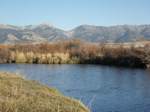
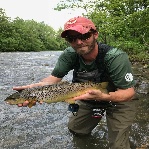
Little Lehigh, Lehigh Co., 03/02/10

Squaretail

Active member
Joined
Dec 29, 2006
Messages
1,855
Upon meeting LouM, the first time I ever saw him he was bring a nice rainbow to hand. 🙂
Slightly slightly stained water and about 42 degrees ait temps. Decent 16-18 bwo's came off, and the trout rose but not to my fly. 3 on Clouser crayfish, all browns. Fish pops still seem to be dwindling in the kiddy hole-flyshop stretch. Since I first started going back there maybe three yrs ago, theres less trout every time. ?
 
I definitely agree about the fish population declining in that stretch. Not sure why but maybe less hatchery escapees? Anyone else have any theories?
 
Squaretail wrote:
Upon meeting LouM, the first time I ever saw him he was bring a nice rainbow to hand. 🙂

Always a good first impression!
 
Not sure why but maybe less hatchery escapees? Anyone else have any theories?

That and the amount of slit is pretty bad. Still quite a few wild browns through. The state is gonna shock it this summer then we see whats there!
 
A few years ago the LL Heritage stretch was loaded with stocked fish, which I guess were escapees from the hatchery there. I don't recall if it was because of a high water event or for some other reason. Maybe some LV area guys recall. Anyway, many of the fish there are indeed wild fish. Here's a 2003 FBC survey of the section FYI.

http://www.fishandboat.com/images/fisheries/afm/2003/5_08-11llehigh.htm

Some members on this site feel like this :-D because of the wild fish there, while other are :-( and say the fishing was better when the stockies were there. Each to his/her own.
 
Tom - you nailed it. Hurricane Ivan in 2004 "stocked" around 6000 fish in that stretch. The wild fish are still there, but they're tougher to spot. Check the stream when there's a good hatch going on - you'd be surprised at how many fish there are.
 
I am in the :-D camp.

I enjoy fishing the LL during hatches. Not so much otherwise. I agree with HA. It ain't bad when fish are rising. Like any good limestoner, they come out of the woodwork when the bugs are there.
 
Squaretail it was nice meeting you and your dogs.

The problem with the fish population in the LLH is twofold poaching and silt from upstream developement. I have been fishing the LLH since the 60s ,some of you were not even around then, and the amount of fish has greatly declined. How many of you remember the cable bridge at the hatchery?
 
When I fish there, I often wonder which is hurting it more- the silt or the poaching. I've personally told about 6 people that they can't fish with their worms or spinning gear in the upper FFO section. And based on all the empty containers I see laying around when I'm there, I'd bet those 6 are a very small fraction of the total illegal fishing that occurs on the LL. Damn shame too.
 
The "problem" with the Heritage Area is that there has been a very successful effort to reduce escapement from the hatchery. I don't find that to be a problem at all, but based upon the number of complaints received by the WCO and heard here and there by him, a fair number of people are at least somewhat unhappy about the present fishery. Apparently things have gotten tougher now that these anglers are forced to fish in large part for wild trout. I can't help but wonder whether some of them thought they were fishing for and catching wild trout all along. If so, this "new" LL Heritage fishery, supported in much greater part by real wild trout and their natural variation in year class strength, must be quite a shock.
 
I think a lot people that know about these things knew they weren't fishing over wild trout in spite of unnamed people close to the river stating the "trout here are all wild" I personally had a debate with people regarding this. In any event I don't mind the decline in fish and was just wondering what people thought. I'm glad to see people agree that it had to do with the Hurricane especially when there were probably a 100 Pailimino trout in that stretch after the flood. Seeing trout during hatches that you don't see otherwise is not specific to Limestoners.
 
lilkobain: Check the section number and stocking limits closely. You'll find that the Heritage Area is by-passed when the stream is being stocked. Of course some fish move into the Heritage area from above and below, but it is not stocked directly.
 
Mike; With all due despect. I have been fishing the LLH heritage stretch since it opened. The fishing has declined over the years, especialy after the floods we have had the last 5yrs, or so. Yes the fishing is tough but I almost always manage to get a couple or more at each outing. The hatches have declined especially the sulphers. The silt problem, poaching and herons are adding to the problem. Also why was the Heritage designation dropped and replace with FFO in the regs? On a good note I have been catching some stream bred browns and bows , so some reproduction is taking place. But the creek is in need of some TLC.
 
Also why was the Heritage designation dropped and replace with FFO in the regs?

I dont know Mike would have to answer this. My guess would be that its kind of sending that elitist message to say that Fly fishing only is the Heritage of PA. Or rather a heritage form of fishing.

Either way, its the same regs.

Mike,

I dont buy that either. IMO the LL was never a tough stream. Its bigger than most i fish and the trout never see me coming. As long as i can do that i usually catch fish. I have fished the LL as early as last year and did very well on both trips.

I do however buy that silt, macro life fading and the presence of wild trout rather than stocked fish can make it harder. I only included wild trout because you guys dont stock that section.
Put 1000 fish over top of the 500 wild ones and yes the fishing becomes easier ;-)

Either way, by thinking that the fishing is tougher because it is just wild fish is pretty ridiculous.
The silt will make wading harder and alert to fish to your presence. The less food source will not make them strike anything, just makes them focus harder on one thing.

I say lets focus on the problem. The problem with the fishery is not lack of stocking or presence of wild trout. Its degraded....plain and simple.

Whats the size of the population? Is it as good as it could be?
I would say its smaller than you think and a very large NO! for the last question.

Fixing the stream will make more fish and more bugs. And that equals better fishing.
 
salvelinusfontinalis wrote:
Also why was the Heritage designation dropped and replace with FFO in the regs?

I dont know Mike would have to answer this. My guess would be that its kind of sending that elitist message to say that Fly fishing only is the Heritage of PA. Or rather a heritage form of fishing.

My understanding is that the term "heritage" was simply dropped and replaced with FFO in order to consolidate the different categories of special regulation. The fact that they had both Heritage Angling and FFO was likely seen as redundant once the plan was made to make FFO areas C&R.
In the past, the famous Cumberland Valley Streams that were formerly "heritage" used to be labeled as Limestone Springs Wild Trout Water (I think Little Lehigh had this too). The regs are the same today - only the name has changed on these waters in the past 20 or so years. When I first started fishing the Cumberland Valley, Letort allowed the harvest of one 20" per day but this rule was removed (thankfully) in about 1984. Since then, the rules on these famous waters has been unchanged FFO rules (one minor change is barbed hooks are allowed now). I think this has all been about consolidation of special reg categories.
 
I suspect that the barb restriction was lifted because it was nearly impossible to effectively enforce, and that a smashed barb that didn't pass the "cotton test" was grounds for violation. I will say that my opinion on the latter was that it was ridiculously nitpicky.

Is that correct?
 
It happened when they decided to "simplify" the rules and got rid of all the barbless regs and lumped all them in with the FFOC&R because people were supposedly too stupid to handle multiple restrictions.
 
jayL wrote:
I suspect that the barb restriction was lifted because it was nearly impossible to effectively enforce, and that a smashed barb that didn't pass the "cotton test" was grounds for violation. I will say that my opinion on the latter was that it was ridiculously nitpicky.

Is that correct?

You may be right about the unenforceable aspect. There may have also been an expectation that requireing barbless hooks might discourage spin fishermen from participating in C&R waters(?)
As for the "cotton test" - I had heard rumors and stories about WCOs testing hooks by sticking them in panty hose to see it the barb would stick. Truth be told, I have been checked dozens of times over the years on barbless waters and I never saw this being done. I had WCOs ask to see my fly - they'd glance at it and say "okay." Maybe some other forum members actually got the cloth treatment but I'm inclined to believe this was really an urban legend.
 
Fishidiot is correct: simplification through consolidation was the objective.

As previously discussed on this site by board members, the unfortunate biological truth was that this placed some DHFFO waters that get extremely warm into the C&R program. In those cases the fish have little chance for survival throughout most summers and when some do survive they do so in poor condition (low fat reserves, poor immunity), which most likely leads to high overwinter mortality. Nevertheless, unless my memory is fading, I have yet to see someone in this forum suggest that any of these waters be shifted into DHALO, where at least a few of the fish could be harvested and 70% of the anglers on average are fly anglers anyway.

I should add a historical perspective, however. A number of these former DHFFO streams that are now C&R have been moved from program to program. They originated in the old statewide FFO program (1970's), which was comprised of stream sections that were set aside for fly fishing. The only substantive special regs on these, aside from FFO, was the nonsensical 9 inch length limit and a 6 fish creel limit (statewide limits in other waters at the time were 6 inch length limit, 8 trout per day). Simply put, these stocked stream sections were closed to fishing until opening day and then fly anglers could fish them under the 9" length limit and 6 fish creel limit. The regulations were appropriate for streams that get warm in late spring, although I don't think that all of them or possibly even the majority had that problem. But in SE Pa, many if not most had that problem.

As for the Little Lehigh problems,sedimentation might be a cause for the decline in trout abundance in the former Heritage area. I will give you that. But, of equal if not greater probability, is natural variation in year class strength (meaning that with one big year class or two, your whole opinion could change). Those variations are usually related to weather and flow from fall through late winter.
 
Back
Top