hooker-of-men
Well-known member
I cut my hook points off and re-hone the blunt wire, too. Far superior to the inherent failings associated with factory sharpened hooks.


While i agree with this...The narrative that a loop to loop connection is bad is so strange to me. I've done it every way and notice zero advantage over not using a loop to loop. The troutbitten guy (who's sole goal it seems is to make flyfishing the most complicated activity in the world)
It is much lower profile and does not have the shape that hangs up in the tip guide. It is as smooth as a nail not with the leader run through the core of the line. In regards to cutting through the coating, a cinched down loop-loop will do that anyway so that is not an advantage. This is why i recommend a mico loop, which will get sealed up as part of the process. See this link for a tutorial on making a micro loop, which I believe is the next logical step and an overall improvement: Micro Loop Video...saying tying a clinch knot to the loop also makes no sense to me. Why would that hang up any less than a regular loop to loop? Also it cuts the coating on the line inviting water to soak into it.

On the drift boat (especially solo where I need to position, anchor up and then transition to shoot line fairly quick), I was running into having to pull the loop de loop through the tip tops quite a bit, but running it around back of the reel seat fixed the problem. Even on the Upper Delaware with a 16’-17’ summertime size dry fly leader it’s not much of an issue that way.I guess I don't run into a situation where hanging up in my guides happens that often. When flyfishing my leader is usually 10-12 feet with an 8.5 or 9 foot rod and I really only ever deal with that when landing a fish, and that is no big deal to me to just pull the line back out after releasing it if it does happen.
When I commit to nymphing with a super long leader I just put enough mono on there so my fly line never leaves my reel, so again it's not an issue.
I can see the value in this other stuff if you choose to have your line / leader connection going through your guides often for whatever reason.
Am I missing something here, or does this diagram show the same two-step method but with a different end result?There is a trick to the smoothest connection...
You HAVE to make sure your connection looks like a 'handshake," like THIS:
View attachment 1641251927
NOT like a "cow hitch," like this:
View attachment 1641251928

Am I missing something here, or does this diagram show the same two-step method but with a different end result?
I understand what it is trying to show with regard to the "handshake" being the correct method, but I think the second diagram does not correctly illustrate the method that results in the incorrect "cow hitch" connection. Doesn't the cow hitch result when the end of the leader is passed back through its own loop to make the connection?

I always aim for the handshake connection, and I'm pretty sure I do it correctly most, if not all, of the time.Yes, you are missing something, 😉 you can get two different results using the same method...
IDEALLY a hitch is less likely to happen if you pass the leader through the line loop versus the leader loop, but regardless of which loop you pass the leader through, a "hitch" results when one or the other loops flips down from the sides of the other loop.
In all situations, you can "fix" the problem WITHOUT removing the leader by simply flipping the offending loop up to the side of the other loop.
If the hitch was created by passing the leader through its own loop, flipping the loop to the correct position will put a half twist in the offending loop which isn't a big deal. Just remove the leader the next time you clean your line (IF you clean your lines) or decide to change leaders and do it correctly.

Dear Skook,I always aim for the handshake connection, and I'm pretty sure I do it correctly most, if not all, of the time.
I was always under the impression that putting the leader loop through the fly line loop and then back down through itself was how the incorrect cow hitch connection was made.
I learn something new every day, lol.

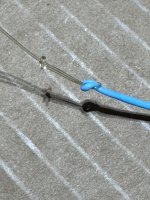
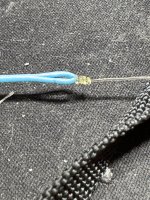
I was thinking the same thing - I’ve never really liked the surface disturbance caused by loop to loop attachments on the pickup for the next cast, but also, I believe a 4X tippet would break before 30# mono would slice through a mono core coated fly line - but to that end, I have a cheap $10 imported WF7F with a loop that I will test and see - worst case, I lose a leader and a bug - I’ll experiment with Smallmouth too - I can’t see normal small stream trout fishing as cutting through - but Smallies on a medium size river using strip set methods will be a viable test - here’s a before and after pic of the changeover you can already see the scoring from the mono loop - with this new rig it’s hard to not foresee failure … on the water experience will tell - hopefully soonI used numerous methods before fly lines started coming with welded loops. The nail knot was my preferred. It didn't matter what I sealed it with though, it always compromised the buoyancy of the fly line more quickly than a loop to loop.
The only reason I would tie a nail knot now is if a loop broke. I've never had that happen but could see it happening if tying a clinch knot directly to the fly line loop. A loop to loop drastically increases the load distribution to the soft plastic of the fly line compared to a clinch knot. It's not as good as the nail knot in this regard but I can't think of a better way to cut through fly line than clinch knotting to it.
I listen to the troutbitten podcast. I fish differently for the most part but certainly glean some good information from it. I don't watch the videos but the advertising on the podcast isn't as bad as many out there.
I cut my hook points off and re-hone the blunt wire, too. Far superior to the inherent failings associated with factory sharpened hooks.

When I first started the prevailing knowledge was "cut off your leader when you can't fix it and nail knot a new one on." That seemed silly and I quickly learned most people just left a length of old leader and loop-to-looped a new one in place. Or bought some of that bright red Amnesia and used that. I think I still have a couple feet of it Heritage Ed gave me once to do that with...
I assume that was the purpose of the red Amnesia??

Then it’s a necessary evil!When you're hung over and you're stringing up your rod and the line slips through your fingers, that loop to loop keeps the whole line from slipping all the way down through every guide. 🤔