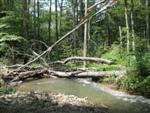
Hammer Creek, Lancaster County 1/28/2023

So a couple things…

No, I’m not looking forward to another flood to improve the fishing on these streams. Floods cause devastation far more wide reaching and impactful than just to Trout fishing. But, the good fishing we’re all agreeing was taking place on these streams coincides to the same few year period, after a major flood.

Second, the transition from Brookies to Browns is/was happening independent of the overall decline in fish/habitat. Overall numbers of fish are down in all of them. Brookies/Browns/both, whatever. The one stream (this will probably give it away) that I had 40+ days on in the 2013-2015 timeframe is already all Browns. Or, at least I’ve never caught a Brookie in it. Walnut, Kettle, and Elders are all still all, or mostly Brookies. Furnace and Segloch are 50/50-ish, and I don’t really have a good read on Hammer, but I think it’s definitely trending toward more Browns and less Brookies. But, my point was, regardless of species, they’re all fishing relatively poorly at the moment. Which was my recollection of them before the 2011 floods. The floods happened, habitat noticeably improved, and they all fished better for a while. Habitat is now kinda back to baseline, and they’re all again fishing relatively poorly. The fact that they all seemingly went through this cycle in a similar fashion supports the flood and geological theory as the cause of this. I wouldn’t expect some other factor (water quality, changes in the headwaters, etc) to impact them all, all at once. Though I’m not saying this isn’t impacting some of them on an individual basis. It probably is. But the flood overcame those issues, temporarily at least, by clearing the stream channel of the sand deposition.
 
Last edited:
Right. Like I said (in my typical verbose way), it's compounding variables. The DEP document seems to imply lack of canopy = increased temperatures is a primary issue in the Hammer watershed. Temperatures have been shown to tip the scales in sympatric populations to favor the species that is more temperature tolerant. A few years of poor brook trout recruitment coupled with other environmental/biotic factors could be the answer.
Silverfox, I agree with you that in situations where sympatric populations have existed for years, it would most likely be a change in habitat, water quality, water quantity, or temperature that would cause a permanent shift in species predominance. I say permanent because temporary shifts within a range of population equilibrium conditions are to be expected with variable year class production by either species in any given year.
 
Yea thats my point they cram up in the headwaters. During the summer but the 6 million trout state wide go in during prime growing season when they need to use the larger water to forage and go to other tribs to facilitate gene flow
Point of clarification…the sampling was all done in the formerly stocked (years prior) Class A sections, not in the streams’ headwaters. Segloch within the SGL was one of them in the SE. The WBr Perkiomen was another in its SGL and vicinity. Given the pattern you’re suggesting, if that were true in these cases, then the fish that showed up on these sites would have been downstream “foraging” just prior to opening day and outside of the formerly stocked sections.

This is one reason why I have inquired here in the past as to whether the dam on Segloch downstream from the Pa Tpk is still intact, if it breached on its own, or if it eroded around one side or from beneath the footer. This would potentially be an explanation for the reported increase in BT reported here.
 
Last edited:
When we say habitat we usually mean physical cover or some feature unique to the stream like its plan form. Habitat projects have been shown to favor invasive trout species.

I am trying to do hydrology projects not habitat projects if that explains anything better. Ground water recharge as a consequence of better flood plain connection, connecting surface water with gravel basal layer, increased upland soil carbon, and vegetative buffers. I am trying to steer these project discussions as far away from in-stream habitat because of the dangers as I can but I am not always successful. Still, that being said like silver fox said that altered hydrology that results in warmer temps gives those browns an advantage we can hopefully take away to a degree in the hammer creek. I think completely unforested swaths of pasture perched on legacy sediment getting remediated can out run climate change and cool that stream down. We have a good chance here for native brook trout if we don’t loose the fish here in the meantime.

To not loose the fish we need to pull out all the stops and that includes all invasive hatchery fish. As silver fox said there is no “safe” amount of brown trout just like theres no safe amount of a cancer it can always grow. but i loved river whys comments because it showed a willingness what needs to be done. It is very hard to eliminate non native trout in spring fed systems with toxicants so that won’t happen in the hammer but i do agree with river why “mowing the lawn” or “debulking” hammers brown trout disease could ahift the balance like Dr. Phaedra Budys research on biotic reais with cutts and browns in utah and what we have seen with the unsuccessful mirco population of browns that continually fails in the savage.

We need to pull out all the stops
 
FWIW, I checked my notes. My last good day on a Furnace Hills stream was on Hammer, in August 2020, after a rain, fishing Hoppers. I caught mostly Browns. That was a fun day.

Beyond that, it was a warm April day in 2017 on Segloch. I caught about a 50/50 mix.

From 2013 through 2015, I didn’t have a “bad” day, on any of them. Roughly 2016-2017 was when I started to notice a shift back to poorer fishing in general. By 2017-2018 it was the norm.
 
So a couple things…

No, I’m not looking forward to another flood to improve the fishing on these streams. Floods cause devastation far more wide reaching and impactful than just to Trout fishing. But, the good fishing we’re all agreeing was taking place on these streams coincides to the same few year period, after a major flood.

Second, the transition from Brookies to Browns is/was happening independent of the overall decline in fish/habitat. Overall numbers of fish are down in all of them. Brookies/Browns/both, whatever. The one stream (this will probably give it away) that I had 40+ days on in the 2013-2015 timeframe is already all Browns. Or, at least I’ve never caught a Brookie in it. Walnut, Kettle, and Elders are all still all, or mostly Brookies. Furnace and Segloch are 50/50-ish, and I don’t really have a good read on Hammer, but I think it’s definitely trending toward more Browns and less Brookies. But, my point was, regardless of species, they’re all fishing relatively poorly at the moment. Which was my recollection of them before the 2011 floods. The floods happened, habitat noticeably improved, and they all fished better for a while. Habitat is now kinda back to baseline, and they’re all again fishing relatively poorly. The fact that they all seemingly went through this cycle in a similar fashion supports the flood and geological theory as the cause of this. I wouldn’t expect some other factor (water quality, changes in the headwaters, etc) to impact them all, all at once. Though I’m not saying this isn’t impacting some of them on an individual basis. It probably is. But the flood overcame those issues, temporarily at least, by clearing the stream channel of the sand deposition.
Somehow I got the notion that there was a brookie Renaissance a while back on Hammer. I think Mike mentioned that Hammer was considered a good wild trout stream back in the 70's. At that time, I was in High School and fished mainly Middle Creek. Jeff and I got our dad to occasionally take us to other nearby streams and especially the Seglock. Caught my first native Brookie fishing amongst the stockies. If memory serves, it seemed much clearer and gravellier at that time.

Trips to the Hammer increased once we got our drivers licenses. We fished at the pumping station, and we never caught any wild or native fish. I never even gave it a thought until we saw some natives in the pipe hole on lower Walnut. I did explore some of the upper meadow branches around the late 80's, early 90's catching a few wild browns up there.
My recollection of the good Brookie fishing on Hammer seemed to coincide with Swattie's 2011 flood theory. Weird that I don't remember catching much if anything before that, wild or stocked. I always thought it looked great but the catching was terrible. Two Questions:

1. Does anyone remember the fishing from the 1960's and 1970's? Were there many wild trout back then? Brookie vs. Brown Mix?

2. When did they take the pumping station dam out? I do remember that I discovered the brookies in Walnut prior to the breaching of the dam. But unsure of catching brookies in the main stem below the dam prior to dam removal. My guess is yes but I think it improved substantially after dam removal. Did that connect more of the Brookies in Walnut to the stretch from the old pumping station downstream? I realize Kettle was also a source. I really wish I had done a fishing log and commend Swattie on his ability to recall specifics and timing of the streams he fishes.
 
Silverfox, I agree with you that in situations where sympatric populations have existed for years, it would most likely be a change in habitat, water quality, water quantity, or temperature that would cause a permanent shift in species predominance. I say permanent because temporary shifts within a range of population equilibrium conditions are to be expected with variable year class production by either species in any given year.
I'm curious about situations where (this may apply to Hammer watershed) brook trout are on the edge of extirpation due to environmental issues. What might the outcome have been if it was allopatric? Assuming the hypothesis that it is an actual permanent shift and not just perceived.

I've seen a few studies recently where species biomass seems to synchronize across species. Virginia (below), and I believe I saw a similar result from MD (Catoctins I think). The VA graphic below wasn't a proper study but rather just a review of data over the years that seemed to show a trend. I think this jives with some other research where brook trout are nonnative and brown trout are native. In some cases, they don't mix well at all.

It may not be that BT are the villain as much as ST and BT really shouldn't be mixed, and if they are already, it's not a good thing. i.e., we shouldn't be striving to have "wild trout" populations or somehow suggesting that mixed pops are a good thing. Or that just because there's been a fairly even mix over the last 20 to 40 years that it will remain that way. I'm not even implying that we need to do anything about it. It just concerns me when sympatry is written off as no big deal.

An important note here is VA DWR didn't seem to have any idea why this is/was happening. These aren't impaired waters. The thought was, "maybe brown trout aren't negatively impacting brook trout as much as we thought" when (in my opinion) it should have been "maybe species interactions aren't good for either species."

Screen Shot 2023-02-04 at 11.12.35 AM.png
 
When we say habitat we usually mean physical cover or some feature unique to the stream like its plan form. Habitat projects have been shown to favor invasive trout species.

I am trying to do hydrology projects not habitat projects if that explains anything better. Ground water recharge as a consequence of better flood plain connection, connecting surface water with gravel basal layer, increased upland soil carbon, and vegetative buffers. I am trying to steer these project discussions as far away from in-stream habitat because of the dangers as I can but I am not always successful. Still, that being said like silver fox said that altered hydrology that results in warmer temps gives those browns an advantage we can hopefully take away to a degree in the hammer creek. I think completely unforested swaths of pasture perched on legacy sediment getting remediated can out run climate change and cool that stream down. We have a good chance here for native brook trout if we don’t loose the fish here in the meantime.

To not loose the fish we need to pull out all the stops and that includes all invasive hatchery fish. As silver fox said there is no “safe” amount of brown trout just like theres no safe amount of a cancer it can always grow. but i loved river whys comments because it showed a willingness what needs to be done. It is very hard to eliminate non native trout in spring fed systems with toxicants so that won’t happen in the hammer but i do agree with river why “mowing the lawn” or “debulking” hammers brown trout disease could ahift the balance like Dr. Phaedra Budys research on biotic reais with cutts and browns in utah and what we have seen with the unsuccessful mirco population of browns that continually fails in the savage.

We need to pull out all the stops
Weeding out the BT in the basin would be a challenge given the trib reproduction. That’s a lot of water to cover.
 
I'm curious about situations where (this may apply to Hammer watershed) brook trout are on the edge of extirpation due to environmental issues. What might the outcome have been if it was allopatric? Assuming the hypothesis that it is an actual permanent shift and not just perceived.

I've seen a few studies recently where species biomass seems to synchronize across species. Virginia (below), and I believe I saw a similar result from MD (Catoctins I think). The VA graphic below wasn't a proper study but rather just a review of data over the years that seemed to show a trend. I think this jives with some other research where brook trout are nonnative and brown trout are native. In some cases, they don't mix well at all.

It may not be that BT are the villain as much as ST and BT really shouldn't be mixed, and if they are already, it's not a good thing. i.e., we shouldn't be striving to have "wild trout" populations or somehow suggesting that mixed pops are a good thing. Or that just because there's been a fairly even mix over the last 20 to 40 years that it will remain that way. I'm not even implying that we need to do anything about it. It just concerns me when sympatry is written off as no big deal.

An important note here is VA DWR didn't seem to have any idea why this is/was happening. These aren't impaired waters. The thought was, "maybe brown trout aren't negatively impacting brook trout as much as we thought" when (in my opinion) it should have been "maybe species interactions aren't good for either species."

View attachment 1641228770
I often wonder the same thing and I am sure there are are extirpations across the state that would have been prevented in an allopatric scenario
 
I'm curious about situations where (this may apply to Hammer watershed) brook trout are on the edge of extirpation due to environmental issues. What might the outcome have been if it was allopatric? Assuming the hypothesis that it is an actual permanent shift and not just perceived.

I've seen a few studies recently where species biomass seems to synchronize across species. Virginia (below), and I believe I saw a similar result from MD (Catoctins I think). The VA graphic below wasn't a proper study but rather just a review of data over the years that seemed to show a trend. I think this jives with some other research where brook trout are nonnative and brown trout are native. In some cases, they don't mix well at all.

It may not be that BT are the villain as much as ST and BT really shouldn't be mixed, and if they are already, it's not a good thing. i.e., we shouldn't be striving to have "wild trout" populations or somehow suggesting that mixed pops are a good thing. Or that just because there's been a fairly even mix over the last 20 to 40 years that it will remain that way. I'm not even implying that we need to do anything about it. It just concerns me when sympatry is written off as no big deal.

An important note here is VA DWR didn't seem to have any idea why this is/was happening. These aren't impaired waters. The thought was, "maybe brown trout aren't negatively impacting brook trout as much as we thought" when (in my opinion) it should have been "maybe species interactions aren't good for either species."

View attachment 1641228770
 
Weeding out the BT in the basin would be a challenge given the trib reproduction. That’s a lot of water to cover.
Yea thats why I suggested a debulking or mowing of the lawn. Not trying to weed out simply trying to shift the balance to see if any biotic resistance can be gained.

All these brook trout horror stories are always death by 1000 cuts but I think what often gets ignored is the timing of them and Id be curious to see If brown trout to brook trout ratio dropped while base flow increased and water temperature dropped if that would be a game changer. You could hit a large area of the main-stems, clean em, donate the fish to a homeless shelter. The removal could be done by a willing academic who wants to study the response the biggest hurdle would be getting Pa fish and boat approval to do so
 
Per the graph above in #67, Wr is typically a statistic that is a measure of the weight of a fish or a length group of fish against a standard such that the relative condition or plumpness of the fish in a population can be gaged against that standard. In essence, are they fat or skinny in comparison to some norm?
 
Per the graph above in #67, Wr is typically a statistic that is a measure of the weight of a fish or a length group of fish against a standard such that the relative condition or plumpness of the fish in a population can be gaged against that standard. In essence, are they fat or skinny in comparison to some norm?
Right. They cautioned that this wasn't an abundance study and it wasn't designed to consider any other variables. It was simply a review of the data they gathered while surveying over the years.
 
Somehow I got the notion that there was a brookie Renaissance a while back on Hammer. I think Mike mentioned that Hammer was considered a good wild trout stream back in the 70's. At that time, I was in High School and fished mainly Middle Creek. Jeff and I got our dad to occasionally take us to other nearby streams and especially the Seglock. Caught my first native Brookie fishing amongst the stockies. If memory serves, it seemed much clearer and gravellier at that time.

Trips to the Hammer increased once we got our drivers licenses. We fished at the pumping station, and we never caught any wild or native fish. I never even gave it a thought until we saw some natives in the pipe hole on lower Walnut. I did explore some of the upper meadow branches around the late 80's, early 90's catching a few wild browns up there.
My recollection of the good Brookie fishing on Hammer seemed to coincide with Swattie's 2011 flood theory. Weird that I don't remember catching much if anything before that, wild or stocked. I always thought it looked great but the catching was terrible. Two Questions:

1. Does anyone remember the fishing from the 1960's and 1970's? Were there many wild trout back then? Brookie vs. Brown Mix?

2. When did they take the pumping station dam out? I do remember that I discovered the brookies in Walnut prior to the breaching of the dam. But unsure of catching brookies in the main stem below the dam prior to dam removal. My guess is yes but I think it improved substantially after dam removal. Did that connect more of the Brookies in Walnut to the stretch from the old pumping station downstream? I realize Kettle was also a source. I really wish I had done a fishing log and commend Swattie on his ability to recall specifics and timing of the streams he fishes.

Good history here, thanks for that. The first thing I thought of when reading about good fishing in the 70’s, and seemingly less sand (and more gravel) in Segloch at the time was Hurricane Agnes (1972). Wonder if the same flood, clean out cycle, was occurring then too, producing relatively better habitat and fishing for the next few years. Interesting to ponder.

I don’t know what (if any) major flooding events happened in between Agnes and 2011. IIRC, I think there was a big January thaw/runoff type high water event in 1995 or 1996…Big, wet snow, followed by a big warm up and rain event. Anyone think of any others?
 
Yes, 1996 was the big snowfall year and the big snow melt year, not just because of the snow but because a substantial rain storm added to the melt and the ground was still frozen. Remember it well
 
we are currently trying to get the Ag BMP’s going at a faster rate then we had. We have been focused on wetland creation for flood relief and ground water recharge but the benefits from things like cover crops, precision grass strips should reduced those huge flood surges if we can get wide buy in. Alot of those BMPs are up and running in a season and especially cover crops will decrease the volume of water making it to the creek overland big time. This will actually decrease the flooding from a lot of these storm events you guys are talking about.
 
Point of clarification…the sampling was all done in the formerly stocked (years prior) Class A sections, not in the streams’ headwaters. Segloch within the SGL was one of them in the SE. The WBr Perkiomen was another in its SGL and vicinity. Given the pattern you’re suggesting, if that were true in these cases, then the fish that showed up on these sites would have been downstream “foraging” just prior to opening day and outside of the formerly stocked sections.

This is one reason why I have inquired here in the past as to whether the dam on Segloch downstream from the Pa Tpk is still intact, if it breached on its own, or if it eroded around one side or from beneath the footer. This would potentially be an explanation for the reported increase in BT reported here.
I only fished turnpike down to the bridge once and that was a long time ago. I don't remember a time but do remember a multifloral jungle in that stretch. I never went back. I'm taking the dog back to Kettle and I'll take a look. No one has commented on that one yet.
 
I only fished turnpike down to the bridge once and that was a long time ago. I don't remember a time but do remember a multifloral jungle in that stretch. I never went back. I'm taking the dog back to Kettle and I'll take a look. No one has commented on that one yet.
I just got back from Kettle. I hiked a trail that I could pretty much see all the trickles form the stream. The most water came right out of a dry mountainside. Interesting. Because of the dog, I couldn't really check out the stream but I didn't see any trout.
 
I just got back from Kettle. I hiked a trail that I could pretty much see all the trickles form the stream. The most water came right out of a dry mountainside. Interesting. Because of the dog, I couldn't really check out the stream but I didn't see any trout.
you seem to be around hammer/middle a lot its awesome your local and right there. Do you have any contacts at that sportsman’s club who stocks if so id like to reach out and talk to them about their stocking.
 
Back
Top