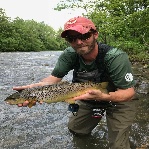
Hammer Creek, Lancaster County 1/28/2023

I don't think predation is the biggest issue. It may be one, but likely not the biggest. If the stream can support wild reproducing brook trout, then all of the environmental factors should allow the long-term survival of stocked trout. Assuming their instinct to survive is strong enough.

Most of the research I've read indicates that "presence" is the issue. Competition for habitat, competition for food, and aggression all cause stress to brook trout. To the point that the brook trout's behavior is modified, changes in foraging rate, growth rate, increased risk of disease from stress, and impacts to reproductive success are all impacted by the presence of nonnative trout.

Otherwise, as Mike said, the other biggest issue (probably THE biggest) is incidental mortality. These stocked streams would see little to no angling pressure if they weren't stocked. This is why I've always had a hard time believing the line that "stocking isn't the limiting factor." It is having an impact in many (most?) cases. Is it the only impact? No. Is it a multiplier? I say yes. Regardless, it certainly isn't helping the brook trout population. Isn't one of the tenets "to enhance?" No matter how you slice it, stocking over brook trout is far from enhancement.

So you've got increased angling pressure = more incidental mortality, and then, especially in a brook trout stream with increased voluntary C&R, you've got remnant stocked fish competing w/ the brook trout. Add in some wild naturally reproducing brown trout, and some habitat problems, water quality problems, temperature problems = extirpated brook trout, or severely suppressed populations anyway.
 
I don't think predation is the biggest issue. It may be one, but likely not the biggest. If the stream can support wild reproducing brook trout, then all of the environmental factors should allow the long-term survival of stocked trout. Assuming their instinct to survive is strong enough.

Most of the research I've read indicates that "presence" is the issue. Competition for habitat, competition for food, and aggression all cause stress to brook trout. To the point that the brook trout's behavior is modified, changes in foraging rate, growth rate, increased risk of disease from stress, and impacts to reproductive success are all impacted by the presence of nonnative trout.

Otherwise, as Mike said, the other biggest issue (probably THE biggest) is incidental mortality. These stocked streams would see little to no angling pressure if they weren't stocked. This is why I've always had a hard time believing the line that "stocking isn't the limiting factor." It is having an impact in many (most?) cases. Is it the only impact? No. Is it a multiplier? I say yes. Regardless, it certainly isn't helping the brook trout population. Isn't one of the tenets "to enhance?" No matter how you slice it, stocking over brook trout is far from enhancement.

So you've got increased angling pressure = more incidental mortality, and then, especially in a brook trout stream with increased voluntary C&R, you've got remnant stocked fish competing w/ the brook trout. Add in some wild naturally reproducing brown trout, and some habitat problems, water quality problems, temperature problems = extirpated brook trout, or severely suppressed populations anyway.
Yea in most streams predation is not the biggest issue by itself I agree. But its just additive like you mentioned to all the other factors competition, incidental mortality, predation, decreased gene flow.

Hammer creek is an example where PA fish and boat should be a resource manager.

Since Penn state smeal college said from a financial standpoint that they can’t afford to meep stocking like this 5 years ago and they are now using tax payer money in the form of state and federal grants to float this operation, why not trial some of these streams for 5 years off the stocking list and see what happens?????


I know why
 
In the recent past there were no state or federal grants that went into any part of adult trout production in PFBC hatcheries, including the stockings. I have strong doubts that that has changed.
 
In the recent past there were no state or federal grants that went into any part of adult trout production in PFBC hatcheries, including the stockings. I have strong doubts that that has changed.
This is semantics its like saying I ask for donations to fun my monthly housing cost because i spend all my money on cocaine.

Same thing with the “wild trout permit”

They are using so much money on hatcheries that they cannot manage the resource effectively so instead SOME wild trout permit money goes to native brook trout projects.

So on a balance sheet is that money going towards stocming? No

Can Pa fish and boat keep stocking at the current level without that money and just on license sales? No

So their floating themselves with tax layer money
 
Well the Brook Trout and wild Browns thrived in there for many years right alongside the stocked fish. The main problem seems to be something else. The fact that Walnut seems devoid of fish would make me start looking there. Also several nearby streams that had good populations of wild Browns and in one case Brook Trout are also dead and would be worth a look. I suspect siltation is the main culprit.
 
Well the Brook Trout and wild Browns thrived in there for many years right alongside the stocked fish. The main problem seems to be something else. The fact that Walnut seems devoid of fish would make me start looking there. Also several nearby streams that had good populations of wild Browns and in one case Brook Trout are also dead and would be worth a look. I suspect siltation is the main culprit.
Right. Like I said (in my typical verbose way), it's compounding variables. The DEP document seems to imply lack of canopy = increased temperatures is a primary issue in the Hammer watershed. Temperatures have been shown to tip the scales in sympatric populations to favor the species that is more temperature tolerant. A few years of poor brook trout recruitment coupled with other environmental/biotic factors could be the answer.
 
I too believe Walnut is the key here. It has likely been the biggest nursery for Hammer Creek Brook Trout. Combination of subtle land use changes including ponds. Fishsticks mentioned one near the source off Walnut Run Rd. There is also one on a heavily landscaped property on a perennial side branch that crosses 322. The stream and pond are all open to the sun and I would assume the lawns heavily manicured with fertilizer and pesticides. That is how the lawn area at the gated entrance to this property is maintained. With any rain that is enough to get that "stream" flowing, it runs brown. Brown pond water is not what you want feeding into the upper branches of a brookie stream. Have there been any macro studies on Walnut?

Widening of 322 another factor. More hot water running into the one smaller branch. Cutting down trees and spraying herbicides along highway is ridiculous. I have seen it being done. it is collapsing hillsides along the highway, the water of which feeds Hammer and Shearer's.

Huge development going up just to the east of Shaefferstown does not bode well for the upper parts of the main stream. Others on this forum can comment more on the upper meadow stretches. I have not been up there recently.

I would love to see Hammer become the focus of Brook Trout restoration and support ending stocking there if the public is on board. Will take some PR efforts but I think it can be done. As Caddisflyer said the Brookies and Browns did live side by side fairly recently, so I don't think extirpation of Brown Trout is necessary but maybe some culling could be encouraged.
 
Brook trout and brown trout "coexisted" in Spring creek. Until they didn't. Brook trout and brown trout "coexisted" in the Letort. Until they didn't. It doesn't always work out.
 
Well the Brook Trout and wild Browns thrived in there for many years right alongside the stocked fish. The main problem seems to be something else. The fact that Walnut seems devoid of fish would make me start looking there. Also several nearby streams that had good populations of wild Browns and in one case Brook Trout are also dead and would be worth a look. I suspect siltation is the main culprit.
Yeah Walnut and Kettle are a big concern. No changes on Kettle. (physically) Why about 8 years ago were there tons of tiny brookies in Kettle when I checked it out. In 4-5 stream-side walks and 1 time fishing have I seen 2 trout?
 
Last edited:
And growing greener has gone to harcheries so theres that…..
They are not state nurseries; they are run by sportsmen’s clubs with technical guidance and provision of fingerlings from the PFBC. The Growing Greener program is not run by the PFBC so if $ went to a co-op, the proposal must have qualified with another agency for said $.
 
Well the Brook Trout and wild Browns thrived in there for many years right alongside the stocked fish. The main problem seems to be something else. The fact that Walnut seems devoid of fish would make me start looking there. Also several nearby streams that had good populations of wild Browns and in one case Brook Trout are also dead and would be worth a look. I suspect siltation is the main culprit.
I doubt Walnut is devoid of fish, but the legal size fish do get concentrated in that stream in low flow periods, probably vacating other areas, and the bedrock sections would appear to be devoid of fish to an angler because they probably have low densities of fish occupying that “habitat” under normal flows and extremely low densities under low flows.

A series of low flow years could reduce adult density, but it could also enhance reproduction success. Even on better streams I have seen ST biomass vary from high Class C to low Class A across a five year time period. Electrofishing would probably produce an eye-opening result, as it usually does. It would also show what I meant about the bedrock stretch(es).

As an aside, the mention that Hammer was once (I assume reference was to the 1970’s period mentioned) the best wild trout stream in Lancaster Co, I suspect that some of the present day good wild trout streams in Southern Lancaster Co are better than Hammer was during that time period either because they have shown so much improvement or were little known at that time.

As for riverwhy’s wish to see stocking eliminated, it appears to be one step closer in 2023, as it will only receive a preseason stocking and I am betting that the preseason numbers will be reduced as well. I’m not certain because I never really looked, but I think that may be a change since last year. It certainly is from some other more recent years. This will reduce angling pressure and the harvest of the RT should occur pretty quickly. If this were 1988, it would occur for the most part in a highly pressured stream in about 3 days with some stragglers remaining for another week or so. From creel surveys I would expect that you are looking at 10 or less days of angling pressure for stocked fish, primarily concentrated on opening weekend.
 
Last edited:
None of those streams are devoid of fish. They are right now however devoid of habitat. Natural sedimentation, it’s pretty obvious IMO. See my post above. 8-10 years ago, their physical habitat was much better after the floods of 2011.

I’ll use Segloch as my example, as I fished it the most of this group of streams pre-2011 floods. It fished like junk, was shallow, full of sand, and held what I perceived to be very few fish. After the floods, I noticed how good the habitat became and it started fishing really well. This got me interested in its neighbors and I started fishing all of them…Every stream mentioned in this thread so far. They all fished well. And then slowly, they began to re-fill with sand, and the fishing began to deteriorate. I’d say Segloch is basically back to where it was pre-2011 now. And I infer that the others likely are too. A good day is a couple of fish. Where as in 2013-2015 or so, 20 fish days on all of them were the norm. Had a couple 40+ fish days on one in particular…I’ve been skunked the last two times I’ve fished it.

This is NORMAL for these streams. This is their natural state. If you fished them about 8-10 years ago, that wasn’t normal. It was great, don’t get me wrong, and I wish it was still like that, but that’s not what the natural geology of this area dictates is normal. There’s nothing wrong with any of them, that wasn’t wrong with them 8 or 10 years ago when they were fishing well.

In the case of Walnut, there’s a certain primo hole right up against 322 with a big rock on the right. That hole was 3x as deep after the floods as it is now. Look at the stretch above the PS Rd. bridge and up to that big hole. It’s nothing but sandbars getting moved around and reforming the stream channel. Zero habitat. But this is what streams with sandy geology do. There’s nothing to “restore” or “rehabilitate”. This is all natural, and normal for these streams.
 
Last edited:
I doubt Walnut is devoid of fish, but the legal size fish do get concentrated in that stream in low flow periods, probably vacating other areas, and the bedrock sections would appear to be devoid of fish to an angler because they probably have low densities of fish occupying that “habitat” under normal flows and extremely low densities under low flows. Electrofishing would probably produce an eye-opening result, as it usually does. It would also show what I meant about the bedrock stretch(es).

None of those streams are devoid of fish. They are right now however devoid of habitat. Natural sedimentation, it’s pretty obvious IMO. See my post above. 8-10 years ago, their physical habitat was much better after the floods of 2011.

I’ll use Segloch as my example, as I fished it the most of this group of streams pre-2011 floods. It fished like junk, was shallow, full of sand, and held what I perceived to be very few fish. After the floods, I noticed how good the habitat became and it started fishing really well. This got me interested in its neighbors and I started fishing all of them…Every stream mentioned in this thread so far. They all fished well. And then slowly, they began to re-fill with sand, and the fishing began to deteriorate. I’d say Segloch is basically back to where it was pre-2011 now. And I infer that the others likely are too. A good day is a couple of fish. Where as in 2013-2015 or so, 20 fish days on all of them were the norm. Had a couple 40+ fish days on one in particular…I’ve been skunked the last two times I’ve fished it.

This is NORMAL for these streams. This is their natural state. If you fished them about 8-10 years ago, that wasn’t normal. It was great, don’t get me wrong, and I wish it was still like that, but that’s not what the natural geology of this area dictates is normal. There’s nothing wrong with any of them, that wasn’t wrong with them 8 or 10 years ago when they were fishing well.

In the case of Walnut, there’s a certain primo hole right up against 322 with a big rock on the right. That hole was 3x as deep after the floods as it is now. Look at the stretch above the PS Rd. bridge and up to that big hole. It’s nothing but sandbars getting moved around and reforming the stream channel. Zero habitat. But this is what streams with sandy geology do. There’s nothing to “restore” or “rehabilitate”. This is all natural, and normal for these streams.
Swattie, I'll take your word for it. I have to say those years were spent coaching and watching my kids sports rather than doing much fishing. Having said that, Walnut and Segloch have been impacted in the headwaters. And what % were brookies? We really need some surveys although where and when would need some serious thought. I also believe there is a Middle Creek-Segloch connection for the browns as you stated a year or 2 ago.
 
None of those streams are devoid of fish. They are right now however devoid of habitat. Natural sedimentation, it’s pretty obvious IMO. See my post above. 8-10 years ago, their physical habitat was much better after the floods of 2011.

I’ll use Segloch as my example, as I fished it the most of this group of streams pre-2011 floods. It fished like junk, was shallow, full of sand, and held what I perceived to be very few fish. After the floods, I noticed how good the habitat became and it started fishing really well. This got me interested in its neighbors and I started fishing all of them…Every stream mentioned in this thread so far. They all fished well. And then slowly, they began to re-fill with sand, and the fishing began to deteriorate. I’d say Segloch is basically back to where it was pre-2011 now. And I infer that the others likely are too. A good day is a couple of fish. Where as in 2013-2015 or so, 20 fish days on all of them were the norm. Had a couple 40+ fish days on one in particular…I’ve been skunked the last two times I’ve fished it.

This is NORMAL for these streams. This is their natural state. If you fished them about 8-10 years ago, that wasn’t normal. It was great, don’t get me wrong, and I wish it was still like that, but that’s not what the natural geology of this area dictates is normal. There’s nothing wrong with any of them, that wasn’t wrong with them 8 or 10 years ago when they were fishing well.

In the case of Walnut, there’s a certain primo hole right up against 322 with a big rock on the right. That hole was 3x as deep after the floods as it is now. Look at the stretch above the PS Rd. bridge and up to that big hole. It’s nothing but sandbars getting moved around and reforming the stream channel. Zero habitat. But this is what streams with sandy geology do. There’s nothing to “restore” or “rehabilitate”. This is all natural, and normal for these streams.
I think it is pretty obvious that streams of this nature go through natural phases. But that ignores the obvious unnatural changes being done to the watersheds as I mentioned above. Are you hoping for another flood to restore the glory days?

I agree there is little to restore in the streambed itself. It is what it is. But these streams provided some fine fishing in the past (admittedly somewhat cyclical). Headwater protection is what is sorely needed IMO.
 
I doubt Walnut is devoid of fish, but the legal size fish do get concentrated in that stream in low flow periods, probably vacating other areas, and the bedrock sections would appear to be devoid of fish to an angler because they probably have low densities of fish occupying that “habitat” under normal flows and extremely low densities under low flows.

A series of low flow years could reduce adult density, but it could also enhance reproduction success. Even on better streams I have seen ST biomass vary from high Class C to low Class A across a five year time period. Electrofishing would probably produce an eye-opening result, as it usually does. It would also show what I meant about the bedrock stretch(es).

As an aside, the mention that Hammer was once (I assume reference was to the 1970’s period mentioned) the best wild trout stream in Lancaster Co, I suspect that some of the present day good wild trout streams in Southern Lancaster Co are better than Hammer was during that time period either because they have shown so much improvement or were little known at that time.

As for riverwhy’s wish to see stocking eliminated, it appears to be one step closer in 2023, as it will only receive a preseason stocking and I am betting that the preseason numbers will be reduced as well. I’m not certain because I never really looked, but I think that may be a change since last year. It certainly is from some other more recent years. This will reduce angling pressure and the harvest of the RT should occur pretty quickly. If this were 1988, it would occur for the most part in a highly pressured stream in about 3 days with some stragglers remaining for another week or so. From creel surveys I would expect that you are looking at 10 or less days of angling pressure for stocked fish, primarily concentrated on opening weekend.
Good news. I know 30 fish days of brookies up to 12 inches were still possible in the early 90s. This was in the turnpike to bridge where the Conservancy starts.
 
Swattie, I'll take your word for it. I have to say those years were spent coaching and watching my kids sports rather than doing much fishing. Having said that, Walnut and Segloch have been impacted in the headwaters. And what % were brookies? We really need some surveys although where and when would need some serious thought. I also believe there is a Middle Creek-Segloch connection for the browns as you stated a year or 2 ago.
Yea even if we had the data, which we don’t, that showed that this was part of a larger cyclical predictable change in fish densities that would not explain the ratio of brook trout to brown trout changing.
 
I don’t believe the video was specific to only non stocked trout it never said that. It just said invasive species. Casey weathers thesis also did not differentiate. Stocked trout are actually put in at one of the best times of the year for brook trout to use dispersal corridors to facilitate gene flow
Regarding the last sentence, I can’t speak to telemetry data if that’s what generated your comment, but from statewide fish population estimates done specifically to evaluate that which follows, ST and BT biomasses in the Class A streams sampled and I’m pretty sure the abundances of legal size fish were greater in summer samples than samples at the same sites taken immediately prior to the old opening day (mid-April) during the same year. This was discussed a number of yrs ago closer to when the sampling had taken place.
 
Last edited:
I think it is pretty obvious that streams of this nature go through natural phases. But that ignores the obvious unnatural changes being done to the watersheds as I mentioned above. Are you hoping for another flood to restore the glory days?

I agree there is little to restore in the streambed itself. It is what it is. But these streams provided some fine fishing in the past (admittedly somewhat cyclical). Headwater protection is what is sorely needed IMO.
This is exactly right what needs to be improved in hammer is ground water recharge, flood plain connection, and upland soil carbon storage along with vegetatove buffers. I will say it again as i have said in the past. I am against habitat structures. I do not have full control of the hammer effort but i always push for no engineered structures
 
Regarding the last sentence, I can’t speak to telemetry data if that’s what generated your comment, but from statewide fish population estimates done specifically to evaluate that which follows, ST and BT biomasses in the Class A streams sampled and the abundances of legal size fish were greater in summer samples than samples at the same sites taken immediately prior to the old opening day (mid-April) during the same year. This was discussed a number of yrs ago in this forum when or relatively soon after that sampling had taken place.
Yea thats my point they cram up in the headwaters. During the summer but the 6 million trout state wide go in during prime growing season when they need to use the larger water to forage and go to other tribs to facilitate gene flow
 
Back
Top