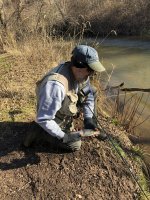
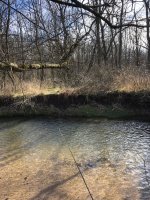
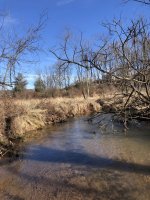
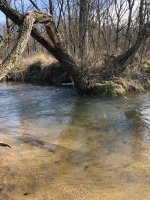
Hammer Creek, Lancaster County 1/28/2023

JeffP

Well-known member
Joined
Nov 21, 2007
Messages
1,398
City
Lititz, Pa
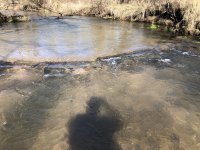
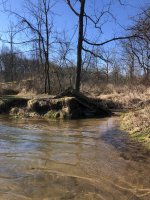
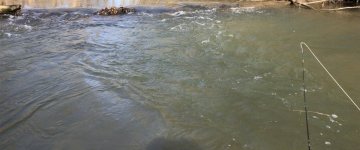
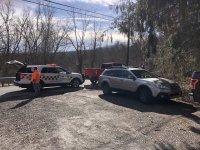
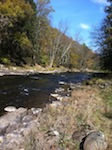
I got out to fish Hammer with a friend. We had planned to fish the County Park and then explore some upstream water. We fished from 10-1. This is a section that is unstocked by the Fish Commission but stocked heavily by a sportsman club. I have caught a decent number of wild browns over the years and native brookies until 5-6 years ago. My friend caught 1 almost right off the bat. He missed another. No hits for me! I fished a black bugger and he fished a mop fly and squirmy work. We saw a couple midges in the sunny spots. It was an awesome morning to be out. Water temp was a surprising 43 at noon. There was lots of medical activity in the parking lot and I have no idea what was going on. Everyone was very tight-lipped and they drove the rescue vehicle back the trail. I posted a bunch of pictures to show the beuty and problems of the Hammer in this section.
 

Attachments

  • IMG_2301.jpeg
    IMG_2301.jpeg
    440.8 KB · Views: 124
  • IMG_2302.jpeg
    IMG_2302.jpeg
    431.2 KB · Views: 124
  • IMG_2304.jpeg
    IMG_2304.jpeg
    346.6 KB · Views: 115
  • IMG_2305.jpeg
    IMG_2305.jpeg
    381.7 KB · Views: 117
  • IMG_2306.jpeg
    IMG_2306.jpeg
    318.1 KB · Views: 116
  • IMG_2307 2.jpeg
    IMG_2307 2.jpeg
    374.3 KB · Views: 122
  • IMG_2308.jpeg
    IMG_2308.jpeg
    121.6 KB · Views: 126
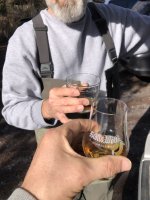
Capping the day off. Had to stay for a second drink. Couldn't get out of the lot.
 

Attachments

  • 69662017335__0573B3DC-A9C8-4B59-BCCB-581484DBE711 2.jpeg
    69662017335__0573B3DC-A9C8-4B59-BCCB-581484DBE711 2.jpeg
    156.4 KB · Views: 110
  • 69662056281__8CB9349D-677C-45C1-ADE3-2FA1E0336C03.jpeg
    69662056281__8CB9349D-677C-45C1-ADE3-2FA1E0336C03.jpeg
    381.6 KB · Views: 110
Sounds like a fun day of fishing. Jan & Feb before the stocking lock out is my favorite time to fish alot of streams including the hammer.
 
Something bad happened to this stream. I just know it. The wild fish just are not there like they used to be. There's another small stream not far from it and the same deal. They were there as recently as when the 17 yr cicadas were around but not long after that the numbers went way down. Any thoughts?
 
Something bad happened to this stream. I just know it. The wild fish just are not there like they used to be. There's another small stream not far from it and the same deal. They were there as recently as when the 17 yr cicadas were around but not long after that the numbers went way down. Any thoughts?
We have had some discussions here. Brookies seem to be almost gone. I have caught way less the last couple years but admittedly been there less and during few hatches. Certainly there is lots of silt but plenty of gravel as well with some beautiful runs. I have seen little evidence of trout in the feeders. I do believe the trout do move a lot, but I do believe numbers are way down based on what I have seen and what others have said.
 
All the Furnace Hills streams are in a down cycle from my experiences. IMO it has to do with natural sedimentation from the red sandstone that makes up their watersheds. It’s pretty, and has some decent buffering qualities, but it breaks down into well, wait for it, red sand.

All of those streams got a good flushing out after the flood of 2011. Holes that were a foot or 18 inches deep tripled in depth. All the red sand got pushed out of the stream channel into huge sand bars on the banks. The fish populations responded, and I had very very good fishing on those streams from about 2013 through maybe 2017 or so. Hammer, Shearers, Segloch, Furnace, Walnut, all of them.

But, slowly and surely the holes have refilled with sand. There’s spots on Segloch where there is literally 18 inches or more of sand in the bottom of holes before you’d hit bedrock. I know this from seeing and fishing those same holes after the floods. I was amazed at how deep they were.

The geology of all those streams is the same (Hammer has limestone in its headwaters, but is mostly sandstone once you get down into the SGL), and the same thing is happening now on all of them. This is their natural geology, and I’m sure they’ve gone through this cycle numerous times before. I still fish them, mostly because they’re the closest reliable wild Trout streams to where I live - maybe 40 minutes or so, but they probably won’t fish all that well until they get scoured out good again. The sand just kills the habitat. I was amazed at how good the habitat became after the 2011 floods. Before, and again now, it’s just meh. And “meh” is about how they’ve fished for me for the last 5 years or so. There’s still fish there, but none of them are fishing great at the moment. It’s not just Hammer, and there’s nothing “wrong” with them per se, it’s just their natural geology and its impact on fish habitat.

 
Last edited:
I had ignored this stream until the early days of the pandemic and we were all cautioned to stay close to home. Desperate for any kind of fishing I headed to the Hammer and was pleasantly surprised. From spring of 2020 until spring of 2022 I was blessed to have a local wild trout fishery with plenty of eager and decent sized brook and brown trout. Then the bottom fell out. A few outings during prime time last spring produced just a few wild fish.

Early on I was fishing it pretty regularly and there were many deeper holes and runs. Most of them really filled in and I think that somehow impacted the wild fish population. Shame - it was a great place to spend an afternoon or evening for a couple of years. Maybe it will rebound at some point.
 
Last edited:
With hammer its very hard to say what has been the dominant cause of the decline of wild native brook trout.

Being as flashy as it is because of schaefferstown it gets a decent amount of high water events with even moderate rain.

Also the hammer is a perfect example of a place where particulate size of the substrate would have less of an impact on natural reproduction due to the abundant spring upwellings as described by Bob carline’s research in wisco. The sediment is not good for macro invertebrate life and probably limits spawning habitat to an extent but there are abundant gravel portions as mentioned and where ground water upwells its not It unworkable.

At the end of the day we see streams like big spring( the ditch is essentially a lake with a silty bottom full of spawners), spring creek in Harrisburg, trindle spring run, falling spring their all silty and most have class A sections.

Trout populations are cyclical yes and hopefully we see brook trout come back. Walnut had a large timber sale that doesn’t help.

water temps not the issue in hammer, especially above 322 where its a real strength.

it always comes down to the 5 components and my perception in these categories have been….

geomorphology/habitat- i have bot observed any drastic changes on hammer atleast. Its always been shallow runs and pools with a lot of fines in the game lands since I have started fishingthe hammer in 2016-17. Maybe some holes have filled in but over all i have not seen anything earth shattering.

Water quality/temp- to my knowledge has not changed, cold with a lot of cow poop/e-coli mixed in with a lot of schaefferstown run off

Hydrology- may be a factor

Connectivity-unchanged

Biologic interactions -stocked by state, 3 landowners I know of personally and have heard of others and a sportsman’s club in a few sections.


I mean you would need research that has not been done to confirm the dominant limiting factor in the hammer for native brook trout but if habitat is the issue those fish are competing for less habitat with stocked fish, if temperature is the issue we have research showing invasive species exacerbate ability to cope with that, if forage is the issue there’s competition for that too. Basically stocking has been going on there for a long time and those brook trout already have to contend with wild invasive browns, its no surprise that they are disappearing.

DFTU is addressing run off, ground water recharge, sedimentation and erosion. Although we have seen that projects fixing these variables don’t benefit brook trout when invasive species present.

Beyond what is already taking place stocking reform is hammer creeks best chance.
 
Last edited:
Hammer has been stocked for as long as I can remember. I began fishing there in the 1970s. Always had decent Brook Trout and wild Browns that seemed to thrive right along with the stocked fish that often held over. The biggest change in recent years was the dam removal. I cannot remember the exact time of that. Its been some years. Walnut has not had good numbers for quite a few years. One of the other tribs amazingly has decent numbers when I last checked. I believe Hammer is a limestone creek at least in the headwaters. At one time it was the best wild trout stream in Lancaster County in my opinion. Not now though.
 
Hammer within the PFBC stocked section above Rt 322 will not become a Class A section due to the seasonal lack of habitat for an abundance of legal size fish combined with the stream’s wide width. In essence, the section averages out to be wide and shallow on a seasonal basis and has little cover for larger fish. The cover for smaller fish exists along and just out from the shallow edge habitat.

The stream has a substantial sedimentation problem, but it has “always” had that problem. It used to have some marginal temps (as I recall) either in the stocked section or somewhere between there and Buffalo Springs, but temps in some areas generally improved over time as revealed downstream, as an example, by the shift from all or almost all stocked trout from 322 down to Speedwell Forge Lk in the 1980’s and at least the early 1990’s to a fishable population of wild trout trout sometime prior to about 2008. The dam removal probably helped that situation.
 
Last edited:
Hammer within the PFBC stocked section above Rt 322 will not become a Class A section due to the seasonal lack of habitat for an abundance of legal size fish combined with the stream’s wide width. In essence, the section averages out to be wide and shallow on a seasonal basis and has little cover for larger fish. The cover for smaller fish exists along and just out from the shallow edge habitat.

The stream has a substantial sedimentation problem, but it has “always” had that problem. It used to have some marginal temps (as I recall) either in the stocked section or somewhere between there and Buffalo Springs, but temps in some areas generally improved over time as revealed downstream, as an example, by the shift from all or almost all stocked trout from 322 down to Speedwell Forge Lk in the 1980’s and at least the early 1990’s to a fishable population of wild trout trout sometime prior to about 2008. The dam removal probably helped that situation.
Habitat certainly could be better but thats been that way for quite some time. As others have mentioned brook trout h
Were more anecdotally abundant at one point not all that long ago despite habitat and a recent survey for fin clips did not turn up enough brook trout to genotype the population.

To use bob bachmans saying, if there are only so many “seats at the table” poor habitat is less feeding and sheltering habitat which could make stocking all the more harmful. Although I don’t think the answer is to go in there and put a bunch rock and wood structures in that stretch either because we know what depth and overhead cover projects do to brook trout trying to hold on where brown trout are.

Thats why I am focusing my efforts on pushing for flood plain/wetland creation upstream towards schaefferstown where less trout live at all and trying to abandon these engineered structures. Increasing baseflow will help temps and decreasing flood intensity will decrease sedimentation and redd scour hopefully. That shallow riffly habitat is probably the reason a lot of those brookies are still there.
 
I wasn’t suggesting that structures were needed in that stocked stretch. The problem of wide and shallow would first need to be addressed by narrowing the channel considerably in those wide areas if more adult trout of any species would be desired. That was the case in parts of Falling Springs Branch in the late 1970’s and Big Spring as well and that’s what was done. Hammer may present a bigger logistical problem though because of what would appear to be poor access for the necessary equipment. If you want bigger fish and maybe even more fish the width to depth ratio needs to be reduced.
 
Last edited:
Habitat certainly could be better but thats been that way for quite some time. As others have mentioned brook trout h
Were more anecdotally abundant at one point not all that long ago despite habitat and a recent survey for fin clips did not turn up enough brook trout to genotype the population.

To use bob bachmans saying, if there are only so many “seats at the table” poor habitat is less feeding and sheltering habitat which could make stocking all the more harmful. Although I don’t think the answer is to go in there and put a bunch rock and wood structures in that stretch either because we know what depth and overhead cover projects do to brook trout trying to hold on where brown trout are.

Thats why I am focusing my efforts on pushing for flood plain/wetland creation upstream towards schaefferstown where less trout live at all and trying to abandon these engineered structures. Increasing baseflow will help temps and decreasing flood intensity will decrease sedimentation and redd scour hopefully. That shallow riffly habitat is probably the reason a lot of those brookies are still there.
When did that survey show a lack of brook trout? Can you share some of the results?
 
When did that survey show a lack of brook trout? Can you share some of the results?
I filed an RTK with FWS for survey and fin clip genetic data and they refused to divulge the survey because the author had not published yet(thought i was going to snoop a publication or something?) but I finally spoke with them on the phone and they told me they only found like 8-11 individuals. That is partially based on where they sampled. They dis not go above the game lands and there are multiple tributaries up there that contain brook trout. I know a farmers bridge that has a 10” brookie sitting under it all the time. The biggest brown trout in the system i have seen are also up there as well.
 
I wasn’t suggesting that structures were needed in that stocked stretch. The problem of wide and shallow would first need to be addressed by narrowing the channel considerably in those wide areas if more adult trout of any species would be desired. That was the case in parts of Falling Springs Branch in the late 1970’s and Big Spring as well and that’s what was done. Hammer may present a bigger logistical problem though because of what would appear to be poor access for the necessary equipment.
For for sure pool depth does correlate with presence of larger adult trout. I’ve seen this is Hoxmier and Deitermans summary paper on brown and brook trout habitat requirements. However, doing this kind of manipulation ,with or without structures, will likely favor displacement of wild native brook by brown trout as a function of increasing depth. Dr. Shirey of Pitt who studied out in the driftless and is familiar with this data first alerted me to it. Then i found the pine creek case study i so often reference. After that was when i came across brock huntsman and corey trego’s studies on the shavers fork showing that these kinds of manipulations only benefit non native trout if present. So your right but if you do that its likely going to be all brown trout and you’ll lose the trout with the conservation need.
 
I wasn’t suggesting that structures were needed in that stocked stretch. The problem of wide and shallow would first need to be addressed by narrowing the channel considerably in those wide areas if more adult trout of any species would be desired. That was the case in parts of Falling Springs Branch in the late 1970’s and Big Spring as well and that’s what was done. Hammer may present a bigger logistical problem though because of what would appear to be poor access for the necessary equipment.
You think so?

I always thought the dirt road access at pumping station and a quick cut of timber in places would make it easy for equipment.

The cut timber could then be used for habitat. And trees replanted.

Just my thoughts.
 
Unless you can remove all the sandstone from the hills surrounding it, the SGL stretch with the public access is what it is IMO. You’ll narrow the channel, and it may temporarily improve things, but it will refill with sand. That’s the natural state of this stream and its neighbors. Enjoy them for what they are, or don’t, but sinking a ton of resources into “improving” them is not a long term viable strategy IMO.
 
Unless you can remove all the sandstone from the hills surrounding it, the SGL stretch with the public access is what it is IMO. You’ll narrow the channel, and it may temporarily improve things, but it will refill with sand. That’s the natural state of this stream and its neighbors. Enjoy them for what they are, or don’t, but sinking a ton of resources into “improving” them is not a long term viable strategy IMO.
Hammers Geology is very complex. It's not just sandstone if my memory serves correct.

I have to imagine the dam caused it's condition, I doubt it was always wide and shallow
 
Unless you can remove all the sandstone from the hills surrounding it, the SGL stretch with the public access is what it is IMO. You’ll narrow the channel, and it may temporarily improve things, but it will refill with sand. That’s the natural state of this stream and its neighbors. Enjoy them for what they are, or don’t, but sinking a ton of resources into “improving” them is not a long term viable strategy IMO.
Correct the reference condition in that SGL stretch would have likely been forested wet lands with multiple braided channels created by large wood in sections that are more like “hollows” where the stream is surrounded by wet lands and skunk cabage. Its not a very narrow valley in alot of places. I think the best thing for tbat section is just letting the trees mature and add LWD naturally.

There is already some of that taming place and an island exists in the middle of the game lands. Alot of these stream sections that are wooded just need time not habitat manipulations. Thats why the work i have been focused on is in bare farm land where cover crops, tree buffers, and flood plain connection is needed. And I try and try and try to avoid deep pools/structures because I am not volunteering my time for large adult trout, I’m doing it for species conservation of wild native brook trout and mottled sculpin.
 
Back
Top