West Branch Caldwell Creek C&R, Warren Co, 7-7-18

Prospector

Well-known member
Joined
Jul 7, 2015
Messages
1,195
City
Butler Co home, Forest Co camp
Time Fished: 8am - 930pm
Weather Conditions: 48 degrees & clear
Water Conditions: 54 degrees & Clear
Insects: none

I fished a caddis dry upstream from the bridge for the full hour and a half with only 1 confirmed trout strike (the size of a stocked fish). I caught a number of small shiners and had what looked like a small native trout about half in before it got off. So I don’t know for sure.

It was a very nice stretch of water with lots of log jams and hiding places for trout. Some holes were very slow moving making presentations very tough. The large forage base of shiners undoubtedly contributes to some large fish living here.

Possibly the cold snap impacted trout activity on the West Branch early on this morning but I wanted to try somewhere else. The water temp at the FFO section on the main stem of Caldwell was 58 degrees at 10am but someone was already there so I checked a few more streams and it took awhile to find one with no one already fishing. I ended up on another native stream in the warmer part of the day and got 18 brookies from noon to 3pm. I caught most of those fish with a sinking inchworm. The stream was 52 degrees at the mouth and 50 degrees upstream where I quit. There were some caddis and I saw more stoneflies as I moved upstream.
 
Sinking inch worm. You do mean Green Weenie right? Don't be afraid to admit to using one, we all do.
 
There were a group of school teachers that came to Kettle Creek every year. This dates back to the late 70s and they pretty much used their "sinking inchworm" exclusively, so that was my first introduction to the fly and I guess their name stuck with me. They key was the little bend they put in the hook to give it more movement on the fall. I never heard the term Green Weenie until about 15 years ago. I guess it's the same fly?

Although the fly I used yesterday is a little different than what I describe above. It was a green inchworm tied like a BH San Juan worm with ultra chenille and thread attaching the Ultra chenille to the hook at the bend and behind the beadhead. The UC is run along the hook but not wound around the hook. The other sinking inchworm I tie (like those school teachers) has regular chenille wound around the hook from the bend to head (I did not use that fly and I think that is what some may call a green weenie).

Probably doesn't matter what it is called...it is green and it sinks...serves the same purpose but the profile is much smaller.

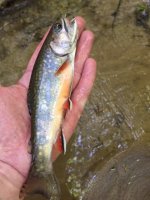
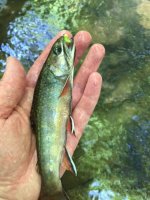
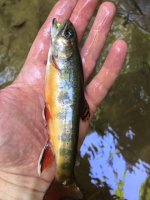
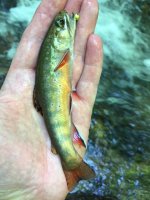
Here are some photos.
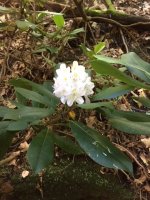
Mountain Laurel still in bloom
First trout was on a caddis, other 3 were on the green fly
 

Attachments

  • Brookie1 Jul 7 2018.JPG
    Brookie1 Jul 7 2018.JPG
    103.2 KB · Views: 17
  • Brookie3 Jul 7 2018.JPG
    Brookie3 Jul 7 2018.JPG
    115 KB · Views: 4
  • Brookie6 Jul 7 2018.jpg
    Brookie6 Jul 7 2018.jpg
    105.2 KB · Views: 13
  • Brookie8 Jul 7 2018.JPG
    Brookie8 Jul 7 2018.JPG
    104.1 KB · Views: 17
  • Mtn Laurel Jul 7 2018.JPG
    Mtn Laurel Jul 7 2018.JPG
    139.9 KB · Views: 10
Prospector wrote:
There were a group of school teachers that came to Kettle Creek every year. This dates back to the late 70s and they pretty much used their "sinking inchworm" exclusively, so that was my first introduction to the fly and I guess their name stuck with me. They key was the little bend they put in the hook to give it more movement on the fall. I never heard the term Green Weenie until about 15 years ago. I guess it's the same fly?

Although the fly I used yesterday is a little different than what I describe above. It was a green inchworm tied like a BH San Juan worm with ultra chenille and thread attaching the Ultra chenille to the hook at the bend and behind the beadhead. The UC is run along the hook but not wound around the hook. The other sinking inchworm I tie (like those school teachers) has regular chenille wound around the hook from the bend to head (I did not use that fly and I think that is what some may call a green weenie).

Probably doesn't matter what it is called...it is green and it sinks...serves the same purpose but the profile is much smaller.

Do you remember what type of chenille they used?


salvelinus wrote:
Not mountain laurel, but Rhododendron maximum. Blooms about a month later than laurel. Very beautiful with the brookies. Nice pics.
Thanks. That makes more sense. I was wondering why the blooms didn’t have a pinkish tint. I have never seen white rhododendron in anyone’s yard. Mine are red and purple.

And sorry for the orientation on those pictures. I made sure they were rotated properly before downloading (all heads at top of picture), but somehow most of them got turned. Second time it has happened to me.
 
Troutbert,

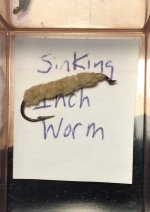
There were 2 different kinds of chenille from that really old fly but I can't remember any more than that. One retained water better. My father was the only one lucky enough to get an original from the guy. I stuck one that we made in a flybox where I save patterns to reference many years later. Unfortunately I didn't save one with the bend in the shank.

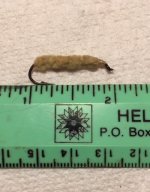
Hopefully this picture will help you. Obviously I've kept this fly so long it lost it's green color, but you can see the type of chenille we used. True to it's name it is an inch long.

Interesting story about the school teacher from Pittsburgh that fished it the most. His technique was a cast, upon hitting the water he started the silent count of 1, 2, 3, 4, 5 and then he would set the hook. If no fish, he would just come forward into a cast just a few feet further downstream. So if he fished a mile of stream he would set the hook 1800-2600 times. He ended up wearing grooves in his top guide and the metal bar on his reel. He also needed shoulder surgery at one point. It was quite a price to pay but he caught 30-40 fish a day while it lasted.
 

Attachments

  • SIW with Ruler.jpg
    SIW with Ruler.jpg
    110.8 KB · Views: 15
  • SIW in box.jpg
    SIW in box.jpg
    143.6 KB · Views: 7
^That sure looks like honeybug cotton chenille. I used to tie what Prospector describes on a heavy wire Mustad #3906 hook and insect green honeybug chenille. There is something about that material that drives fish nuts. You can also tie them in cream and pale yellow with similar results
 
If you haven't been on the West Br. at least 10 times, it doesn't know you well enough to show you any fish to speak of. It's like that.

On the other hand, if you go there more than 10 times and it still doesn't show you many fish, it may have decided it doesn't like you.

It's like that too....🙂
 
RLeep2 wrote:
If you haven't been on the West Br. at least 10 times, it doesn't know you well enough to show you any fish to speak of. It's like that.

On the other hand, if you go there more than 10 times and it still doesn't show you many fish, it may have decided it doesn't like you.

It's like that too....🙂

^This
 
RLeep2 wrote:
If you haven't been on the West Br. at least 10 times, it doesn't know you well enough to show you any fish to speak of. It's like that.

On the other hand, if you go there more than 10 times and it still doesn't show you many fish, it may have decided it doesn't like you.

It's like that too....🙂

Sounds like some women I've known......
 
Back
Top