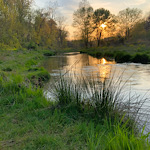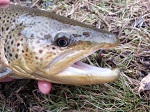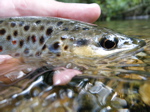
Watery Hollow, Cumberland County, 8/23/18

klingy

Well-known member
Joined
Jul 31, 2010
Messages
612
So there has been discussion in some recent posts about forested brook trout streams, and how to find ones that fish well. As was pointed out in most of those threads (and many times previously on this site), the best way to find out about a stream is to get out and fish it! Below is a a quick breakdown of a small stream in Michaux State forest that I fished yesterday.

Watery Hollow is a tributary to the Breeches that starts on South Mountain in Michaux state forest. I had fished it about ten years ago, and didn't catch a thing. It is, however, a beautiful stream, and looks like there should be brookies in every square inch of it. When I was recently perusing the Natural Reproduction List, I noticed it had been added in the time since I had fished it. Was it fishing better now? Had the stream chemistry changed to the point where brookies were now found in impressive numbers? Would it be full of fat browns? Only one way to find out!

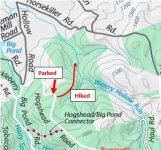
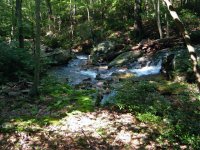
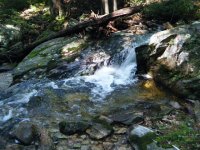
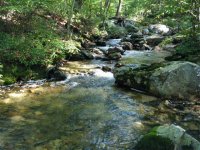
I parked on Hog's Head road, and then bushwhacked about a half-mile down to the stream. It was just as beautiful as I remembered! Plunge pools, deep runs, lot's of pockets, cold water - brookie heaven! I chose a nice deep pool to start plopping a size 14 parachute adams into. If there was a trout there, it wouldn't be able to resist.

Nothing.

Next pool. Nothing.

Great looking deep run. Nothing.

Continued like this for about an hour. Caught nothing. Saw no fish. Got bit by many mosquitoes. I am sure there are trout there somewhere, but my guess is that they are few and far between.

This is the point where I cross it off the "fishing" list, and add to to the "nice place to hike" list. Seriously, it's a pretty stream, but not a stream worth fishing. But I guess the only way to know for sure is to fish it yourself 😉

 

Attachments

  • Nat. Repro. List.jpg
    Nat. Repro. List.jpg
    15.8 KB · Views: 21
  • Map.jpg
    Map.jpg
    49.6 KB · Views: 13
  • Watery 1.JPG
    Watery 1.JPG
    113.1 KB · Views: 17
  • Watery 2.JPG
    Watery 2.JPG
    86.3 KB · Views: 15
  • Watery 3.JPG
    Watery 3.JPG
    89.9 KB · Views: 20
Yeah, that's darn good looking water. You hit it in basically perfect conditions too. I agree - I'd write that one off as a swing and a miss.

Had a very similar experience on Tumbling Run in that area a few years ago. Further south, drains into EB Antietam. Vacant plunge pool after vacant plunge pool was what I found. Eventually I stopped fishing and just walked up to pools and trudged through them to see if I could kick out a fish. Nothing. Acidic water with poor buffering I suspect is the issue in that area.

I call those kinds of streams one and done's. If I hit a stream in good conditions and it doesn't fish well, most often I won't try to fish it again. However...Earlier this year I fished a stream on the nat repro list in pretty good conditions and took a thorough skunking over about 2 miles of water. Flows were good, water was perhaps still a touch cold, but warm enough that I should have been into some fish. Found out since then that the very section I was fishing was surveyed in 2017, and had a very high class A mixed Brook/Brown population...80 kg/ha or so. It's currently being reviewed for inclusion on the Class A list. I'm gonna try that one again...Perhaps it was just fished the day before.
 
Yea I agree, that stream looks quite “trouty.” I wouldn’t write it completely off however as many things could factor into getting skunked. Wildlife roaming near the water that you weren’t aware of that spooked the fish? pH off a bit as Swattie eluded too, and many more. As long as you enjoyed your time out there, I mean, it sucks you expended that energy and had no trout to show for it but I enjoy a nice hike through nature sometimes without even bringing fishing gear. Maybe it just needs some time and you can have another go at it later?
 
Swattie - it reminds me a lot of Tumbling Run. Not quite as much drop, but great looking water with few fish.

Jason - I've had similar experiences on many streams in michaux. Most streams look the part, but they need to be fished (sometimes a couple times) to get a good feel. There are some streams that seem almost dead, and you can fish for an hour and maybe catch one fish. That one fish though might be pushing 12 inches. You travel a couple miles over to the next watershed, and could be fishing over a class a population with fish almost every cast. Very geologically dependent.
 
Klingy - I made the same hike in 2012. Water flow was perfect but my #14 Royal Wulff brought nothing to hand in two hours. I’ve the same issue on several other streams flowing out of Michaux into the CV.
 
This is typical of the situation on South Mountain (Michaux SF).

I often remind folks that, although it may look and feel like Lycoming or Potter County when you're in Michaux... it isn't. Brookie streams there can treat you well, but don't expect dozens of fish in an afternoon. I consider a good afternoon in Michaux to be a handful of fish caught.

When you're exploring Michaux, keep your expectations on the realistic side.
 
Klingy, it sounds like you had no strikes at all. I’ve found in marginal trout waters there are a good population of minnows that attack my fly. It sounds like you weren’t even seeing dace (or whatever the common minnows are where you fish). That seems a bit odd.

When I’m hunting in the fall and during spring turkey I often check small streams that I cross to see if they have trout. It is neat to look into to pools with my binoculars and see the little brookies swimming around but in some streams every hole is filled with dace and no trout. I assume that is more water temp related where the trout can’t survive there.

I’m certainly no expert on water quality but if no fish of any kind are in the creek then that can’t be good.
 
klingy wrote:
Swattie - it reminds me a lot of Tumbling Run. Not quite as much drop, but great looking water with few fish.

Jason - I've had similar experiences on many streams in michaux. Most streams look the part, but they need to be fished (sometimes a couple times) to get a good feel. There are some streams that seem almost dead, and you can fish for an hour and maybe catch one fish. That one fish though might be pushing 12 inches. You travel a couple miles over to the next watershed, and could be fishing over a class a population with fish almost every cast. Very geologically dependent.

I think geology is probably the explanation why not trout were caught. They probably simply aren't there.

From the photo, it looks like the rocks are white or pale-colored sandstones. They are that color because they are nearly 100% silica, so their chemical composition is much like glass. Very, very low amounts of soluble materials such as calcium, phosphorus, etc. that would buffer the water and provide nutrients to the food chain. So the pH of the water probably gets very low, because of acid precipitation.

In mid-state and northcentral PA, there are places with rocks that have different names, but that look similar and that are also mostly silica. And you have the same situation regarding trout. The upper ends of these streams often have no trout or other fish, and very low amounts of aquatic invertebrates.

So why is this stream on the wild trout list? Probably they sampled it further downstream than where you fished. Further down, it probably flows out of that geologic layer, and into a lower layer which provides more soluble materials that buffer the water, so the pH goes high enough for brook trout to survive.

Probably the upper stretches hold no trout, but the lower parts do. I've never explored this stream, so I'm speculating somewhat. But this is the pattern I've seen with similar streams that originate in very infertile pale-colored sandstones here in mid-state and north-central PA.


I think tb is on point. I’ve never fished Watery Hollow, but the Tumbling Run that’s nearby that I mentioned above I recall having a very white, sandy substrate. This is common high up in many watersheds in Michaux.

I’ve also seen it fairly high up in the headwaters of Oregon Creek in Fulton Co. Also turned up no Trout there, though I did observe some. Fowlers Hollow in Tuscarora SF is much the same too. Has Brookies down lower, but they peter out as you go upstream, where the stream bottom turns to a very light colored sand.
 
I'd be curious to know when it was surveyed. Depending on the time of year, and the location of the survey (often close to the mouth), you'd potentially be picking up wild fish moving out of the Breeches to spawn or using it as a coldwater refuge.

Personally, I can't say that I've ever fished a "white sand" stream and done well. As Dwight notes, the geology just isn't conducive to providing the type of water chemistry that can assist the growth of trout. A lot of streams coming off of South Mountain are like that; beautiful to look at and at times, devoid of trout.
 
Sometimes you catch them and sometimes you don't. I am an explorer and a big fan of the DeLorme Atlas and Gazetteer map books. I have them for PA, NC, VA and WV.

I think that the WV one is the least accurate and have done plenty of canoe dragathons in my lifetime just because I wanted to explore something different.

One of my adventures was the headwaters of the Yellow Breeches Creek(not a canoe trip). Armed with the PA Delorme Atlas and Gazetteer, I started my adventure at the Rte. 233 bridge along the Yellow Breeches in Cumberland County and followed it as best I could into the South Mountain headwaters.

I never saw or caught a trout in what I was positive was the headwaters of the Yellow Breeches coming off of the north side of the South Mountains. This just didn't work for me, but I wasn't going to give up.

Instead, I explored what has always worked and explored the south side tributaries of Mountain Creek in the Michaux State Forest since I was already there on the other side of the mountain.

 
salmonoid wrote:
Personally, I can't say that I've ever fished a "white sand" stream and done well.

Me too. On the other hand, I’ve found that red sand often correlates to good wild Trout fishing. Assuming red sandstone has better mineral content and more buffering capacity?
 
Good points about the geology which is a primary limiting factor. However, there are other secondary factors since brookies thrive in infertile waters unless they are always the PH of white vinegar. One factor is low flow so either need enough holding water/structure in the small stream itself or need suitable "transition" water downstream for temporary refuge during low hot water as well as episodic acid events. Suitable means larger rather infertile water where bigger brown trout and smallmouth are not yet abundant. Those CV streams get way too low (in fact some dry up at lower ends) and problem is they dont have any transition water since they dump directly into Yellow Breeches which sucks for brookies. So practically speaking there is no refuge for brookies when they need it most so the populations are small or non-existant. Essentially they are isolated and too small. Good brookies streams are infertile and either isolated with good holding water or have a stretch of suitable transition water for seasonal use.

One other point is brookies hate paved roads and houses in general and those CV streams have too many paved roads and houses.

Tumbling Run is a different story and one of the nicer small streams I never saw a fish in. Not sure about that one other than to say its reverse of above in that Anitetam is much better brookie water and rather big for normal PA brookie water. So brookies stay in the main creek and have no reason to go into little (maybe acidic) Tumbling run other than occasionally (weak argument I agree). Antietam is an anomaly since since in southern PA virtually every similar size stream is brown trout or transition water. I've seen that a few times including 1 small Class A stream that I found to be rather fishless but the parent water downstream (not listed as Class A) was loaded with natives so I assume PAFBC sampled in the rare time when the brookies were in the trib.

No matter the reason, for brookies those CV streams suck but the Antietam / Mountain Creek areas are ok though not every trib is good.
 
Angled,
I think you're over-thinking it. Watery hollow doesn't hold fish because it is too acidic. It would appear to have plenty of good holding water, even in times of low flows. The fish have a free path to traverse into the breeches if they wanted. The fact that there are browns in the breeches doesn't mean the brook trout couldn't hold there for part of the year. Brookies seasonally run into brown-dominated streams all over the place (Big Fishing, Penns, Slate, Cedar, etc, etc, etc). Heck, they run into the ocean where possible. Bigger worries than browns there I would suppose.

There are many fragmented/isolated brook trout populations around the state as well. Impassable culverts, acidic mine discharge, warm water, and other factors isolate brook trout populations, sometimes to tiny tribs. But if the water quality is there, so are the fish. Which brings me back to my first statement - there ain't no fish because the water quality doesn't allow it.
 
“too acidic” is likely correct but may be under-thinking. Acidity often means pH. Streams in that area are roughly pH of 4.5 which is low but not lethal. Some streams in that pH range have viable fish but many do not so there are other secondary factors at play. Things like flow patterns and fishing pressure factor in also. For example, one no-name stream in the Watery Hollow area (likely similar geology/acidity) seems mostly fishless except one section has abundant brookies always, yet the water quality is no different (its all rather poor) but that section has a different physical structure than the rest of the stream. I know another small infertile stream that was loaded with brookies until the beaver dams disappeared and so did the brookies…go figure.

Various studies show low pH often equals fishless but not always. The same low pH does not yield the same result for every stream. Aluminum may be a bigger factor which is related to pH but not perfectly. Flow patterns may determine if brookies can find refuge from aluminum. Those CV streams are isolated and rather linear which may have no refuge (like a clean trib) as opposed to a stream of similar size with a more dendritic watershed and more springs flowing in. They are also too accessible which is just one more factor on top of all of above. Brookies are a friendly fish and that is often their downfall.
 
Yeah, you're probably right. I always thought those streams were too straight. I should have also known there wouldn't be any fish when I was able to follow gemmie fry crumbs the whole bushwack from my car to the stream. Led me right to it. And the beaver I interrupted sipping a martini in "hot tub hole" should have been the final straw. What was I thinking? 🙂
 
Back
Top