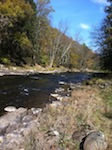
Tulpehocken Creek, Berks County?, 7/3/2012

What used to be the deep part of the lake is filled with sediment from the tribs flowing in. TCTU has been trying to stabilize stream banks of said tribs to decrease sediment in lake but the damage is done. Basically the lake is turning into a flat bottom. No place for cool water to last in the lake throughout the summer. It just isn't there. Until they drain and dredge trout will die during summer months. Don't hold your breath.
 
The Tully DH Area was not stocked in Feb, 2012; it was stocked on March 6, 2012. If you did well fishing in February, most of the fish you were catching were probably from the fall (October), 2011 stocking of adult trout.
 
I find that the Lower Tully fishes well from the October stocking the whole way through till the summer months.

I try to really read up on this stream before I go out this time of year. I trust what TCO has to say about it. If they say its too warm, I back off.

If, however, the fish are going to die anyway, what is the harm in going and harvesting?
 
I think the time to harvest the trout from the Tully often coincides with the first Blue Marsh lake beach closing due to discovery of fecal choloform bacteria. Shrug.
 
I've seen hundreds of fish eaten by herons but never saw one go belly up from the heat. Then again, I usually stop fishing there by June 10th or so.
 
nymphmaniac wrote;

"Is there a particular reason why you fished under those conditions?"

I figured sooner or later someone would ask that - When I arrived it was by no means hot. I actually took off my short sleeve shirt and put on a long sleeved one. The water was comfortable but didn't appear too warm - but then I didn't have a thermometer.

By 6:00 a.m. many fish were rising, and eating, my offerings. The rainbows and browns to 12" fought with vigor and swam away easily when released.

The fish continued to feed very well until 11:00 a.m. Only the large browns, four to be exact, appeared to be stressed. They were much larger than I thought were found in the Tully. None under 17". The one that died came to the surface gulped some air and started to drift down stream. I got out of the water and walked swiftly down below it to intercept it. I lifted it out of the water but it was barely holding on, it's gill cover were opening very little. The gills were just pinkish. It died shortly after and I quit fishing.
 
I've seen hundreds of fish eaten by herons but never saw one go belly up from the heat. Then again, I usually stop fishing there by June 10th or so.

Maybe not hundreds, buy my experience has been the same
 
And Bald eagles!
 
Rainbows and smaller brown trout appear to be ok. The larger browns appear to be stressed. Trico season = very light tippets = light weight fly rods = encounters with large brown trout that just last too long = stressed large brown trout.
 
FCP: It is simpler than that. Large trout are typically the first to stress and die under warm water and/or lowered dissolved oxygen conditions, even without having been caught. This is precisely why a maximum size limit or a C&R reg. would be inappropriate on the Tully and other similar, warm DH Areas if the goal of such regs would be to produce more larger fish. The fish (large)that anglers would want to protect from harvest would be the first to die anyway and the population of large fish would annually slide backward to the summer carrying capacity of the stream's few thermal refugia, except perhaps during the occasional, cooler, wet summers that we experience. Population abundance at the end of the typical summer would be independent of the regs and dependent upon temperature and predation effects, ie no net gain in large trout.
 
I wish I would have taken a picture of the 22+" "cutbow" but it was actually another angler who told me he had caught a similar fish, and said some one had stocked "cutbows." (I'm thinking, who would have done that?) I first labeled it a mature rainbow with a particularly dramatic coloration so I would not make any claim as to its ancestry, but it sure looked a lot different from your standard hatchery rainbow.

The fish was so big when it came to the net I thought it wanted to have a conversation.

Other than the fun of catching it, though, it was clearly an inappropriate fish - it gave me that "fishing in a petting zoo" feeling - to be dropping into what is clearly a temperature challenged watershed.

I headed up to the mountains ths past weekend and caught brookies and got over it.
 
Mike, the OP posted this on July 4. And all in all, he did pretty well, at least as summertime fishing on larger streams goes. A good 2 weeks after the current DH date.

If the DH date were moved up to memorial day, would he have done as well? I don't know the degree to which it would harm the fishing, but it certainly wouldn't help.

You seem to be of the opinion that allowing fish to die due to water temps and predation should be avoided. That's the part I respectfully disagree with. The goal is to hold onto a decent fishery as long as possible into the summer.

A fish that gets caught 4 times and then dies due to warm water is MORE valuable than a fish that gets caught twice and harvested before water temps do it in.
 
wbranch, this was probably answered already. But fish are stocked in the fall too. So catching trout in February is in no way indicative that those fish made it through the previous summer.
 
A fish that gets caught 4 times and then dies due to warm water is MORE valuable than a fish that gets caught twice and harvested before water temps do it in.
+1. Especially since many of us know a few patches in streams where cooler water is sustained and allow a few trout to survive through the summer.
 
Mike
In reference to your statement that “Population abundance at the end of the typical summer would be independent of the regs and dependent upon temperature and predation effects, ie no net gain in large trout”.

When the Tully was stocked with fingerlings the presence of holdover trout was obvious. Your electrofishing studies revealed the number of holderovers.

Section 5 – 1200 foot section – Fingerlings with NO Tackle Restrictions
5 studies between 1981 and 1984 (between 1980 and 1984 bait was allowed)
Number of Trout – 7 to 31 trout
Number of Trout greater than 12 inches (holdovers) 3 to 15

Section 5 – 1200 foot section – Fingerlings with DHALO regulations
5 studies between 1985 and 1993
Number of Trout – 134 to 195 trout
Number of Trout greater than 12 inches (holdovers) 20 to 58

The Tully has significant number of trout that holdover and provide an excellent sport fishery during the summer and early fall before the Fall stocking. On the Tully special regs have had a significant beneficial effect on the trout population.


When I said "regs" in the paragraph from which the sentence quoted above was taken, I was referring only to C&R regs and maximum size limits, those that I mentioned in the paragraph.
 
Wow, there is a ton of really bad information in this thread.
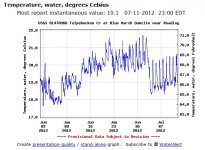
The Blue Marsh Dam operators did exactly what they are requested to do. When the stream temperatures EXCEED 70 degrees PEAK temps for a number of days (theoretically 3 days) they will open the bottom release which releases the cool (not really cold) water. This clearly happened on July 3rd when we see temps of prior days ranging from 68 to 70 degrees. From that point forward you see a VERY consistent range of 65 low to 69 high.

So it is being stated that brown trout over 12" die when exposed to temps of 65 - 69? I am no biologist but I call BS on that one. I would suggest that maybe someone needs to look into what is happening to cause fish to go belly up with that frequency at an average temp of 67 degrees. Certainly this stream has been cooler on average during the last 8 days than the LL which seems to hold fish.

Response?


Attachments

  • Tully Chart.jpg
    Tully Chart.jpg
    96.1 KB · Views: 0
JD,

Agree with all of the above.

The dam control is the best it can be under the current conditions (limited cold water pool).

Also, Westbranch is a 5 star guy, and I believe his observations about the brown trout struggling to stay alive. As I posted, I saw the exact same thing not long ago in similar water temp conditions, in the same stream section.

Long and short, the stream cannot sustain many stocked trout through the summer. The release of cool water will end any week now, and the stream temps will rise well into the 70's through late July and August, depending on the weather.


Yes, the Tully temps are marginal. Yes, the flows at times are not ideal. Yes, it is a low gradient stream that does not look like a typical PA mountain trout stream. Yes, some sections lack optimal cover. But for Southeastern Pennsylvania the Tulpehocken is a large stream that has significant number of holdovers and provides a good year round trout sport fishery. I do agree that when the temps get marginal one should not fish. When the temps drop you will find significant numbers of trout are still there. The PFBC’s electrofishing studies reveal substantial numbers of holdover trout.

When the Tully was stocked with fingerlings the presence of holdover trout was obvious. Your electrofishing studies revealed the number of holderovers.

Section 5 – 1200 foot section – Fingerlings with NO Tackle Restrictions
5 studies between 1981 and 1984 (between 1980 and 1984 bait was allowed)
Number of Trout – 7 to 31 trout
Number of Trout greater than 12 inches (holdovers) 3 to 15

Section 5 – 1200 foot section – Fingerlings with DHALO regulations
5 studies between 1985 and 1993
Number of Trout – 134 to 195 trout
Number of Trout greater than 12 inches (holdovers) 20 to 58

20 to 58 holdovers in a 1200 foot section of stream – what more do you want.

When it is hot and dry most trout fisheries get stressed especially in Southeastern Pennsylvania.

 
Back
Top