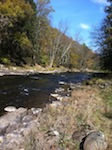
Tulpehocken Creek, Berks County, 5/15/15

McSneek

Well-known member
Joined
Apr 12, 2011
Messages
2,369
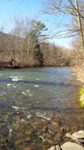
Water is extremely low. 80cfs per the USGS gauge. The ACE must be filling up Blue Marsh for Memorial Day. Fished from about 5:00pm to 7:30pm. Sporadic caddis and sulphurs. Trout showed no interest in the sulphurs. Plenty of interest in the caddis. Did well with #14 and #16 tan cdc caddis. The Tully has really degraded into a heron rookery and a haven for carp and suckers. Watched a really nice smallmouth protect its spawning bed from the carp. Felt sorry for that fish having to spend so much energy on that. Thousands of these fish. If you want to catch a carp on a fly rod go to the Tully. I won't go back until/unless the flow goes up to 150 or so.

Finest tail water in the east? lol
 
The thing that gets me is that they had a major release of water a couple months ago. Now they are filling the lake back up. That seems weird.
 
The Tulpehocken is definitely a fine carp fishery. I'm pretty sure there is more carp biomass in that stream than trout.
 
jeremymcon wrote:
The Tulpehocken is definitely a fine carp fishery. I'm pretty sure there is more carp biomass in that stream than trout.

You may be right. Last evening it just seemed polluted with large carp and suckers. I'm talking hundreds. There are carp in there that look like 10# or more. They aren't as shy as most carp typically are. If anyone wants to catch a carp on a fly rod try the Tully. You may even get a bonus trout or two.
 
I fished various places on the Tully on Friday and didn't do too bad with 10 fish on dries. The one thing that really bothers me is the area from Reber's bridge down to the refrigerator hole. It's just void of trout. In past years this area held many fish. TCO claims this area was float stocked but I really have to question that. Carp, suckers, mink and herons are all plentiful however.
 
Opie610 wrote:
I fished various places on the Tully on Friday and didn't do too bad with 10 fish on dries. The one thing that really bothers me is the area from Reber's bridge down to the refrigerator hole. It's just void of trout. In past years this area held many fish. TCO claims this area was float stocked but I really have to question that. Carp, suckers, mink and herons are all plentiful however.

Opie- I fished from about 100 yards above down into the refrigerator hole between about 5:15 and 7:30 last night. There were plenty of trout. Nice stocker browns. You just had to wait for them to come up between the carp and suckers. And yeah. Herons everywhere.
 
I was down in the Gring's Mill area of the Tully for about 6 hours yesterday, some trout rising, hooked up on a few browns with a Elk Hair Caddis, caddis pupa dropper rig. But I agree on the Carp, they have just taken over, I'm actually heading back today and just to target carp. I had a heron following me around for awhile as well.
 
Herons are very effective predators and are readily habituated to anglers. Carp thrive and populations expand in degraded, uniform habitats. Think of it this way, if it was not a good area for foraging and if the birds were not successful, they would not be there in quantity. Likewise, if the habitat was unsuitable for carp, their numbers would not be increasing (if they, in fact, are).

Note that there have always been large numbers of carp in Blue Marsh and there have always been periodic large discharges of water from the lake......36 years' worth. So IF carp have been increasing in the creek in recent years it is most likely related to habitat. If the perceived increase suddenly occurred this spring, then the recent high discharge could have something to do with it.
 
i have not had any issues finding fish below rebers the last few weeks. just take a walk, just because they put them at the easy access points does not mean they will stay there
 
I have been fishing the DHALO section of the Tully before the Blue Marsh Dam and before the existence of the DHALO. I am talking about the 1970s. Would it surprise you that the carp and herons were always there. The flows have been low recently because of the lack of rain. With the low water the carp become much more apparent.
 
Gosh guys, first I agree with FCP. Secondly no rain equals low water.
Low water means more expose fish for the herons. Low water means you can see more fish, therefore it looks like there are more carp 'cause they are big and will stand out better.

Take a look at the TCO website "stream conditions". Most of the creeks and rivers are low due to lack of rain. Last year everyone was complaining because we had too much rain and this year there are complaints about lack of rain. Ain't Mother Nature Wonderful!

THE WORST PREDATORS ON THE STREAM ARE THE POACHERS. I HAVE WITNESSED QUITE A BIT AND HAVE RECEIVED NUMEROUS COMMENTS FROM FELLOW FISHERMEN. IT IS GETTING OUR OF HAND AND THE SPECIAL REGS. SECTION IS LITTERED WITH CRAP NOT CARP!
 
FCP certainly knows what he is talking about if he is who I think he is. I shouldn't get so negative about the Tully but even in the short time (15 years or so) that I've become familiar with it, it's not what it once was. I cut my fly fishing teeth on the beautiful and difficult to catch rainbows that were the product of the old fingerling stocking program. Miss those quality fish. I also don't think the caddis hatch is as strong as it used to be. Maybe I just haven't hit it right.

The water is just really low for May. I really didn't notice much in the way of litter the other night and I put in at Reber's and went down to the Refrigerator hole.

In the end, it's a nice haven in an urban environment. I can leave work and be fishing in about 15 minutes to rising trout. Not all that bad.
 
Re the poachers, I keep the WCO telephone numbers on my phone - a helpful hint: if the signal isn't strong enought to carry a call, text him instead. It will often go through, and if not, as soon as you move to the top of a hill or somewhere where the signal strengthens, your phone will pump out the text, and that may still be timely enough to let them go catch the poachers.
 
Catching poachers red-handed is nearly an impossibility for the WCO. Each county has one or two WCO's and one or two part-time deputies. At this time of year, they are mandated to spend the majority of their time enforcing boating regulations (for revenue purposes I suppose). However, if you take a photo of the poachers license plate and submit a complaint to the WCO, often-times that is enough to issue a citation. If the presumed violator challenges the citation in court, you, as the witness, must be willing to testify before the judge. Otherwise, the state has no case.
 
It would not surprise me if carp and great blue herons were always there. I suspect what the folks are noting is the high abundance of both.

Just suppose that there are 12 great blue herons in the DH area each day ( It would not surprise me if the number were higher, since what anglers see is the "day shift." There is also a "night shift.") and each consumes a PFBC adult stocked trout on a daily basis, then that would be enough predation to consume 2500 trout from spring through summer.

These theoretical numbers just show the potential magnitude of cumulative effects when only one trout is taken daily per bird by a dozen birds. Obviously, they don't focus solely on trout, but herons are very opportunistic and artificial or otherwise unusually high numbers of fish in habitat that favors heron predatory success will be attractive. Some of you may have an estimate of how many herons may be present simply by assuming equal distribution along the stream and doing some rough calculations based on the length of the stretch you fish vs the length of the DH Area.

While the predation rate is not likely to be a constant, low flow and/or warm water probably enhance success, as do concentrations of fish noted at a few thermal refugia and pods of fish noted during the trico hatch. Additionally, the predation rate increases during nesting season (three rookeries known) as well as in late August and September when immature birds from Delaware and Chesapeake Bays migrate north before heading south.

Some commercial hatcheries report losing three trout per day to each heron and I have personally seen one heron eat 8 eight inch white perch in about a two to three hour period. They are also effective meadow vole catchers, as witnessed by me in a field by Lake Nockamixon.
 
Probably should just shoot them like the guy up here near Lehighton. Bald Eagle and a bunch of herons and he only got a $4,000.00 fine.
 
What continues to amaze me about the Tully is the number of holdover trout I find in the fall before the restocking of adult trout with all that heron predation and the “few” thermal refuges. I have spent a lot of time on the Tulpehocken over the years and honestly believe that a day shift of 15 heron plus a night shift is just a "little" high. I also wonder what is the purpose of all the negative talk about this fishery. It is marginal and may not be the “best trout fishery” in the state but for Southeastern Pennsylvania that fingerling based trout fishery was very unique and special. The fingerlings turn into trout that looked and behaved like “wild trout.” It attracted a lot of attention from serious trout fishermen. The numbers of fish would vary from year to year depending on conditions but the trout were always there. And then there were good water years when there were a lot of trout and the fishing was outstanding. When I look at my fishing log some of my best fishing on the Tully was after 2000. I always thought that the fish commission would be pleased with this fishery (it was a fingerling based trout fishery for 25 years) and continue to take advantage of what this tail water has to offer.
 
That story is a shame. I admire all avian predators. I particularly have an enhanced admiration for great blue herons' opportunistic behaviors. I know of two back yard garden "ponds," one in an urban area, that were somehow spotted by the birds and lost most or all of their koi.
 
FCP wrote:
I also wonder what is the purpose of all the negative talk about this fishery. It is marginal and may not be the “best trout fishery” in the state but for Southeastern Pennsylvania that fingerling based trout fishery was very unique and special.

I've been guilty of some of that negative talk. Mine probably comes from the fact that for awhile at least, many were claiming this stream to be a premium tail water fishery. I don't think in the best of times it would have been that good. Second, the elimination of the fingerling stocking resulted in a lower quality of trout. There are many nice stocked brown trout in the stream this spring but they are nothing compared to the rainbows I used to catch which, as you said, took on many of the characteristics of wild trout.

I truly enjoy fishing the stream on a weekday evening after work. What a great way to wind down.
 
McSneek,
You mentioned how you used to enjoy catching the rainbows from the fingerling stockings, but have you not been catching them ( from privately stocked RT fall fingerlings) over the past two seasons in addition to the PFBC adult Bt and RT?
 
Back
Top