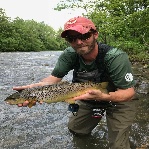
Tulpehocken Creek Berks County 12-8-13

eunanhendron

Member
Joined
Mar 27, 2011
Messages
541
Fished at Papermill where the feeder stream enters the main river.

Saw fish active on the surface in the feeder stream for the 2.75 hours i was there (11.45-2.30pm) despite the temperature starting at 32F and dropping to approx 27F by the time i left.

Fished a number of combinations of midges and nymphs.

Caught three trout,
1 Rainbow about 5 inches - Black Zebra Midge Size 18
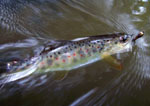
1 Brown about 8 inches - Red Zebra Midge Size 18
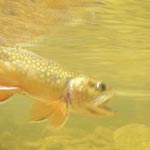
1 Tiger trout about 8 Inches - Red Zebra Midge Size 18

Not sure about water temp, prob in 40s. Count see what fish were rising too, but I only saw them rising in the feeder.

Also saw a couple of natives, but no other fishermen on the stream.

2013-12-08-12-36-37-625.jpg

 
I know from experience that they frequently rise to midges right there at the mouth of the feeder (Cacoosing).

Frequently, there are a fair number of WILD browns right there.
 
TCO stocks fingerling bows, I believe. At least, I know they were planning to. I haven't fished it since then so I haven't seen any.

They were supposed to start their fingerling program in October of 2012 but Hurricane Irene put an end to it. But they intended to go forth with it in October 2013, and were holding fundraisers, but I never saw the confirmation that they had indeed stocked them. The bow kind of confirmed to me that they did.

If it came from that it shoulda had the adipose fin clipped.

I'm more interested in where the tiger came from? The state only stocks adults. TCO I thought was only stocking bows. The brown could either be a smallish adult fall stockie or a wild fish from Cacoosing, which has plenty of wild browns. But the tiger? There are no brookies around that I know of, so likely not wild. Did it get mixed in with the rainbow fingerlings?
 
Pcray is correct. TCO did stock Rainbow fingerlings with clipped adipose fins. I seem to recall that they said a few brookies were mixed in with the bows. Maybe the tiger was one of those.
 
The guys at TCO told me the bow was a stockie.

I was surprised to see the Tiger too, but pretty happy about it. I didnt think there were Brookies either stream....


The three times i've fished this river, all at the same location, I've caught fish...
First trip was a brown trout, next trip, a larger rainbow, and then yesterday the triple...

Great little stream. Maybe next time i'll explore a bit more around there....

Eunan
 
i checked the water temp on the Tully online on Saturday - 37 below the dam, 42 above.

i'd intended to go check it out on Sunday before the heavy snow started.
 
It's not. TCO is a private, local fly shop, who got permission to stock them. Fish commission not involved, other than the granting of permission.
 
pcray, thank you for so quickly correcting Sasquatch. We're not going there again and I am not interested wasting valuable time once again trying to correct the rumor mill (this time that the PFBC had stocked RT fingerlings).
 
I missed where someone mentioned it was TCO that stocked them.

Sorry Mike, I didn't realize stocking of fingerling bows was some kind of hot button topic!
 
The_Sasquatch wrote:
Sorry Mike, I didn't realize stocking of fingerling bows was some kind of hot button topic!

Yeah! It's not like they're getting put into VC or WyoC or something else that would've blown up!
 
I think I just missed something, that's all. I definitely wasn't stirring the pot!

One reason I wondered about the bow was, it was a pretty good year for trout streams all around. I have no doubt the trout in the Tully were able to find holding spots a little easier this year. I don't know when the stocked brand of bows spawn here and with the spring and fall stockings on the Tully, and my ignorance on TCO's stocking habits, I was scratching my noggin.
 
Sas,
Regarding the Tully, it never crossed my mind that you might intentionally be stirring the pot. Your comment was innocent enough, but by its nature and with the stream's past history I had to speak up quickly in order to keep that subject from reeling its ugly head again.

By the way, we have occasionally recovered a wild RT fingerling or two in that general stretch of the stream (Cacoosing Ck downstream to the Rt 222 bridge). Likewise for a few brown trout fings as well.

Mike
 
Wild bows suprise me, a bit. I suppose occasionally a stocked bow may be successful at reproducing in Cacoosing. Probably would not represent a stable population by any stretch of the imagination.

Browns don't surprise me at all. I've caught numbers of wild browns from Cacoosing down.
 
Mike wrote:
Sas,
Regarding the Tully, it never crossed my mind that you might intentionally be stirring the pot. Your comment was innocent enough, but by its nature and with the stream's past history I had to speak up quickly in order to keep that subject from reeling its ugly head again.

By the way, we have occasionally recovered a wild RT fingerling or two in that general stretch of the stream (Cacoosing Ck downstream to the Rt 222 bridge). Likewise for a few brown trout fings as well.

Mike

Gotcha!

I know that they're upstream of the dam, but that's no surprise to anybody.
 
There are RT reproducing in Plumb Creek also. I'm sure some of them make their way down into the Tully.
 
Mike wrote:
Sas,
Regarding the Tully, it never crossed my mind that you might intentionally be stirring the pot. Your comment was innocent enough, but by its nature and with the stream's past history I had to speak up quickly in order to keep that subject from reeling its ugly head again.

By the way, we have occasionally recovered a wild RT fingerling or two in that general stretch of the stream (Cacoosing Ck downstream to the Rt 222 bridge). Likewise for a few brown trout fings as well.

Mike

Hey Mike, have you ever thought about trying the RT fingerling program again in the Tully? LOL.

In all seriousness, and certainly not starting that conversation again, what was the average annual fingerling stocking back in the day. I thought it was like 6 kazillion billion, but recently overheard someone say "a few thousand". Wasn't it between 10,000 - 15,000?
 
The DH Area typically received 6000 RT and 4000 to 6000 BT. The greater or lesser numbers of BT never seemed to make much of a difference. RT typically survived much better and predominated in the fishery.
 
Back
Top