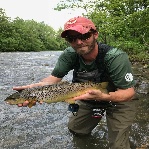
Tulpehocken Creek, Berks Co., 12/15/2014

dc410

Well-known member
Joined
Mar 14, 2012
Messages
3,537
City
Lancaster, PA
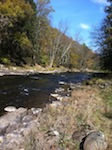
I was travelling today in the area of the Tully and stopped at one of my favorite spots to make a few phone calls. As I watched the Tully flow by I could see many very subtle, dimple type rise forms along many of the current seams. Well, after I was done with my calls I just couldn't resist. I didn't have time to mess around with donning the waders and the whole bit so I just rock hopped along the bank in my Redwing boots.

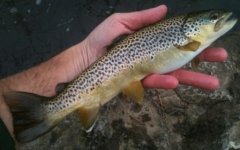
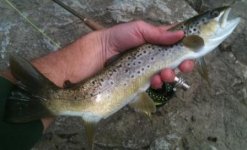
The air temperature was 44 degrees and the water temp was at 43 degrees. The stream was flowing right around 200 cfs and the water was just about perfect in color. I figured that these fish were on midges and probably were taking emerging pupas just under the surface or in the film. Fishing from the bank was a bit of a disadvantage as I was forced to pile cast along the seams to try to get a decent 5 or 6 foot drift before my line was getting pulled all directions and dragged around. I rigged up with size 20 Griffiths gnat with a dropper. The two droppers that I used were a size 22 Zebra midge and a size 22 Olive WD-40. I managed to catch three stocked brownies rather quickly one on each of the mentioned flies. For hatchery fish just put into the stream this fall these fish were very healthy looking and were literally gorging themselves on midge pupas in the film as the midges were just gushing out of their gullets as I released them and a few of the trout were sporting some pretty good bellies that I am sure were packed full of midges. Here are a couple of photos of the fish.
 

Attachments

  • Tully winter brown1.jpg
    Tully winter brown1.jpg
    29.4 KB · Views: 13
  • Tully winter brown 2.jpg
    Tully winter brown 2.jpg
    28.8 KB · Views: 13
nicely done.

its amazing what you can see if you slow down and take the time. i have a bud who always eats an apple when he gets to the water.

its a lesson i need to take to heart.
 
Nice report John - as we all know, it's never a bad time to walk down to the stream and check things out, you never know what you'll see.

Those are some good looking browns.
 
Nice John! That bottom brown got a gut!
 
The bottom BT photo appears to be that of a fish that was stocked in spring. All fins have healed to the extent that they will.
 
I've seen some eating on top on the Tulpehocken and on a small freestone cr. in the past week. Good stuff.

Mike-I'm glad to know some hold over through the summer.
 
NickR wrote:
Shame those weren't utilized.

People tried dude! I saw people fishing there all summer, rippin' those trout out of their cold water refuses, releasing them back into 76 degree water after being played on 7x tippet!

People tried.
 
Andy, fixed your post:

People tried dude! I saw people fishing there all summer, rippin' those trout out of their cold water refuses, releasing them back into 76 degree water where they were then 'utilized' by the herons.
 
Yep, thinning out the trout population when it is jammed into the low capacity thermal refugia reduces agonistic behavior and related stress, saves energy, reduces competition for limited forage, and improves the chances that the remaining fish will not have to occupy the warmer edge habitats, giving them a better chance of being fully exposed to cold water. Thus, the survival rate and health of the remaining fish are enhanced if fish density is greatly reduced. This also improves fish body mass and fat reserves, increasing the chance that they will survive the winter, providing those larger holdover fish that anglers desire.

Remember, I stated earlier that the Tully DH Area is overstocked for the size of its relatively small thermal refugia. And as Sal noted, one way or another the population will be reduced to the stream's carrying capacity. In the Tully, DH Area thermal conditions and low flow, including limited habitat that allows fish to stay cool and at the same time escape avian predators, are some major limiting factors.

Given a choice, I prefer to see harvest (2nd choice is bird predation)reduce the population to near carrying capacity prior to the fish entering the refugia rather than having them get into poor condition due to overpopulation in the refugia. If the population more nearly matched refugia carrying capacity as fish entered these areas they would have a much better chance to grow faster, get larger, and be healthier come fall.

If you have not spent enough time at shrinking thermal refugia on any stream to watch the behavioral struggle and the death throngs as the fish lose the energy that allows them to maintain a position in the coldest water, you owe it to your "doubting Thomas" selves to do so. It is quite a lesson.
 
Yep, thinning out the trout population when it is jammed into the low capacity thermal refugia reduces agonistic behavior and related stress, saves energy, reduces competition for limited forage, and improves the chances that the remaining fish will not have to occupy the warmer edge habitats, giving them a better chance of being fully exposed to cold water. Thus, the survival rate and health of the remaining fish are enhanced if fish density is greatly reduced. This also improves fish body mass and fat reserves, increasing the chance that they will survive the winter, providing those larger holdover fish that anglers desire. Remember, I stated earlier that the Tully DH Area is overstocked for the size of its relatively small thermal refugia. And as Sal noted, one way or another the population will be reduced to the stream's carrying capacity. In the Tully, DH Area thermal conditions and low flow, including limited habitat that allows fish to stay cool and at the same time escape avian predators, are some major limiting factors. Given a choice, I prefer to see harvest (2nd choice is bird predation)reduce the population to near carrying capacity prior to the fish entering the refugia rather than having them get into poor condition due to overpopulation in the refugia. If the population more nearly matched refugia carrying capacity as fish entered these areas they would have a much better chance to grow faster, get larger, and be healthier come fall. If you have not spent enough time at shrinking thermal refugia on any stream to watch the behavioral struggle and the death throngs as the fish lose the energy that allows them to maintain a position in the coldest water, you owe it to your "doubting Thomas" selves to do so. It is quite a lesson.

Sounds to me that you would be better served not over stocking a stream you know can't handle the amount of fish that you stock.

Why do this? Seriously. Read everything you just wrote and explain to me why you stock this stream the way you guys do? You know the majority of anglers release their catch, you know this because of your "studies" and "surveys". So you over stock the tully, then complain that people are releasing too many fish and your answer is to change the regs? Makes total sense.

I remember being told that changing wild trout stream regs from statewide regs to c&r would have little effect because of low angler use and catch and release mentality.
Yet you seem to think changing regs on a delayed harvest stream will remedy your non-utilized fish issue.

How about you try thinking about this Mike?
 
I doubt he will rethink it. I'm pretry sure he knows this change is a done deal, it's just a formality now.
 
DH Artificials only-would seem to be the appropriate regs for this stretch of the creek. Why change anything? What is the PROBLEM with things as they are? Is there some group who is demanding regulation changes? I don't understand any of this. And if you get a kick out of pounding fish out of cold water refuges and eating them nothing is stopping you with the current regs.
 
salvelinusfontinalis wrote:
Yep, thinning out the trout population when it is jammed into the low capacity thermal refugia reduces agonistic behavior and related stress, saves energy, reduces competition for limited forage, and improves the chances that the remaining fish will not have to occupy the warmer edge habitats, giving them a better chance of being fully exposed to cold water. Thus, the survival rate and health of the remaining fish are enhanced if fish density is greatly reduced. This also improves fish body mass and fat reserves, increasing the chance that they will survive the winter, providing those larger holdover fish that anglers desire. Remember, I stated earlier that the Tully DH Area is overstocked for the size of its relatively small thermal refugia. And as Sal noted, one way or another the population will be reduced to the stream's carrying capacity. In the Tully, DH Area thermal conditions and low flow, including limited habitat that allows fish to stay cool and at the same time escape avian predators, are some major limiting factors. Given a choice, I prefer to see harvest (2nd choice is bird predation)reduce the population to near carrying capacity prior to the fish entering the refugia rather than having them get into poor condition due to overpopulation in the refugia. If the population more nearly matched refugia carrying capacity as fish entered these areas they would have a much better chance to grow faster, get larger, and be healthier come fall. If you have not spent enough time at shrinking thermal refugia on any stream to watch the behavioral struggle and the death throngs as the fish lose the energy that allows them to maintain a position in the coldest water, you owe it to your "doubting Thomas" selves to do so. It is quite a lesson.

Sounds to me that you would be better served not over stocking a stream you know can't handle the amount of fish that you stock.

Why do this? Seriously. Read everything you just wrote and explain to me why you stock this stream the way you guys do? You know the majority of anglers release their catch, you know this because of your "studies" and "surveys". So you over stock the tully, then complain that people are releasing too many fish and your answer is to change the regs? Makes total sense.

I remember being told that changing wild trout stream regs from statewide regs to c&r would have little effect because of low angler use and catch and release mentality.
Yet you seem to think changing regs on a delayed harvest stream will remedy your non-utilized fish issue.

How about you try thinking about this Mike?

Yeah. Think about it Mike. The PAF&BC sets the amount of trout to be stocked so why the heck are they "overstocking" the Tully? Why not put some of those fish elsewhere? You admit it's overstocked than push for fishermen to harvest the overstocked trout so they don't suffer death by thermal stress. Makes no sense to me. But then , much of how the commission manages both stocked and wild trout fishing makes no sense to me.
 
I also feel that the current regulations are appropriate for the Tully. I have really enjoyed fishing it over the years and learned an awful lot about flyfishing by time spent on this stream. It kind of was like an outdoor classroom for me learning about fishing caddis hatches. It is also where I finally gained some confidence in fishing tricos. However, I always hung up the trout fishing when the water temps started to approach 70 degrees. This past year I only caught one trout on a trico in the Tully. It was on June 24 and the water temp was 66 degrees, according to my journal. Fortunately a few years the tricos really started early and offered some good fishing in the latter part of May. When the water gets warm I also enjoy sight fishing for carp. The Tully has some big ones! Overall, the Tully "is what it is", certainly not a classic tailwater fishery, but a great recreational opportunity for many anglers in Southeast PA and I have truly enjoyed fishing it over the years.
 
McSneek wrote:
Makes no sense to me. But then , much of how the commission manages both stocked and wild trout fishing makes no sense to me.

It makes sense to me.

To be sure, like many of you, I haven't always agreed with PFBC stocking policy...however, we need to be able, once and awhile, to see things from the PFBC's point of view instead of just through our own wild trout fly fishing lenses.

"Overstocking" is a rather arbitrary concept. In this case, the Tully, we're dealing with a large, very popular fishery that attracts a lot of anglers but that has limited CW refuge for a couple months of the year. If stocking was based on summer refuge capacity, far fewer fish would be stocked in the early spring and fall. If this were done, the PFBC would be flooded with complaints about there being "no fish in the Tully!" We might be happy, but it creates another set of problems for the PFBC (one with which they are very familiar with over many years of experience - complaints by anglers about lack of fish). Is it "overstocked?" Perhaps. However, to greatly reduce stocking would create an even bigger problem for the agency. The agency can't make everyone happy.

I think, in the case of the Tully, the PFBC gets the balancing act fairly well for the most part.
 
Sal and McSneek, let me try to a'splain it to you.

The stocking reflects the high angler use in spring. and the trout die in summer.

The commish wants to increase revenue.

Trout from trucks are the convenient "carrot" of the commish to sell or maintain licenses and trout stamps.

So in the scramble to maintain/grow license sales they are gonna try to dangle every stocked trout that goes into the water out in front of potential and current license buyers.

If stocked in waters under general regulations they will be harvested early. This way they can continue to satisfy the demand of C&R fishermen and then after we've gotten the "bang for the buck" out of the fish, they can get another bang out of them.

And allowing bait in to seal the deal. Oh and let the bait guys in a few weeks earlier, right smack dab in the middle of May...mayfly season, hatch time.

As I've said before, we are not important to them. We are a faction of anglers that will ALWAYS buy a license. We can be kicked to the curb anytime they feel like it and they will still get our dough.

Imagine approaching a pool, seeing riseforms, sitting down a minute to observe the insects, wind and sun on your back. Choosing an appropriate fly, slowly and quietly wading into position. Make a few false casts to gage distance and just as you let go of that line a nightcrawler and bobber come plopping into the pool from the riffle above. Thanks Mr Arway!

You know if they followed their science and creel surveys they would be stocking less trout...even in the general reg areas. Putting a compress on the bleeding wound. Or shouting from the rooftops that the trout there are not utilized, get back in there and harvest them. But they don't because they don't want to upset and belittle the the masses that pay their salaries. Instead they listen to them...a small faction of old timers who think all the trout are stocked behind those black and white signs of the special reg areas.

You wanna increase license sales...stop the bleeding? How about raising the senior license age or eliminating it altogether. They are the ones gutting trout anyway. Every year they sell tens of thousands of senior licenses, and never get another dime again from those freeloaders. Do the math...there is your leak in the bucket. Rather than try to open the faucet more and more, how bouts we plug the hole?

And if the old timers stop buying a license (which they have since they turned 65) they can push the license sales reduction saying hey we stock many more fish than licenses sold and make their case that way. Come and get your stocked trout....the old folks don't wanna pay their way.

 
The stocking reflects the high angler use in spring. and the trout die in summer. The commish wants to increase revenue. Trout from trucks are the convenient "carrot" of the commish to sell or maintain licenses and trout stamps. So in the scramble to maintain/grow license sales they are gonna try to dangle every stocked trout that goes into the water out in front of potential and current license buyers.

I understand it just fine but they do not.
They can dangle trout carrots in front of the horses all they want. It will never increase license sales for the same reason TU is having trouble getting youth into the sport.

Want the cart to move? You have to make fishing interesting to a digital age youth. The PFBC cannot control this, only parents.

Good luck!
 
Back
Top