Tulpehocken Creek, Berks Co., 10/9/18

outsider

Active member
Joined
May 28, 2010
Messages
1,538
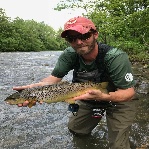
My son and I fished the Tully this morning. Got there about 8:15. The flow was 357 cfs. There was enough insect activity for Sean to fish a dry fly. In the first 35+- minutes he caught a brown about 14" and missed several others. During that time span I lost 2 pretty good fish. Sometimes I am too easily distracted, and it usually happens when a fish takes. I wasn't distracted when the third fish took my fly. That fish went airborne right in front of me and the fight was on. And I knew this would take a while because......

As I was fighting this fish, the flow suddenly got higher. A lot higher. I got this fish in close and I called for Sean's assistance. I couldn't budge it from the bottom of the stream in that heavy flow. So Sean got below me and did the honors for me. When he saw the fish he said "holy crap, is this fish big!" A 22" trout is pretty impressive, but it was the girth of the fish that was so impressive. And he also was impressed by the vibrant colors of that rainbow. The flow at that time was 606 cfs. Short day, good day.


 
Were these most likely wild, holdover stockies or freshly stocked? I saw in the other post they weren’t stocking until earlier today unless someone else stocked it. 22” is a very impressive fish!
 
All holdover fish. In all the decades I fished the Tully, I never (to my knowledge) caught a stream-bred fish in the lower Tully. The high water may have been a pain in the butt to us fisherman, but has been good for the fish. Exception being when floods have scoured streams.
 
The rainy summer in 2018 produced the kinds of somewhat rare conditions (perhaps once per decade) that have historically been conducive to better numbers of holdover fish in the fall, winter and following spring than normally occur. When these conditions occur, there are even nice size holdovers in the "bait area" from the covered bridge down to the last access road below the Berks Campus of PSU. Frankly, I have been waiting to hear of reports of colorful, big (Keystone Fish from 2018) holdover fish being caught in 2019, as well as good numbers of 12-15 inch holdovers (regular stockies from 2018 that have since grown about 3 inches).

Nice catch, Outsider.
 
Right Mike.....more flow usually means better holdover capability for the trout. Why not work with ACOE on getting better flows. Think outside the box.
 
LehighRegular wrote:
Right Mike.....more flow usually means better holdover capability for the trout. Why not work with ACOE on getting better flows. Think outside the box.


This topic has been discussed before. Blue Marsh is a flood control dam. This is first priority for the COE. It is also a relatively shallow lake. The COE does bottom release during the summer to provide the coldest water. But that only lasts for so long depending upon precipitation, temperature, etc.

And please: Think outside the box? Have a little more respect for Mike.
 
It's not the flow released from the dam in these unusually wet summers that I am referencing. It is the temperature. It is all about the basin experiencing a perfectly timed, unusually large storm event during the summer that raises the lake level substantially, as occurred about a decade ago, or as occurred last summer, record rainfall throughout much of the summer. The benefit to the creek below is that in theory the thermocline either keeps getting broken up (or partially broken up) by the inflow or the depleted/nearly depleted cold water below the thermocline is replaced by water that possibly has somewhat better marginal temperature characteristics than the water that is typically released during certain periods of the summer.

Add to that possible cooler inflows of higher than normal volume for longer periods throughout the summer from Plum and Cacoosing Cks., and perhaps it is not only or even a change in reservoir stratification or thermocline temps that apparently improves the holdover capabilities of the stream in those years. (These temporary improvements in holdover capacity have not been generally reported by anglers, but were observed by a few, particularly in the bait area, Section 08, during Decembers following wet summers or summers with unusually big, high volume storm events).

In normal summers the cold water reserve disappears between July 22 and August 4. From early to mid-June through that cold water reserve exhaustion point the discharge, as measured at the USGS gauge, is generally kept at 68 F as a starting point at 8 AM, which is also, coincidentally, the generally accepted starting point for RT temperature stress. Make the 8 AM temperature target colder and you lose the cold water below the thermocline at an even earlier date. Already tried. Release more water and the same thing happens, as is witnessed in summers when the Corps has to spill water occasionally in anticipation of storm events.

Drought summers like the most recent one in 2016 are the best for the tail-race temps other than the extremely high flow summers that seem to occur about once per decade. The reason is that in dry summers the Corps does not have to release excess water to lower the lake level to recreational pool each time a rain event raises the lake level a bit. Nor does it have to lower the lake level in anticipation of major storm events. In each of these cases, precious cold water from beneath the thermocline often is lost depending upon the flow that needs to be released (cfs), which then determines gate selection. Without the loss of this cold water in the lake level lowering process, the supply is extended and the tail-race, particularly in Section 07, stays cooler farther into late July or early August. (A side note: Section 07 immediately upstream from Cacoosing Ck is colder than the immediate tail-race Section at the USGS gauge, which is Section 06, at least during drought summers like 2016).
 
Mike - Totally agree 100% with everything you said and have experienced all the conditions explained. Excellent summary of how Blue Marsh affects the downstream tailwater.

But I think there is one missing piece to this puzzle that could help the tailwater fishery and its holdover capability. If the Corps could release water in a manner that is more beneficial to the fishery when rain events cause the lake elevation to rise above normal pool level.

I realize the Corps is "obligated" to return the pool to the "summer pool" elevation as quickly as possible. But determining the level of flexibility with the Corps could help in maintaining slightly higher releases for an extended period of time during the summer months.

With Tailwaters, if one can maintain flows that benefit the aquatic life the most ( I forget the terminology), those flows can also provide overall benefits to the fishery, even if the water temps are not optimal. It is also a reason that in "wet" summers holdover potential for the trout is improved in addition to everything you/Mike has explained above.

So, my thought is that if the Corps would be open to improving flows and varying their releases during the summer months, especially when there is loss of the hypolimnion/coldwater, when rain events raise the lake level and how the Corps releases the water to drop the lake elevation. And based on my conversations with the Corps, I'm sure they will do anything within their capability without jeopardizing their authorization and purpose of the reservoir operations. So, one needs to be a little creative and understand the limitations of the lake operations.

My thought would be to create a "green zone" (from elevation X to X in the lake) during draw down operations where the Corps would release a certain volume of water above inflow (IE- inlflow = 250 cfs, outflow = 350 cfs). This would maintain a better volume of water in the Tully tailwater, while still being able to draw down the reservoir.

Typical operation by the Corps is to reduce to elevation of lake as quickly as possible and then cutting the release once it hits target lake pool elevation, then they match inflow with outflow.

More water in the Tully, especially during summer months, even though temps may not be optimal, creates more wetted habitat, higher O2 levels, reduces thermal warming which should benefit the fishery and potentially help holdover capability.

This theory may be difficult to visualize, but I think it can help the fishery. That is what I mean by thinking outside the box. This will take discussion and negotiation with the Corps, maybe even drafting of a MOU between the Corps and PFBC...all takes work, time and effort. I realize Blue Marsh has its limitations, but slight adjustments on how the Corps releases water may help the fishery.

Outsider - I have a lot of respect for Mike. He is one of the PFBCs best biologists and I realize he really cares about our fisheries. Yes, I give him a bag of crap from time to time, but that's because I think he can do a better job, because he gets it, and sometimes people get stuck in one way of thinking. He will be missed upon his retirement.


Duty and devotion lead PFBC biologists to do many things in attempts to enhance fisheries and fishing, often without the public's knowledge. Over the years seasonal lake level modifications were proposed to be higher or to be lower under various scenarios in order to enhance spawning and juvenile habitat for bass. Likewise, it was further proposed that lake levels be reduced at a slower pace following storm-related rises in surface elevation than was the ACOE's typical pattern of operation in order to enhance or better protect downstream habitat. Although the lake level modifications were evaluated, none these two proposals was ultimately acceptable to the regional engineers. And reducing the rate at which lake volume could be prepared for the next storm was pretty much a non-starter. One related proposal did gain acceptance, however.

That which did gain some acceptance was the result of an IFIM ( instream flow incremental methodology ) hydrological study conducted by the PFBC's Leroy Young with some field assistance from TU. While this description may not be exactly stated, the study revealed that a minimum of 90 cfs, which I think was the "inflection point" in such studies, was important for aquatic life and the wetted perimeter in the Blue Marsh tail-race. As a result, the ACOE agreed to target 90 cfs, when possible, as the lower limit of flow for fisheries wetted habitat purposes. When the subject was last discussed with BM's staff a few years ago that was still the approach. I assume that the approach is taken whenever possible and when such release rates are not in conflict with the reservoir's higher priority purposes, such as flood control, water supply, and water quality maintenance in the Delaware Estuary.

Pa is respected in IFIM work and Leroy Young played a very active role. Via a search engine it was easy to find the major study on wild trout streams in the Susq Basin that now helps guide water allocations and wild trout habitat protection.
 
FYI - many of the ACOE engineers you may have spoke with and were hesitant on your ideas are no longer there. Might be time to revisit some of those ideas.
 
I have no reason to believe that the engineers in the Phila district office, who reviewed my proposals, gave them anything other than the professional attention that they deserved and that their decisions against water level manipulations were solely based on dam design, facilities capacity (boat ramps and docks were cited), the operational plan and flood control mandates.
 
LR,
My sentence above in #13 does not have the clearest sentence structure, so to clarify: I should not have said "and that." I should have started a second sentence that read as follows: Their decisions against water level manipulations were solely based on dam design, facilities capacity ( boat ramps and docks were cited), the operational plan, and flood control mandates. I was never given any cause to believe otherwise. Those were engineering and mandate type decisions.

 
LehighRegular wrote:
Mike - Totally agree 100% with everything you said and have experienced all the conditions explained. Excellent summary of how Blue Marsh affects the downstream tailwater.

But I think there is one missing piece to this puzzle that could help the tailwater fishery and its holdover capability. If the Corps could release water in a manner that is more beneficial to the fishery when rain events cause the lake elevation to rise above normal pool level.

I realize the Corps is "obligated" to return the pool to the "summer pool" elevation as quickly as possible. But determining the level of flexibility with the Corps could help in maintaining slightly higher releases for an extended period of time during the summer months.

With Tailwaters, if one can maintain flows that benefit the aquatic life the most ( I forget the terminology), those flows can also provide overall benefits to the fishery, even if the water temps are not optimal. It is also a reason that in "wet" summers holdover potential for the trout is improved in addition to everything you/Mike has explained above.

So, my thought is that if the Corps would be open to improving flows and varying their releases during the summer months, especially when there is loss of the hypolimnion/coldwater, when rain events raise the lake level and how the Corps releases the water to drop the lake elevation. And based on my conversations with the Corps, I'm sure they will do anything within their capability without jeopardizing their authorization and purpose of the reservoir operations. So, one needs to be a little creative and understand the limitations of the lake operations.

My thought would be to create a "green zone" (from elevation X to X in the lake) during draw down operations where the Corps would release a certain volume of water above inflow (IE- inlflow = 250 cfs, outflow = 350 cfs). This would maintain a better volume of water in the Tully tailwater, while still being able to draw down the reservoir.

Typical operation by the Corps is to reduce to elevation of lake as quickly as possible and then cutting the release once it hits target lake pool elevation, then they match inflow with outflow.

More water in the Tully, especially during summer months, even though temps may not be optimal, creates more wetted habitat, higher O2 levels, reduces thermal warming which should benefit the fishery and potentially help holdover capability.

This theory may be difficult to visualize, but I think it can help the fishery. That is what I mean by thinking outside the box. This will take discussion and negotiation with the Corps, maybe even drafting of a MOU between the Corps and PFBC...all takes work, time and effort. I realize Blue Marsh has its limitations, but slight adjustments on how the Corps releases water may help the fishery.

Outsider - I have a lot of respect for Mike. He is one of the PFBCs best biologists and I realize he really cares about our fisheries. Yes, I give him a bag of crap from time to time, but that's because I think he can do a better job, because he gets it, and sometimes people get stuck in one way of thinking. He will be missed upon his retirement.


The Tully is a very marginal "tailwater" fishery, dependent on stocked trout in mostly marginal habitat and water quality with a barely adequate pool of cool water to mitigate high water temperatures in the summer.

I'm not sure any amount of tweaking by the ACOE will do much of anything to improve the fishery to any significant degree.

I believe Mike when he states the engineers have cooperated and worked with the PFBC to squeeze out every last drop of cool water to optimize the fishery within their established guidelines.

You cannot get blood from a stone or cold water from too small of a pool.


Mike - I gotcha. I'm surprised the ACOE wouldn't even compromise on some changes. I realize who was in those positions before and completely understand the resistance. But, some people have moved on and those replacements may be more open to some ideas.

Afish- I totally understand the coldwater limitations. And I know Mike has done what he has been able to sustain the cold/cool water for a long as possible.

What I'm referring to is flow, especially when the cold/cool water is exhausted. Mike has referred to wet years being good for trout to holdover in the Tully. Why is this, because the tailwater has more water flow/volume than normal, which creates more wetted habitat, more O2 and reduces thermal impact. And even though the release may be 70F from the lake, those temps are carried downstream for greater distance and there is less thermal heating during periods of higher flow. Which are beneficial to the point it may (and sounds like it is true) hold more trout during wetter than normal summers.

So, I'm proposing (and it sounds like Mike tried) is to increase flows during the summer months within the capabilities of the reservoir. I have a hard time when people say "NO". There is usually a middle ground or something that can be worked out if all information is laid out on the table.

And based on what I read on this forum, it sounds like anglers would prefer to catch holdovers and even grown up fingerlings compared to the cardboard cookie cutter stockies that are placed in the stream every spring or fall.

So, would it be worth pursuing better flows to allow trout to holdover better....????
 
I apologize for this response: clueless
 
Back
Top