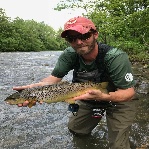
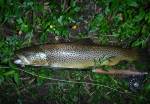
Nymphed the section downstream from the DH Area from 5PM to 7:30 PM. Water temp 60 F, occasional rain. Caught 3 Browns ( 1 wild, 1 holdover. 1 recently stocked) and 5 RT, including 1 holdover. Caught on Al’s Rat and bead-head gold ribbed hares ear. Two other anglers fishing...both fly anglers. Only one angler seen in lower DH area as I left. Caddis and sulphurs active, but sparse. Some trout rising.

You are using an out of date browser. It may not display this or other websites correctly.
You should upgrade or use an alternative browser.
You should upgrade or use an alternative browser.
Tulpehocken Ck, Sect 08, Berks Co. 5/9/21
- Thread starter Mike
- Start date

I'm noticing a theme with your stream reports and the Al's Rat. I agree, it's a great fly..I probably don't fish it enough.
Here’s the situation. There are midges in every stream, more by far than any other insect. The fish are used to seeing the larvae and feeding on them. Almost every stocked trout stomach and intestinal length that I have examined has produced at least one midge and often many more. They may be keying in on something else, but they are still eating midges. So Al’s Rat and SJ Worms (imitates Chironomini larvae...bright red...dwells in detritis and anaerobic muck) work in many streams. I want to try these at a place like Kettle, however, where water is cleaner and land use differs substantially. Your streams in Mifflin and Juniata Co that are ag influenced would probably be good candidates for the rat fished as a nymph. Likewise Penns, Pine, and Elk as well as Spring Ck and Fishing Ck. Suspended under a dry would be interesting too.
Mike, I fish small sized brassies and zebra midges a lot. Same general idea as the rat. And I do very well on these diminutive, easy nymphs.
I tie my Al's rats unweighted to target rising trout. The brassies and the zebra midges I fish deep under indicators.
I tie my Al's rats unweighted to target rising trout. The brassies and the zebra midges I fish deep under indicators.

Is it my imagination or are there far fewer trout rising, and very sparse caddis hatches, on the Tully the past few years compared to prior to 2017?
I used to have 20 fish trips after about 5/6 hours fishing. Now I'm lucky see half a dozen rising fish. Maybe the dynamics have changed. I used to have good day time fishing. Maybe the caddis are emerging late afternoon to dark when I'm not there.
I used to have 20 fish trips after about 5/6 hours fishing. Now I'm lucky see half a dozen rising fish. Maybe the dynamics have changed. I used to have good day time fishing. Maybe the caddis are emerging late afternoon to dark when I'm not there.

landmark wrote;
Well nice to see I'm not the only guy thinking that. I've been there three, maybe four, times since mid April and three times saw no more than a handful of caddis and only two rises. The last time I went which was no more than a week ago I saw four rises and each fish ate a #20 Iris caddis on the first drift.
No other rises and virtually no more than a handful of caddis. I used to love going up before the Delaware system turned on and had pretty much constant action with fish rising everywhere. Maybe some of the epic flows of over 1000 cfs have scoured the bottom and wrecked havoc with the caddis. Much of the Tully has very little bottom structure to mitigate the effects of high water and washing away aquatic insect life.
wbranch- I agree there are less. Seem to be less Caddis. Not the heavy multiple hour long hatches in a few yrs.
Well nice to see I'm not the only guy thinking that. I've been there three, maybe four, times since mid April and three times saw no more than a handful of caddis and only two rises. The last time I went which was no more than a week ago I saw four rises and each fish ate a #20 Iris caddis on the first drift.
No other rises and virtually no more than a handful of caddis. I used to love going up before the Delaware system turned on and had pretty much constant action with fish rising everywhere. Maybe some of the epic flows of over 1000 cfs have scoured the bottom and wrecked havoc with the caddis. Much of the Tully has very little bottom structure to mitigate the effects of high water and washing away aquatic insect life.
wbranch, I believe it all started in 2016. I think that was the year when there was a terrible drought. The flow fell to 50 cfs at times with high temps. Then the following 3 years there were drastic flows, at times over 2,500 cfs. Yes, it totally changed. I live 15 minutes away, and have fished it well over 1,000 times since 1980. For 36 years I could set my watch by this: Around 8:00 a few caddis appeared. 8:30, more. And between 9:00 and 11:00 it was lights out. So many caddis and so many fish rising. By 11:30 it was winding down. Not any more.
I've been to the Tully three times in the past two weeks. In an area that usually had a lot of consistently rising fish, I saw very few. Found two other areas that had quite a few consistently rising fish. My secess rate the first two times was not great, missed a lot of takes, and has to keep changing flies to get hits, but did catch six or so fish each time. The fish I caught were primarily rainbows. Today was a different story, hooked up on most of the takes, used the same flies most of the time (elk hair caddis and emerger). Caught about fifteen fish in about two to three hours. Today they were all browns.
Not sure what the difference was, but as I left, I noticed the water was a little higher. I checked the gage and the flow increased from 150 to 250 about the time I got there. Could that have made the fish more aggressive?
I'm pretty sure that I wasn't any better!
Not sure what the difference was, but as I left, I noticed the water was a little higher. I checked the gage and the flow increased from 150 to 250 about the time I got there. Could that have made the fish more aggressive?
I'm pretty sure that I wasn't any better!

Interesting.
Anyone doing any rock rolling to look for caddis larva or cases? Do the rocks have fewer nymphs than what you would have expected to see in the past?
Anyone doing any rock rolling to look for caddis larva or cases? Do the rocks have fewer nymphs than what you would have expected to see in the past?
KGStine,
It is unclear to me whether or not when you caught the browns you fished the same locations as in the previous trip(s). Section 07, Rebers Bridge down to the covered bridge, has at least in the past been stocked with a higher number/proportion of browns.
It is unclear to me whether or not when you caught the browns you fished the same locations as in the previous trip(s). Section 07, Rebers Bridge down to the covered bridge, has at least in the past been stocked with a higher number/proportion of browns.

mt_flyfisher
Well-known member
I fished there yesterday afternoon and evening for the first time in a couple weeks. There were multiple hatches, swarms of caddis over the riffles, and about as many rising fish later in the evening as you’d see anywhere, at any time.
I fished 6 mornings in the past 15 days at several locations, and the hatch was very sparse. Last week I fished with Salvelinus, and I think I could have counted the number of caddis I saw on two hands. mt_flyfisher I am glad to hear a report of a good evening hatch. I very seldom fish in the evenings anymore due to pain.
mt_flyfisher
Well-known member
I was there again yesterday afternoon and evening, and had several hours of steadily rising fish from the moment I arrived until the time I left. Although the hatches weren’t as heavy as the night before last, there were sill lots of insects on and above the water. There were other fishermen above and below me on the stream and just about every time I looked in their direction it seemed one of them was into a fish.
I’ve experienced heavier hatches on other tailwater rivers, as well as other lakes, streams and rivers in the east and west, but I certainly wouldn’t call the hatches on the Tully sparse. The fish I caught were well fed and healthy.
P.S. I’ve always preferred to fish in the evening at this time of the year. With some notable exceptions, that’s when insect activity is ordinarily the heaviest and fishing is best. (And after spending nearly 20 years on the Yellowstone River in Montana, I loved to watch 95% of the guides and anglers stop fishing at 5:00pm, knowing that I’d have the river mostly to myself for the best fishing of the day.)
I’ve experienced heavier hatches on other tailwater rivers, as well as other lakes, streams and rivers in the east and west, but I certainly wouldn’t call the hatches on the Tully sparse. The fish I caught were well fed and healthy.
P.S. I’ve always preferred to fish in the evening at this time of the year. With some notable exceptions, that’s when insect activity is ordinarily the heaviest and fishing is best. (And after spending nearly 20 years on the Yellowstone River in Montana, I loved to watch 95% of the guides and anglers stop fishing at 5:00pm, knowing that I’d have the river mostly to myself for the best fishing of the day.)
Outsider,
Re: Tully stockings in May. It makes sense to stock the Tully in May because it is one of the coolest streams in SE Pa. As such, it can handle later stockings well while other streams can’t and need to be stocked before the Tully. Additionally, Tully gets a lot of angler use all of the way through June, while the vast majority of the other streams don’t or can’t (because of warm temps/low flow). So stocking the Tully later still puts the trout under plenty of fishing rods. Furthermore, if I can catch good numbers of trout in the “bait area” in May after a single first week of the season stocking in April, there certainly would be no need from a fishing quality standpoint for the PFBC to move the DH Area’s 2nd stocking forward. The DH Area receives even more fish per acre than the “bait” area. I hope you now have a better feel for the big picture of stocking across a region.
Re: Tully stockings in May. It makes sense to stock the Tully in May because it is one of the coolest streams in SE Pa. As such, it can handle later stockings well while other streams can’t and need to be stocked before the Tully. Additionally, Tully gets a lot of angler use all of the way through June, while the vast majority of the other streams don’t or can’t (because of warm temps/low flow). So stocking the Tully later still puts the trout under plenty of fishing rods. Furthermore, if I can catch good numbers of trout in the “bait area” in May after a single first week of the season stocking in April, there certainly would be no need from a fishing quality standpoint for the PFBC to move the DH Area’s 2nd stocking forward. The DH Area receives even more fish per acre than the “bait” area. I hope you now have a better feel for the big picture of stocking across a region.