To buy or Tie?

I'm in the camp if you enjoy tie and if you don't buy. You definitely save money if you keep it to a handful of simple effective guide type flies made with inexpensive materials. This is especially so if you keep material colors to a minimum of a dark color and a light color. But who does that! Pretty soon you will have 6 shades of sulphur dubbing to match every stream and time slot in PA and then try to match every possible hatch. You will have periods tying different styles of flies, all with different materials. For dries I have gone through periods when I was partial to Catskill style, snowshoe hair, Comparadun, parachute, CDC, and synthetic wings. It can be addictive and before you know it you can accumulate a room full of material.

You could can catch fish with only Adams, buggers, pheasant tails, a tan sparkle duns in your box. But what fun is that!
 
I agree with a few others on here - tie because you like to tie.

I'm still relatively awful at it, but few things put the mind at ease like being hunched over a tying desk in your basement trying to get some feathers and fur to look like a bug. You may have more bandwidth, but it takes 100% of my focus.

Oh, and beer helps.
 
I think the biggest advantage of tying for me is the convenience of not having to go to a fly shop (closest one to me is 45min away) or having to wait for an online shipment to come in. If I realize I'm low on PTNs the day before a fishing trip, I can just go bang out 10 and they're in my hand and ready to go.
 
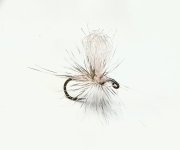
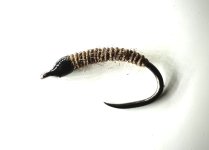
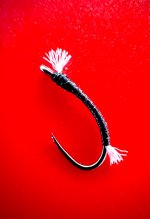
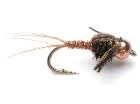
One I thought enough of to photograph.

5KErq5D.jpeg
 
For me it's not about the cost of "buying" flies. With all of the K___p in my fly tying area I could have purchased 1-2 of every fly ever tied in several sizes. I find great satisfaction in the finished product and greater joy in catching fish with a self tied fly. I got a D in the last art class that I ever took. However, I'm quite proud of my fly thing creations.
 
Dear wildtrout2,

You've never seen flies I tied. They work but works of art they ain't. 😉

Regards,

Tim Murphy 🙂
Your comment reminds me of a line from a New Jersey Supreme Court on nude dancers and the First Amendment. "Swan Lake it isn't."
 
I have a Thompson “A” fly tying kit from the early 70s. Since my stroke I’m thinking about tying again for some therapy. What makes sense to buy or tie or a mix of both? Thanks

I tie & buy...

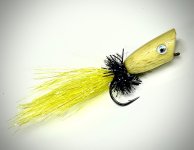
I buy the stuff I'm too lazy to tie or patterns that take me too long to fabricate; poppers are an example.

However, the flies I fish most often are creations of mine or modifications of some well known pattern meaning stuff I'm NOT likely to find in a fly shop. THIS is why I tie and conveniently, most of these patterns have a simplified recipe of just a few materials.

When I first started tying if I knew I'd end up fishing mostly my own designs, I would have probably bought flies until I discovered what worked FIRST, before trying to tie every fly I saw in a book or fly shop. That MO results in over-buying materials that you may never use again...

As far as cost goes, as an example...

99% of the mayfly patterns I tie & fish with sucess are generic Thorax or Parachute patterns consisting of a poly wing, Microfibett tails, a body made of synthetic packaged dubbing and hackle (most often Whiting 100 packs) and I use Daiichi or Tiemco hooks.

So using 100 flies (because of the 100 Pack) as a standard to figure out the cost per fly, here is my generic dry fly material cost:
100 Daiichi 1180 Hooks - $35.00​
Whiting 100 Pack Hackle - $22.00​
1 Package Micro Fibbettes - $3.50*​
1 Package Superfine Dubbing - $3.50*​
1 Package Hi-Viz Wing Material - $3.25*​
1 Spool of UNI Thread - $3.75*​
* Will tie more than 100 flies​
Total cost for materials - $71.00​
Cost of materials per fly - $ .71​
Everybody on here knows that you don't have to use Daiichi hooks, Whiting Hackle or even UNI thread so I imagine you could get that down to $ .60 or less and of course, most of the packaged material will tie more than 100 flies so that brings down the cost per fly even more.

Obviously this doesn't account for the start-up costs of a vise & tools, but that cost will be divided over 100's if not 1000's of flies. So as others have stated, tying your own flies can POSITIVELY save you money if you don't give up after the first dozen. 😉

One caveat is YOUR time. Based on experience and familiarity, I'd expect to spend to no more than 30 minutes of my time to tie a dozen of my generic dry flies. Based on that, I would spend about 8 hours to tie 100 flies.

If tying flies is something that takes valuable time away from your job or other responsibilities, then maybe the money lost or time spent tying flies is an important consideration...

However if you have the time to go fishing to try out the flies you tied, I assume it is a moot point. 🙂

Good luck!

 
after reading Marinaro, Skues, Sawyer, Brooks, Fox, and Schwiebert over and over , I got this life changing book and became more concerned with function over form:
 

Attachments

  • IMG_1729.jpeg
    IMG_1729.jpeg
    122.5 KB · Views: 5
  • IMG_3494.jpeg
    IMG_3494.jpeg
    93 KB · Views: 4
  • IMG_3470.jpeg
    IMG_3470.jpeg
    146 KB · Views: 5
  • IMG_3231.jpeg
    IMG_3231.jpeg
    173.7 KB · Views: 5
  • IMG_2913.jpeg
    IMG_2913.jpeg
    217.5 KB · Views: 6
  • IMG_2357.jpeg
    IMG_2357.jpeg
    134.7 KB · Views: 6
  • IMG_6537.jpeg
    IMG_6537.jpeg
    150.8 KB · Views: 6
Since I got into fly fishing a few years ago, I haven’t bought a fly yet. Everything I’ve caught has been on a fly I tied. To me, it is therapeutic to sit and tie flies. This year I got into smallmouth and have enjoyed tying them too. Like someone else said on here, mine may not be perfect, but they work. Just makes it all the more fun and rewarding. However, with all the materials I’ve “impulse bought”, I definitely don’t think I’m saving money by tying my own. 😂
 
I truly enjoy my time at the vise. I only fish with flies that I have tied. As others have stated, I have enough materials to last a second lifetime. My only purchases are hooks and beads. I also teach a fly tying class during the winter through TU. During these sessions I explain there is no need to tie multiple different flies or have exact materials. My goal is to teach proper proportions and techniques. I provide alternative material suggestions and stress you do not need the exact components found in any pattern.
 
I tie & buy...

I buy the stuff I'm too lazy to tie or patterns that take me too long to fabricate; poppers are an example.

However, the flies I fish most often are creations of mine or modifications of some well known pattern meaning stuff I'm NOT likely to find in a fly shop. THIS is why I tie and conveniently, most of these patterns have a simplified recipe of just a few materials.

When I first started tying if I knew I'd end up fishing mostly my own designs, I would have probably bought flies until I discovered what worked FIRST, before trying to tie every fly I saw in a book or fly shop. That MO results in over-buying materials that you may never use again...

As far as cost goes, as an example...

99% of the mayfly patterns I tie & fish with sucess are generic Thorax or Parachute patterns consisting of a poly wing, Microfibett tails, a body made of synthetic packaged dubbing and hackle (most often Whiting 100 packs) and I use Daiichi or Tiemco hooks.

So using 100 flies (because of the 100 Pack) as a standard to figure out the cost per fly, here is my generic dry fly material cost:
100 Daiichi 1180 Hooks - $35.00​
Whiting 100 Pack Hackle - $22.00​
1 Package Micro Fibbettes - $3.50*​
1 Package Superfine Dubbing - $3.50*​
1 Package Hi-Viz Wing Material - $3.25*​
1 Spool of UNI Thread - $3.75*​
* Will tie more than 100 flies​
Total cost for materials - $71.00​
Cost of materials per fly - $ .71​
Everybody on here knows that you don't have to use Daiichi hooks, Whiting Hackle or even UNI thread so I imagine you could get that down to $ .60 or less and of course, most of the packaged material will tie more than 100 flies so that brings down the cost per fly even more.

Obviously this doesn't account for the start-up costs of a vise & tools, but that cost will be divided over 100's if not 1000's of flies. So as others have stated, tying your own flies can POSITIVELY save you money if you don't give up after the first dozen. 😉

One caveat is YOUR time. Based on experience and familiarity, I'd expect to spend to no more than 30 minutes of my time to tie a dozen of my generic dry flies. Based on that, I would spend about 8 hours to tie 100 flies.

If tying flies is something that takes valuable time away from your job or other responsibilities, then maybe the money lost or time spent tying flies is an important consideration...

However if you have the time to go fishing to try out the flies you tied, I assume it is a moot point. 🙂

Good luck!
A dozen flies in 30 minutes. That’s impressive. I take at least 12 minutes for a dry fly and somewhat less on nymphs.
 
A dozen flies in 30 minutes. That’s impressive. I take at least 12 minutes for a dry fly and somewhat less on nymphs.

One of the biggest time saving things I've incorporated is keeping my bench cleared of everything EXCEPT the tools & materials required for the fly being tied.

Other things I do is to get my materials prepped ahead of time, using homemade gauges to measure proportions on things other than hackle length, splitting tails with a thread tag versus a dubbing ball or X-wraps and eliminating unnecessary thread wraps; 3 or 4 will do for most operations versus the 7-10 I see on some tying videos.
 
I tie & buy...

I buy the stuff I'm too lazy to tie or patterns that take me too long to fabricate; poppers are an example.

However, the flies I fish most often are creations of mine or modifications of some well known pattern meaning stuff I'm NOT likely to find in a fly shop. THIS is why I tie and conveniently, most of these patterns have a simplified recipe of just a few materials.

When I first started tying if I knew I'd end up fishing mostly my own designs, I would have probably bought flies until I discovered what worked FIRST, before trying to tie every fly I saw in a book or fly shop. That MO results in over-buying materials that you may never use again...

As far as cost goes, as an example...

99% of the mayfly patterns I tie & fish with sucess are generic Thorax or Parachute patterns consisting of a poly wing, Microfibett tails, a body made of synthetic packaged dubbing and hackle (most often Whiting 100 packs) and I use Daiichi or Tiemco hooks.

So using 100 flies (because of the 100 Pack) as a standard to figure out the cost per fly, here is my generic dry fly material cost:
100 Daiichi 1180 Hooks - $35.00​
Whiting 100 Pack Hackle - $22.00​
1 Package Micro Fibbettes - $3.50*​
1 Package Superfine Dubbing - $3.50*​
1 Package Hi-Viz Wing Material - $3.25*​
1 Spool of UNI Thread - $3.75*​
* Will tie more than 100 flies​
Total cost for materials - $71.00​
Cost of materials per fly - $ .71​
Everybody on here knows that you don't have to use Daiichi hooks, Whiting Hackle or even UNI thread so I imagine you could get that down to $ .60 or less and of course, most of the packaged material will tie more than 100 flies so that brings down the cost per fly even more.

Obviously this doesn't account for the start-up costs of a vise & tools, but that cost will be divided over 100's if not 1000's of flies. So as others have stated, tying your own flies can POSITIVELY save you money if you don't give up after the first dozen. 😉

One caveat is YOUR time. Based on experience and familiarity, I'd expect to spend to no more than 30 minutes of my time to tie a dozen of my generic dry flies. Based on that, I would spend about 8 hours to tie 100 flies.

If tying flies is something that takes valuable time away from your job or other responsibilities, then maybe the money lost or time spent tying flies is an important consideration...

However if you have the time to go fishing to try out the flies you tied, I assume it is a moot point. 🙂

Good luck!
This is far too rational and well thought out to convince me that I'm saving money by tying my own flies.

How am I supposed to go into a fly shop, see a cool new color of ripple laser ice dubbing, and not think that might be the secret to catching every fish in the stream?
 
One of the biggest time saving things I've incorporated is keeping my bench cleared of everything EXCEPT the tools & materials required for the fly being tied.

Other things I do is to get my materials prepped ahead of time, using homemade gauges to measure proportions on things other than hackle length, splitting tails with a thread tag versus a dubbing ball or X-wraps and eliminating unnecessary thread wraps; 3 or 4 will do for most operations versus the 7-10 I see on some tying videos.
Id also add
- keeping your scissors in your hand while tying cuts down alot of wasted movement picking up and placing them down.
- put your materials is the same place and order every time you tie. Eventually by habit you can reach for something without even looking.
-cement the heads on all finished flies at same time. Prevents picking up cement and bodkin multiple times.
 
I tie & buy...

I buy the stuff I'm too lazy to tie or patterns that take me too long to fabricate; poppers are an example.

However, the flies I fish most often are creations of mine or modifications of some well known pattern meaning stuff I'm NOT likely to find in a fly shop. THIS is why I tie and conveniently, most of these patterns have a simplified recipe of just a few materials.

When I first started tying if I knew I'd end up fishing mostly my own designs, I would have probably bought flies until I discovered what worked FIRST, before trying to tie every fly I saw in a book or fly shop. That MO results in over-buying materials that you may never use again...

As far as cost goes, as an example...

99% of the mayfly patterns I tie & fish with sucess are generic Thorax or Parachute patterns consisting of a poly wing, Microfibett tails, a body made of synthetic packaged dubbing and hackle (most often Whiting 100 packs) and I use Daiichi or Tiemco hooks.

So using 100 flies (because of the 100 Pack) as a standard to figure out the cost per fly, here is my generic dry fly material cost:
100 Daiichi 1180 Hooks - $35.00​
Whiting 100 Pack Hackle - $22.00​
1 Package Micro Fibbettes - $3.50*​
1 Package Superfine Dubbing - $3.50*​
1 Package Hi-Viz Wing Material - $3.25*​
1 Spool of UNI Thread - $3.75*​
* Will tie more than 100 flies​
Total cost for materials - $71.00​
Cost of materials per fly - $ .71​
Everybody on here knows that you don't have to use Daiichi hooks, Whiting Hackle or even UNI thread so I imagine you could get that down to $ .60 or less and of course, most of the packaged material will tie more than 100 flies so that brings down the cost per fly even more.

Obviously this doesn't account for the start-up costs of a vise & tools, but that cost will be divided over 100's if not 1000's of flies. So as others have stated, tying your own flies can POSITIVELY save you money if you don't give up after the first dozen. 😉

One caveat is YOUR time. Based on experience and familiarity, I'd expect to spend to no more than 30 minutes of my time to tie a dozen of my generic dry flies. Based on that, I would spend about 8 hours to tie 100 flies.

If tying flies is something that takes valuable time away from your job or other responsibilities, then maybe the money lost or time spent tying flies is an important consideration...

However if you have the time to go fishing to try out the flies you tied, I assume it is a moot point. 🙂

Good luck!
Nice breakdown.
 
Id also add
- keeping your scissors in your hand while tying cuts down alot of wasted movement picking up and placing them down.
- put your materials is the same place and order every time you tie. Eventually by habit you can reach for something without even looking.
-cement the heads on all finished flies at same time. Prevents picking up cement and bodkin multiple times.
Never trust anyone with a neat desk.
 
Never trust anyone with a neat desk.

I wouldn't trust me, but it has nothing to do with a neat desk... 😉

In all seriousness, keeping my desk cleared of anything except the materials for the flies I am tying keeps me focused on the task at hand, tying a minimum of a dozen "what-evers" in a particular size.

In the past with crap strewn all over, I was inclined to get distracted and start messing around with something new or something else. That resulted in more time wasted, less productivity and less consistency.
 
Back
Top