The Good, the Bad, and the Unexpected

I honestly didn't realize anybody was against LWD additions in trout streams until this thread.

"LWD projects" that cut trees streamside to use as bankside logs and root wads are not even close to the same as watershed-scale LWD addition projects. The former is harmful - and since TU keeps getting trashed let me say as a current leader of a chapter that I would not support these old school style of habitat improvement projects. By contrast, the watershed scale projects that focus on the entire floodplain and are designed by people who understand floodplain dynamics are yielding fantastic results in many states across the country for their respective native trout populations. Quick Google searches will find you examples in VT, WV, and CA.
 
I remember way back in the mid 70's early 80's, when I was a climber, we took down a LOT of American elm trees due to Dutch Elm Disease (bark beetles). It was sad to see them dying at the rate that they were back then. Many of them were very large, iconic specimens, some of which were on the Swarthmore College campus, which is/was somewhat of an arboretum.

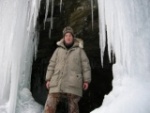
I'm the guy in the tree, the biggest poplar I ever climbed, also at Swarthmore. It had been struck by lightning (you can see the crack), so it had to be removed. We used an old Disston two man chainsaw to start the wedge cut. Ahh, the good ole days.

I hope that UNLIKE most of the cartoons I watched as a kid; you were sitting on the correct side of the saw. 😉
 
I honestly didn't realize anybody was against LWD additions in trout streams until this thread.

"LWD projects" that cut trees streamside to use as bankside logs and root wads are not even close to the same as watershed-scale LWD addition projects. The former is harmful - and since TU keeps getting trashed let me say as a current leader of a chapter that I would not support these old school style of habitat improvement projects. By contrast, the watershed scale projects that focus on the entire floodplain and are designed by people who understand floodplain dynamics are yielding fantastic results in many states across the country for their respective native trout populations. Quick Google searches will find you examples in VT, WV, and CA.
Yes that’s the problem. If they work then you are just robbing future generations. It’s a very fisherman first, resource last project. Whatever benefits come now, don’t come later. We are robbing our grandchildren and harming the creeks long term to feel good about ourselves now. The better the results now, the more harm and stream damage in the future. That’s my point. It harms the stream long term no matter what.
 
Yes that’s the problem. If they work then you are just robbing future generations. It’s a very fisherman first, resource last project. Whatever benefits come now, don’t come later. We are robbing our grandchildren and harming the creeks long term to feel good about ourselves now. The better the results now, the more harm and stream damage in the future. That’s my point. It harms the stream long term no matter what.
Wait, are you saying "chop and drop" LWD additions are bad, staking in trees to create artificial habitat are bad, or both? or something different? At this point I can't tell.
 
I don't think fishing data is the best indicator. What else has happened to these creeks in the last 38 years?

All of the culvert replacement projects I am aware of are on first order streams. They allowed some fish movement but they didn't open up a brook trout paradise to brown trout. The brown trout were already there or the brook trout fishery wasn't great. Kind of off topic but I will add I am totally in favor of adding intentional barriers to prevent movement of brown trout. But I'd like to see them on second/third/fourth order streams. I won't get into the weeds on that.

I'd argue if a culvert is providing the only habitat features that you listed, the creek could probably use some LWD.

Hopefully some surveys will be done where these LWD projects have taken place in PA to prove benefit or not. I personally can not prove anything, I have no data. I won't come on here and claim a fishery has collapsed or boomed. I will say that I trust the data from other projects where LWD was used and I do believe that there used to be natural LWD in PA streams. I can't imagine that humans came in, altered the forests and streams and somehow made brook trout fishing better because "LWD is bad!".

Fishing data is all I have. I agree not great. But data is data. Can’t pretend data doesn’t exist just because it doesn’t fit the mold and agenda of the outcome we desire.

Manmade LWD is bad.

Not all, I’m a huge fan of natural lwd. Here in Pa we are 300-400 years away from that coming back. But all the manmade lwd projects keep setting us back over and over. Which sucks. Some creeks had 50-100 years towards that 300-400 year goal. Now they have been “thinned” and the timer has been reset. The last 50-100 years of healing in the watershed has been undone. Manmade LWD projects are to blame.
 
Wait, are you saying "chop and drop" LWD additions are bad, staking in trees to create artificial habitat are bad, or both? or something different? At this point I can't tell.
The cutting of the immature trees bankside is bad. Sorry, clarity isn’t my strong suit.
 
Last edited:
The cutting of the immature trees bankside is bad. Sorry, clarity isn’t my strong suit.
No disagreement there. But you can add LWD by bringing it from elsewhere. Maybe trees that are cleared for all the data center construction sites.

(ok, I'm trolling by throwing data centers in, but it could be any construction site)
 
You clearly have an axe to grind. Straight up calling someone a liar when your own posts contain substantial falsehoods is brazen.

People constantly complain about large wood in Clarks Creek, which is from natural hemlock mortality. You are about the only one complaining about man added large wood.

I encourage you to watch this presentation. If you dont have 20 minutes to educate yourself, then from 13min on its all about brook trout response to large wood. Similar reaults are being observed in Pa.
I can see why you would feel that way. I still love you and troutbert. You guys make me think and I love it. But when you love someone you don’t sugarcoat and beat around the bush. You tell them the truth. No matter how hard it is. So I did. My observations are what they are. I’m not going to pretend trees are spaced out or far from the bank or strategically placed because someone else heard it in a presentation. In north central Pa brook trout streams where manmade lwd has occurred the trees are too close together and near the banks and not strategically placed. That’s a fact not an opinion.

Someone has to be the voice of reason. I don’t care if I’m the first or the last or alone. The truth is the truth.

These videos prove my point. They actually document what the future generations are losing out on.

Sorry for being rude or coming across that way. That wasn’t my intention, but my own self awareness of how I am being perceived isn’t my strongest trait.
 
No disagreement there. But you can add LWD by bringing it from elsewhere. Maybe trees that are cleared for all the data center construction sites.

(ok, I'm trolling by throwing data centers in, but it could be any construction site)
True they could be from somewhere else. I’d have no problem with that. But in north central Pa on brook trout streams this is not what was done. It got so bad a cabin of guys from new Jersey called the cops on the chainsaw operators for vandalism as it was happening. There are many layers to this story. It’s really sad to see the logging and destruction in person. Masked behind the cloak of stream restoration.
 
True they could be from somewhere else. I’d have no problem with that. But in north central Pa on brook trout streams this is not what was done. It got so bad a cabin of guys from new Jersey called the cops on the chainsaw operators for vandalism as it was happening. There are many layers to this story. It’s really sad to see the logging and destruction in person. Masked behind the cloak of stream restoration.
What stream?
 
True they could be from somewhere else. I’d have no problem with that. But in north central Pa on brook trout streams this is not what was done. It got so bad a cabin of guys from new Jersey called the cops on the chainsaw operators for vandalism as it was happening. There are many layers to this story. It’s really sad to see the logging and destruction in person.
I want to see it in person. What is the location(s) where this occurred?
 
True they could be from somewhere else. I’d have no problem with that. But in north central Pa on brook trout streams this is not what was done. It got so bad a cabin of guys from new Jersey called the cops on the chainsaw operators for vandalism as it was happening. There are many layers to this story. It’s really sad to see the logging and destruction in person. Masked behind the cloak of stream restoration.
If you had said some of these things last night I would have understood more why you were opposed to this practice or at least how it was being practiced. These are seem to be some cost benefits that I would like to hear more about. Does the species of tree taken into consideration?
 
If you had said some of these things last night I would have understood more why you were opposed to this practice or at least how it was being practiced. These are seem to be some cost benefits that I would like to hear more about. Does the species of tree taken into consideration?
I have trouble articulating what I am thinking and putting it down in an organized and concise way. Especially in a way that makes sense to others.

I would think avoiding the healthy shade providing hemlocks would be a priority. Unfortunately that hasn’t been the case.
 
Why not name the stream? It’s apparently not worth fishing anymore so it shouldn’t be a problem.
 
  • Like
Reactions: CRB
I have no idea what is in that pipe. But that is a top notch little stream packed to the gills with brown trout, so I am not worried about that pipe. This fish came from that stream in March of 2026, and it is on the skinny side, but it is one of the longer fish I've pulled out of this stream. In most places, this stream is only about two-three feet across. That is a stream I'm not worried about....

View attachment 1641250956
Does that trout look thin?
 

Here is a presentation about some monitoring of a large wood addition in the ANF. Worth noting that this project also involved removal of a significant berm restricting floodplain access so this is more intensive work than most of the chop and drop large wood addition work that is happenning.

Below is part of the summary of the presentation

"Following restoration in August 2021, the lateral extent of hyporheic zone remained greatest during wet winter and spring months, but increased to as much as 30 m from the channel. Hyporheic flux rates from the stream to the adjacent alluvial aquifer remained high 0.23 m3 s 1) during the spring months, when water levels in the stream are high. During the driest period of the year (August - October), water levels are 0.2m higher across the valley and hyporheic exchange rates increased from 0 to 0.19m3 s-1 Because of the bedrock-alluvium architecture, groundwater gradients continue to be greatest down the axis of the valley and down-valley flow estimated to be 3 to 5 times greater than lateral flow rates. However, increased lateral hyporheic exchange during the hot, dry summer and fall months has consistently decreased stream temperatures during the summer by 2-4°C for the past five years. Side channels, now reconnected and flowing year round, provide refugia for native brook trout during spring floods and spawning habitat in the fall."
I haven't fished that watershed in quite some time, but when I last did, it was an above average trout stream. I'd be interested to head back and fish it again some day.

When I was still in PA, there were quite a few of the smaller streams in the Kinzua valley where small diameter birch was being cut across the stream channel, circa 2022-23. My memory isn't quite certain which streams they were, ANF or private land, but it was definitely north tributaries between Tallyho and Red Bridge. It probably couldn't hurt a couple of those streams, but there's also some decent water that would be a lot harder to fish now.
 
Back
Top