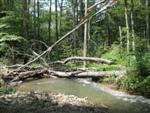
The Good, the Bad, and the Unexpected

Are people not noticing the good habitat spots (pools and cover) created by large woody debris (LWD)?

I think a little goes a long way.

Like anything, if done poorly or excessively, it can act like a beaver dam in the wrong place: contribute to silting up a run, warming water artificially in the heat of summer.

Granted, trees dying and falling across a stream are a natural thing; as are beavers. Been around before all of us, and Fisheries science degrees.

In my view, on high gradient streams needing some bank stabilization, some logs here and there to hold back the eroding bank/channel flows are probably ok.

I have for sure seen places where there was so much deadfall, that once productive runs were silting up and warming the water.

It seems a 'trendy' habitat practice to me right now; perhaps maybe a little overblown/over hyped.

Joe

 
So it makes a better fishing stream but not necessarily a better stream?
How would a better fishing stream made up of adult native fish not necessarily be a better stream?

Why would a stream made up of immature and stunted natives with all those problems and invasive species added be a better stream?
 
I know I’m being feisty and pissing you off troutbert, but I’m not trying to. Not at all.

By the way. FYI.

IMG_0381.jpeg


☝️ Here is a screenshot of my Private message inbox with suggestions of any brookie creeks that any stream projects have improved.

Turns out I’m not the only one that couldn’t think of any. In fact no one messaged me even one example. I doubt they will. I’m not sure it exists.
 
It acts as a migratory barrier.
It increases depth every time.
It provides a wintering home to avoid anchor ice.
It provides protection from predators without giving said predators a perch to sit.
It favors brook trout over brown trout. How?
It provides colder temperatures for the creek and down stream. 1 scour hole below a culvert has no significant effect on downstream temperature.
It provides additional food. How? Now large wood that traps small sticks and leaves provides more food for macroinvertebrates which fish eat.
It allows trout to reach a much larger size.
It increases chances for reproduction. More fish passage improves reproduction success

These are the only differences I could think of off the top of my head. I’m sure there are many more.
An undersized and perched culvert pipe is a migratory barrier. While there may be a large scour hole, the other result is increased velocity and increased bank erosion along with irregular deposition upstream and by the way its great if the road washes out during big thunderstorms.
 
First, I am not sure how a plunge pool would keep the stream cooler. The opposite is likely true. A plunge pool concentrates the fish where someone dangling some garden hackle from the road above could clean out most of the fish. I am sure locals know where this situation exists during most summer low water conditions. Predation from animals and snakes seems pretty likely in this situation.
It has been discussed many times on this site how streams essentially dry up yet fish return the following year sometimes in surprising numbers. This has been attributed to fish finding water that is below the streambed. Fish that can’t be angled for during stressful summertime conditions. I am sure some fish and in particular some larger ones would be lost in these conditions. From what I have seen, plunge pools often create garbage habitat for a stretch below that pool. Could you not conceive conditions where fish would be more spread out and survive better? Especially since the plunge pool would prevent fish from moving up for colder water and for spawning.
I don’t discount the value of these types of pools in certain situations, but I would need convincing that our small runs need these pools to harbor fishable populations.
 
An undersized and perched culvert pipe is a migratory barrier. While there may be a large scour hole, the other result is increased velocity and increased bank erosion along with irregular deposition upstream and by the way its great if the road washes out during big thunderstorms.
Migratory barriers are good for brook trout. Super important. That’s a great point.

I don’t care much about stream velocity and bank erosion once the creek has lost it’s carrying capacity for adult fish.

Also Large woody debris projects increase bank erosion, sunlight penetration, increase water temperature, increase sediment built up, decrease brook trout populations. Reduce spawning habitat. By the way why wait for a thunderstorm. it’s great if a culvert pipe eliminatation project does that for us.
 
First, I am not sure how a plunge pool would keep the stream cooler. The opposite is likely true. A plunge pool concentrates the fish where someone dangling some garden hackle from the road above could clean out most of the fish. I am sure locals know where this situation exists during most summer low water conditions. Predation from animals and snakes seems pretty likely in this situation.
It has been discussed many times on this site how streams essentially dry up yet fish return the following year sometimes in surprising numbers. This has been attributed to fish finding water that is below the streambed. Fish that can’t be angled for during stressful summertime conditions. I am sure some fish and in particular some larger ones would be lost in these conditions. From what I have seen, plunge pools often create garbage habitat for a stretch below that pool. Could you not conceive conditions where fish would be more spread out and survive better? Especially since the plunge pool would prevent fish from moving up for colder water and for spawning.
I don’t discount the value of these types of pools in certain situations, but I would need convincing that our small runs need these pools to harbor fishable populations.
Name a good brook trout stream without a deep hole. I think you answered your own question.
 
IMG_0383.jpeg


Yes we always use shallow impoundments for cold water release dams. Come on man. One hole can decide the temperature of the entire creek!

A mud puddle or a farm pond has more food? Come on man it isn’t the mud puddle.

More fish passage of invasive’s? Without the habitat there isn’t any adult fish that need passage to effect success.
 
Just sucks our future generations won’t get to see natural large wood like this. Not if we keep adding it in projects.
You realize that the reason most streams do not have large wood is because of our past timber harvest legacy that has left many forests too young to recruit large wood on their own. Now we are starting to see some large wood recruitment with dead ash (short lived, rot quickly), hemlock (wooly adelgid), oak (various stressors) and will likely start to see lots of beech in the coming years.

Streams are not meant to be straight and without wood.

ever fish the cross fork watershed? My rod and reel surveys always find brookies around the natural and human felled large wood.
 
You realize that the reason most streams do not have large wood is because of our past timber harvest legacy that has left many forests too young to recruit large wood on their own. Now we are starting to see some large wood recruitment with dead ash (short lived, rot quickly), hemlock (wooly adelgid), oak (various stressors) and will likely start to see lots of beech in the coming years.

Streams are not meant to be straight and without wood.

ever fish the cross fork watershed? My rod and reel surveys always find brookies around the natural and human felled large wood.
I couldn’t agree more. But how is it going to help if we cut it all down again? Prematurely just so we can say we did something? Before it matures? We have already started. Large woody debris projects are just logging all over again. Why would it be different this time? If logging streams worked to improve trout populations, why is Pa struggling so much with trout populations since we started logging 130 years ago.
 
I couldn’t agree more. But how is it going to help if we cut it all down again? Prematurely just so we can say we did something? Before it matures? We have already started. Large woody debris projects are just logging all over again. Why would it be different this time? If logging streams worked to improve trout populations, why is Pa struggling so much with trout populations since we started logging 130 years ago.
Please provide an example of where a large wood addition project is logging and is a clear cut along the stream? You cant.
 
Why?

Pool habitat has a tremendous benefit for trout populations.

The lack of pool habitat is one of the main problems limiting trout populations in our freestone streams.
I'm not sure if we're totally grasping one another here. I have plans to fish a small freestoner soon that I like a lot. It has tiny pools and a steep gradient. I'll post pictures of what I like and what I don't like. I'm not anti-pools; I'm anti-plunge pools that have a tiny pool where the water plunges over the LWD and then immediately shallows out. For fishing, that habitat sucks.
 
Please provide an example of where a large wood addition project is logging and is a clear cut along the stream? You cant.
They are all logging. Cutting down trees excessively is logging. Cutting a little bit less than 100 years ago isn’t gonna solve it.

This whole logging situation is like smoking cigarettes. And now our creeks have lung cancer. But for some reason you guys are convinced that just a few cigarettes. Just a little less smokes than what gave us the cancer. Is somehow going to cure the cancer. Just a little logging. Just a little LWD.

Smoking cigarettes doesn’t cure lung cancer, even just a few. Large woody debris projects don’t cure logging. It’s just more of the same crap that got us sick in the first place.
 
I couldn’t agree more. But how is it going to help if we cut it all down again? Prematurely just so we can say we did something? Before it matures? We have already started. Large woody debris projects are just logging all over again. Why would it be different this time? If logging streams worked to improve trout populations, why is Pa struggling so much with trout populations since we started logging 130 years ago.
Have you actually seen that scenario? If so, where?

I've seen several of the large woody debris addition projects and none of them fit that scenario.

It was forest before the project. And still forest after the project.

Thinning is a common forestry project that can improve the health of the forest, not eliminate it.

And forests thin themselves also. In a young forest there can be many hundreds of young trees per acre. When the trees reach a large, mature size, there is typically only about 60 trees per acre. What happened to all those other hundreds of trees? They died. They got "thinned" out by competition from the more vigorous growing.

These projects do a very light thinning. The people who do these projects are very aware of leaving plenty of trees to provide shade and for future large woody debris supply. They are taking a very low percentage of trees, and often use trees cut well upslope from the stream. not directly on the bank.
 
It seems to me LWD is what creates most bend pools at least in eastern streams.
That may be the case under certain circumstances, but I think bend pools tend to be made by the stream changing direction, forcing water flow to "dig" out a pool. I'm no hydrologist, but I did stay at a Holiday Inn Express. 😉
 
Have you actually seen that scenario? If so, where?
Pennsylvania, logging has destroyed our trout populations. I thought you would have heard about it by now.
I've seen several of the large woody debris addition projects and none of them fit that scenario.
I want to believe you but my inbox lacking even a single example of even a single stream that would prove your point is still empty.
It was forest before the project. And still forest after the project.
No it is a stream with the trees cut down along the bank. It isn’t a forest or natural.
Thinning is a common forestry project that can improve the health of the forest, not eliminate it.
No actually this is bad. Especially for trees. Artificially Forced hourglassing of genetics always results in an inferior species.
And forests thin themselves also. In a young forest there can be many hundreds of young trees per acre. When the trees reach a large, mature size, there is typically only about 60 trees per acre. What happened to all those other hundreds of trees? They died. They got "thinned" out by competition from the more vigorous growing.
Well how would we know if you chopped them all down who was gonna make it and who wasn’t?
These projects do a very light thinning. The people who do these projects are very aware of leaving plenty of trees to provide shade and for future large woody debris supply. They are taking a very low percentage of trees, and often use trees cut well upslope from the stream. not directly on the bank.
Name a single light thinning. Just one. One creek. This is completely untrue. Every single thing you say in this last paragraph is factually untrue. The people doing these projects are very unaware. Very uneducated. They cut down hemlocks and they cut down the trees directly on the bank in all of the projects I have seen. Way too many trees. Everything you said is incorrect and untrue of North Central PA Large woody projects in my experience. Just my experience.
 
Last edited:
Back
Top