You are using an out of date browser. It may not display this or other websites correctly.
You should upgrade or use an alternative browser.
You should upgrade or use an alternative browser.
Praying mantis
- Thread starter Javelin389t
- Start date

wildtrout2
Well-known member
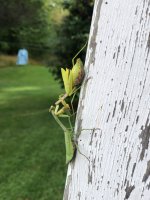
That's a neat pic. The Praying Mantis is my favorite insect. I don't seem to see as many as I did as a kid, for whatever reason. I usually only see one or two each year. I saw this one a few years ago and got a good pic of it. It's amazing how well they blend with their surroundings.
They can actually change colors if there's a need, but it takes several days. I've read they usually only live for one year.
They can actually change colors if there's a need, but it takes several days. I've read they usually only live for one year.
Attachments


A quick check indicated that it does happen about 30% of the time, but more frequently in the confinement of lab studies. Going back to the 1970’s when I took an (Animal) Behavioral Ecology course at PSU it was believed from behavioral studies that in order to successfully complete copulation the female always bit the head off of her suitor. While that would happen as part of the 30% mentioned above, it has some benefit in that it causes the now decapitated male to complete copulation more quickly. Why would a female consume the male? Possibly to gain a large, protein-rich meal that would enhance the quality of the eggs, giving the male a better chance of passing his genes onto a future generation.
Ironically, I think your pic shows a female consuming another female. The lighter colored female has been decapitated. Based on the abdominal segment counts, apparent short antennae, the wing tips not slightly extending beyond the abdominal tips, and the insects’ apparently formerly equal lengths, both are females. I think that pic is possibly somewhat of a unicorn even if it wasn’t intended to be. Very good.
Ironically, I think your pic shows a female consuming another female. The lighter colored female has been decapitated. Based on the abdominal segment counts, apparent short antennae, the wing tips not slightly extending beyond the abdominal tips, and the insects’ apparently formerly equal lengths, both are females. I think that pic is possibly somewhat of a unicorn even if it wasn’t intended to be. Very good.
Last edited:


rancid waders
Well-known member
When I was stationed on Okinawa we had shop Preying Mantis in captivity only larger than the species common to our area. It would kill, skin and eat small geckos

Solitariolupo
Active member
- Joined
- Jan 3, 2017
- Messages
- 524
I used to buy there eggs and hatched them. Was fun watching all those little ones.
Javelin389t
Member
Thanks for all the info. Very much appreciated. Counting those 2 , I had 4 of them on porch , side of house area in the last couple of days. All within about 8- 10 feet of each other. The pic. is from yesterday afternoon. Checked this morning and there’s no sign of those 2 , maybe it flew off with its meal ? Other 2 are still hanging out.A quick check indicated that it does happen about 30% of the time, but more frequently in the confinement of lab studies. Going back to the 1970’s when I took an (Animal) Behavioral Ecology course at PSU it was believed from behavioral studies that in order to successfully complete copulation the female always bit the head off of her suitor. While that would happen as part of the 30% mentioned above, it has some benefit in that it causes the now decapitated male to complete copulation more quickly. Why would a female consume the male? Possibly to gain a large, protein-rich meal that would enhance the quality of the eggs, giving the male a better chance of passing his genes onto a future generation.
Ironically, I think your pic shows a female consuming another female. The lighter colored female has been decapitated. Based on the abdominal segment counts, apparent short antennae, the wing tips not slightly extending beyond the abdominal tips, and the insects’ apparently formerly equal lengths, both are females. I think that pic is possibly somewhat of a unicorn even if it wasn’t intended to be. Very good.
wildtrout2
Well-known member
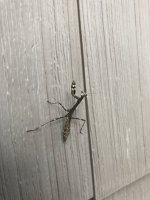
Watch out for these types:
 www.brandywine.org
The Invasive Mantis Species | Brandywine Conservancy and Museum of Art
The praying mantis is a master of deception with a seemingly benign appearance. Despite its tranquil praying pose, this elusive creature is actually quite the predator of the insect world. Most people are able to identify a praying mantis, but many are unaware there are both native and invasive...
Good article. Thanks. I’ve never seen the native one, not even when I was a child finding mantises in the 1950’s. Given their range as explained in the text, I suspect that I would not have found the native species anyway.Watch out for these types:
The Invasive Mantis Species | Brandywine Conservancy and Museum of Art
The praying mantis is a master of deception with a seemingly benign appearance. Despite its tranquil praying pose, this elusive creature is actually quite the predator of the insect world. Most people are able to identify a praying mantis, but many are unaware there are both native and invasive...
wildtrout2
Well-known member
Very interesting, I learned a lot from that. Now I'm wondering if the second mantis I posted is one of the Carolina variety, given it's size, color, and markings?Watch out for these types:
The Invasive Mantis Species | Brandywine Conservancy and Museum of Art
The praying mantis is a master of deception with a seemingly benign appearance. Despite its tranquil praying pose, this elusive creature is actually quite the predator of the insect world. Most people are able to identify a praying mantis, but many are unaware there are both native and invasive...

C3Addict
Member
I’ve had a couple in the backyard in recent weeks, I too think they are way cool.
When I was way younger I found one of their egg sacks. I thought it looked cool and broke the branch it was on and put it in one of my terrariums, who knew.?
My parents were not happy when they hatched…..😳


He or she was eating a moth…..

When I was way younger I found one of their egg sacks. I thought it looked cool and broke the branch it was on and put it in one of my terrariums, who knew.?
My parents were not happy when they hatched…..😳
He or she was eating a moth…..



USGS Stream Gauges