KeviR, unfortunately I can’t provide the reference, as it is in a scientific literature review of special reg use in trout management that I wrote for the agency years ago. That paper is in my old office and not accessible. If I recall correctly, there is more than one reference to that topic and a number of papers have cited that and other similar studies to the extent that I would say those results are well-accepted within the fisheries community.
If you fish trebles or have done so in the past with substantial frequency, you must have noted how infrequently they are lodged in the rear of the mouth or in the tongue, particularly the portion of the tongue where much bleeding occurs. I can only assume,that it is easier for a trout to more fully engulf a spinner with a single hook than one with a treble. That’s one part of taking a hook deeply.
The other part of “deeply” is how deeply the hook penetrates the mouth parts. Single hooks of the sizes typically used on lures on avg penetrate the flesh deeper than trebles, causing more bleeding or injury. For a given amount of force, that force is often divided across multiple tines with a treble hook. One tine being blocked by bony material or cartilaginous material in the mouth may prevent the second or third tine from sinking in. With single hooks, all of the force is delivered to one hook point all of the time, enhancing penetration.
Nice attempt at shifting baseline Mike.
View attachment 1641224911
Unfortunately that red line going upward will never take place in our state because statements like that display lack of the key needed ingredients bolded in red above.
It’s like saying that just because there is some laughable fraction of the life histories and brook trout that used to exist in Penns creek that the stocked/non native trout must be completely benign. Or are you saying brook trout are at their 17th century size and levels current in penns creek?
Not at all…re-read what I said. In summary, I said that despite a large BT pop in Penns, the ST from the tribs being found in Penns can then obviously still move about using Penns as a transport route to enhance genetic diversity in other tribs’ ST populations. I said nothing nor did I come close to suggesting that a historical ST population would or could be established in Penns. I just don’t see those BT preventing the ST exchange of genetic material among tribs over time.
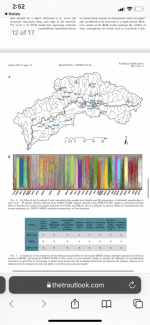
I would add that given how similar the ST genetics are from one trib population to another in the Loyalsock basin despite all of the stocking there and despite tribs with wild BT pops, successful genetic exchange among tribs must be occurring there as well.
Finally, per your own reference within the list of 38, it only took 5 males and five females, 40 in all, introduced into four tribs to substantially enhance genetic diversity within those tribs’ ST populations. This doesn’t have to happen annually or occur 10 fish at a time to have a positive genetic effect. A persistent trickle of immigrants over time should be enough, especially since that trickle likely gets out into the larger stream system on an annual basis and even more-so, or more than a trickle, when year classes produced every two to three years.
ST do this (move out from the tribs) in the Little Schuylkill too during cooler parts of the year and it gets warmer and has lower flow than much of Penns in Centre and part of Union Co. Furthermore, wild ST quickly move into sections of Willow Ck, Berks Co that have gone completely dry in drought years, resulting in total fish kills in the summer. Essentially, as soon as temps are cooler and water starts flowing again in Sept or Oct. the ST are on the move and back in that section. The point is that given the physical and thermal opportunities to move, ST will do so. Having worked with a number of migratory species and species that most people don’t recognize as being migratory on a seasonal basis, I can assure anglers that the urge to migrate and overcome obstacles, physical, chemical, and biological, is quite strong.