CinnamonJoe
Well-known member
I finally was able to get on the water yesterday.
With drought conditions starting to take hold again in this part of Iowa, my expectations were tempered. Our coldwater streams are heavily limestone influenced, so they generally stay cold and clear, but they will rise and fall to an extent, with the state of the springs and aquifers feeding them.
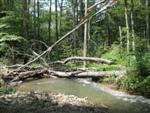
This is Spring Branch, its about a 50 minute drive from my house. Its near the town of Manchester, IA, just south of US20, 40 min due west of Dubuque, IA. I opted to fish the long, upper meadow stretch, after a quick survey hike showed healthy browns holding in the expected spots, with sporadic rises in the bright, late afternoon sun. This stream can be very technical. Its basically our, 'Spring Creek', but also bears strong resemblance to the 'Letort' in its heyday. Not a soul was fishing it. I opted for a 7'6" 80 year old Montague Fishkill cane rod, running #5 DT on an Ocean City Viscoy reel, pushing an 8' knotted leader of my own design, ending in 2' of 5x fluoro. Did the builders of the rod in Montague City, MA or the reel in Philadelphia, PA back-in-the day ever imagine that their wares would ever make it to the Iowa prairies? (hopelessly romantic nonsense) (heck, I never imagined I would end up here either! LOL)
I could say it was a frustrating evening; but with late afternoon temps topping in the low 80s, zero humidity, a buffet of mayflies hatching, and rising trout, I was motivated. While a little low, the water otherwise looked fine, and the browns seemed to be in their happy place.
I am terrible on my entymology. That needs to be a New Year's resolution next year, at least, and needs to change. At least 3 different types of Mayflies were actively, lightly hatching, ~ lighter colored, a little darker colored, and a little darker yet. They definitely were not Sulphurs, nor BWOs. The 'lighter color' tended to a medium grey, and the 'little darker yet' were golden brownish. They were all a runty size #16. Like, bigger than #18, but barely #16. And, as evening wore on, the trout loved them all. You could see their wings, like micro-sailboats in the film, bobbing along, until a hungry brown would erupt from below to devour it. My best guess? the darker flies seemed like runt Hendricksons. The lighter ones resembled some type of Blue Quill.
So, I started with Blue Quills, moved on to Red Quills (stuck one), then finished up with a Hendrickson comparadun that fooled a few more. There was a long drought after catching the 1st one, while stubbornly clinging to that Red Quill catskill style dry. That fly 'worked' right? But, after 20min of refusals, even this hard-headed Sicilian realized he needed to try something else. Hendrickson fared the best, with one fish drilling it so hard, it went fully airborn on the take.
The evening evolved. It may have been that the darker mayflies were more prevalent later on, and that Hendrickson comparadun simply just did a better job imitating them.
I left at late twilight, with the moon peaking through the clouds; trout still sporadically rising as night fell upon the prairie.
Joe

(note the risers up stream-one close in by the flat rock on the left, and then farther upstream near the bend)

(Iowa Driftless prairie butter)

(goodnite!)
With drought conditions starting to take hold again in this part of Iowa, my expectations were tempered. Our coldwater streams are heavily limestone influenced, so they generally stay cold and clear, but they will rise and fall to an extent, with the state of the springs and aquifers feeding them.
This is Spring Branch, its about a 50 minute drive from my house. Its near the town of Manchester, IA, just south of US20, 40 min due west of Dubuque, IA. I opted to fish the long, upper meadow stretch, after a quick survey hike showed healthy browns holding in the expected spots, with sporadic rises in the bright, late afternoon sun. This stream can be very technical. Its basically our, 'Spring Creek', but also bears strong resemblance to the 'Letort' in its heyday. Not a soul was fishing it. I opted for a 7'6" 80 year old Montague Fishkill cane rod, running #5 DT on an Ocean City Viscoy reel, pushing an 8' knotted leader of my own design, ending in 2' of 5x fluoro. Did the builders of the rod in Montague City, MA or the reel in Philadelphia, PA back-in-the day ever imagine that their wares would ever make it to the Iowa prairies? (hopelessly romantic nonsense) (heck, I never imagined I would end up here either! LOL)
I could say it was a frustrating evening; but with late afternoon temps topping in the low 80s, zero humidity, a buffet of mayflies hatching, and rising trout, I was motivated. While a little low, the water otherwise looked fine, and the browns seemed to be in their happy place.
I am terrible on my entymology. That needs to be a New Year's resolution next year, at least, and needs to change. At least 3 different types of Mayflies were actively, lightly hatching, ~ lighter colored, a little darker colored, and a little darker yet. They definitely were not Sulphurs, nor BWOs. The 'lighter color' tended to a medium grey, and the 'little darker yet' were golden brownish. They were all a runty size #16. Like, bigger than #18, but barely #16. And, as evening wore on, the trout loved them all. You could see their wings, like micro-sailboats in the film, bobbing along, until a hungry brown would erupt from below to devour it. My best guess? the darker flies seemed like runt Hendricksons. The lighter ones resembled some type of Blue Quill.
So, I started with Blue Quills, moved on to Red Quills (stuck one), then finished up with a Hendrickson comparadun that fooled a few more. There was a long drought after catching the 1st one, while stubbornly clinging to that Red Quill catskill style dry. That fly 'worked' right? But, after 20min of refusals, even this hard-headed Sicilian realized he needed to try something else. Hendrickson fared the best, with one fish drilling it so hard, it went fully airborn on the take.
The evening evolved. It may have been that the darker mayflies were more prevalent later on, and that Hendrickson comparadun simply just did a better job imitating them.
I left at late twilight, with the moon peaking through the clouds; trout still sporadically rising as night fell upon the prairie.
Joe
(note the risers up stream-one close in by the flat rock on the left, and then farther upstream near the bend)
(Iowa Driftless prairie butter)
(goodnite!)
Last edited: