Loyalsock Creek, Sullivan County, 8/9/14

duckfoot

Active member
Joined
Apr 6, 2014
Messages
1,047
1730 - Haystacks Trail
Air Temp: 70F and cooling
Water Temp: 62F and cooling
Bugs: size 18 waterskippers, size 28 tricos (green and brown), size 16 cream cahills, size 4 giant stoneflies, unidentified nymphs
Water Clarity: stained
Water Depth: 2-8 feet

The geologist in me decided to see what they were all about. Here's some pictures:
tumblr_naa4m0fnF41r043wwo1_500.jpg

tumblr_naa4m0fnF41r043wwo2_250.jpg

tumblr_naa4m0fnF41r043wwo3_250.jpg

tumblr_naa4m0fnF41r043wwo4_250.jpg

tumblr_naa4m0fnF41r043wwo5_250.jpg


Lots of tricos (bright green and brown) coming off the water once the evening hit, and there's some BIIIIIG rainbows that come up to get them. Almost got one, but he rose to the wrong fly.

Most of the Haystacks area are flat shale rocks as big as a house that make up the streambed, and the seasonal ice has fractured them and dug them out underneath. I believe there's many, many more fish than what the eye can see because they're all underneath the shale tables and rise up to the surface between cracks that are maybe a foot wide.

Who knows how deep the stream is under them, honestly.

Yellow stimulators (size 14) also get close inspections from the native brook trout (which there are about a hundred), but no takers on this night.

Did find an interesting nymph/bug clinging to the rocks by the THOUSANDS just above the waterline. Can anyone tell me what they are? Size 12.
tumblr_naa4m0fnF41r043wwo6_250.jpg

tumblr_naa4m0fnF41r043wwo8_250.jpg
 
Very cool rock formations. Wondering if the small insects are midges? Tricos come off in the morning.
 
Great report. Sounds like a good time.

The size 28 bright green and brown insects that hatched in the evening were not Tricos, though. I really have no idea what type of hatch that was given the size and color.

Tricos actually hatch during the nighttime. The spinner fall happens in the morning. Usually later morning on cool days and early morning on hotter days.

You will see swarms forming, usually over the more riffled water and the spinners will begin falling shortly thereafter.

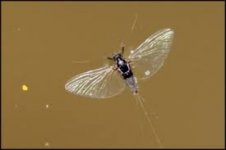
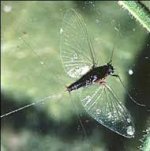
Tricos are pretty much all size 24. The females are white or whitish with a light olive cast abdomen with a black thorax and the males are all black. Check out the photos of each below.
 

Attachments

  • Trico Female.jpg
    Trico Female.jpg
    3.9 KB · Views: 9
  • Trico Male.jpg
    Trico Male.jpg
    5.8 KB · Views: 2
Thanks for the report. The Haystacks are pretty amazing.

Those are probably Isonychia (Slate Drake) shucks in your photos.

Does anyone know what group stocks this section?

The PFBC website says their upper stocking limit is at the confluence of Pole Bridge Run, which is downstream a ways from the Haystacks.

So, I'm guessing a local club stocks in this area.


I couldn't catch one of the small bugs, but they did hatch around 8pm, which is when the sun went down over the trees.

Fish started rising to them. Some were bright (neon) green, some were plain brown.

This is the only chart of the stream that I have to go on. Nothing on here describes these little bugs that the fish love.

loyalsock_hatch.gif
 
Regarding the geology of the Haystacks:

Wikipedia says: "Geologically, they are a bed of quartz sandstone with an undulating upper surface, and are part of the Mississippian-Devonian Upper Huntley Mountain Formation."

Some other info online, from DCNR's website, says the Haystacks are Burgoon Sandstone.

The geologists can battle that out by throwing rocks (either Huntley Mtn or Burgoon) at each other.

 
Whatever they are, they were laid awfully fast. They're not part of the rock geology.

Dynamite can't wreck 'em.
 
Some geologic researched indicates they might have been meteorite impact ejecta.

https://gsa.confex.com/gsa/2010AM/finalprogram/abstract_182362.htm

There are a few areas where someone did dynamite the rock, so I guess we will never know the full extent of what the stacks covered. You can tell these areas, as they are not smooth, but much harsher on the feet. I believe there are a few boreholes still present too.

In your first photo, on the large stack that is mostly not shown on the left side, you could jump into the water and fall into a pothole that was easy 10-15 feet deep, but only a few feet in diameter. I used to backpack the Loyalsock as part of a camp and we'd jump into that hole. Saw a gorgeous wild brookie downstream from the last ledge that runs the whole way across one year and we found a large rainbow even further downstream a different year we were up there. My brother couldn't get him to take a look at anything, until I gave him a black wooly bugger. First cast, he hooked and landed it.

Surprising that your photos don't show the place being inundated with people - it is usually packed over the summer.
 
salmonoid wrote:
Saw a gorgeous wild brookie downstream from the last ledge that runs the whole way across one year and we found a large rainbow even further downstream a different year we were up there. My brother couldn't get him to take a look at anything, until I gave him a black wooly bugger. First cast, he hooked and landed it.

Just downstream of here in the "Haystacks Rapids" is one of my favorite stretches to fish. I can spot fish all day there, including the largest brook trout I ever saw...must've been at least 16 inches.
 
I really enjoyed Sullivan Co. When I was last there. Caught some nice bows big and small in the upper reaches of the stream that looked every bit wild.
 
Back
Top