Little Juniata River, Huntington Co May 22 to noon today (May 24)

wbranch

Well-known member
Joined
May 26, 2009
Messages
2,615
City
York
Arrived at the RR trestle above the 305 bridge at 7:30 a.m. Fish were rising well to emerging caddis. I don't know this river and water very well at all. It is only my 3rd trip after living in PA for 32 years!

I caught a bunch, maybe 20, little browns from 6" - 10". They look wild but as I said I don't know diddly about that stream. Are they wild or does PFBC stock fingerlings in large quantities on the LJ?

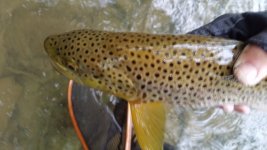
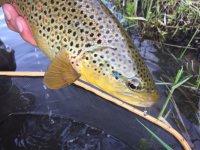
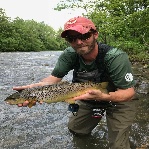
I was getting bored with all the little fish and finally saw a very respectable rise form. I covered the fish twice and it ate the #18 CDC winded Baetis really well. It fought very strongly and ran about 60' of line out. It was very stubborn and when I slipped it into the net I was really surprised, and elated, at how big it was. I waded over close to shore and was able to put a tape on it and it measured 19". A buddy at another forum who fishes there often told me a 19" LJ brown trout is just not an everyday fish and is quite rare.

As soon as I upload the picture from my phone to the PC I will post it.
 
All the browns south of tyrone are wild fish. The little J has almost 20 miles of class a water, Recently water was added above Tipton. There are big fish in the little j and a 19" brown while not caught everyday, will be caught on occassion. I landed a wild rainbow which was 22" below Barree.
 
Here is the picture - it doesn't do justice to the length and girth of the trout. I'm not good holding the fish and trying to press the button on the phone without dropping it in the water. It should look like this.
 

Attachments

  • Little Juniata 091 (640x360).jpg
    Little Juniata 091 (640x360).jpg
    138.2 KB · Views: 16
  • Little Juniata 079.jpeg
    Little Juniata 079.jpeg
    122.9 KB · Views: 14
albud1962 wrote;

There are big fish in the little j and a 19" brown while not caught everyday, will be caught on occassion.

Thanks for the info. It appeared the water I was fishing (below the RR trestle above the Route 305 bridge) had great bug life, relatively cool water for the time of year (I had no thermometer) good bottom structure and very little pressure. I am wondering why there are not more 16" - 19" browns like can be found on the EB and WB of the Delaware. If I fish either of those two rivers for 2 1/2 days I can almost be assured of catching a couple 16" - 18" browns and maybe a 19" - 21".

Might it be because the LJ is a freestone with no year round relatively constant flow regimen and water temperatures while the EB and WB are tail waters with cold water pretty much year round?

Just kind of curious. I could do the LJ as a long day trip while the WB is not a day trip at 3 1/2 hours each way. If there were a more likelihood of seeing good numbers of consistent rising fish during the 8 a.m. to 7 p.m. time period I might go there more often.
 
wbranch wrote:

Might it be because the LJ is a freestone with no year round relatively constant flow regimen and water temperatures while the EB and WB are tail waters with cold water pretty much year round?

The Little Juniata is a limestone stream fed by large springs.

But tailwaters tend to produce larger trout than PA's limestone streams. In all regions of the country, the tailwaters produce big trout.


The LJR is getting something of a reputation as a small fish stream the way Spring is (at least on this board). My experience has been different, I've gotten quite a few fish in the 18" neighborhood there over the years. A 19", while easily the fish of the day, is not the least bit surprising IMO. From what I understand, in the past when water quality was notably worse, the river held even more large fish, albeit fewer fish total.

That's not to say there aren't a lot of small fish there. There are just a lot of fish there overall.
 
Do drought conditions selectively harm larger fish? LJR streamflow was down in the 70 cfs range a number of times during the drought last summer and fall.
 
PenKev wrote;

That's not to say there aren't a lot of small fish there. There are just a lot of fish there overall.

Is it possible there are just too many little 4" - 8" trout in some areas of the LJ that they have to contend with each other for food, and therefore growth, like too many sunnies in a pond. They all get stunted and never get any bigger than 3"-4"?

Where I fished on Monday there were little rise forms everywhere and some were so small that when I set the hook I catapulted them right out of the water and they flew towards me. Kind of funny actually - but boring after a dozen little guys who could barely bend my fly rod.
 
My experience at the LJ has been 10+ years ago lotsa smaller fish. At the time, I (and many other anglers) thought the dinks caught were stocked fingerlings.

Surveys showed the vast majority of trout were wild and the fingerling stocking was halted.

Over the last 5 years or so, the average size of the fish has increased along with the number of lunker trout mixed in.

The cleaning up of the river, the ceasing of stocking and special regs have helped the LJ become what it is today; a quality wild trout fishery able to be mentioned along with all the other well-known Central PA streams.

Nice!...fish on.
 
My belief is that there are fewer dinks over the past few years in the Little J; that is a good area to fish, it gets less pressure
 
The j has a personality of its own, somedays Ill catch nothing but small fish, fish after fish after fish, but all small. Most days I get into the 12-18 class most of the time, but once in a while I get a day of nothing but small fish, its an interesting phenomenon
 
New Sal wrote;

Most days I get into the 12-18 class most of the time, but once in a while I get a day of nothing but small fish, its an interesting phenomenon

Well I guess Tuesday and Wednesday were the little and/or no fish days. This was only my third trip to the LJ in the 32 years I have lived in York. So I am a complete novice on the water and found the RR trestle area only by looking at the stream on Google Earth and looking for parking and access points.

Someone I know on another forum who guides told me that often the LJ is primarily a nymph stream during the day at this time of the year and the fish don't really rise until the hour or so before dark. I fished there Monday night and there were five guys below me and there were just no feeding fish. It did get chilly though so maybe that put off any mayfly emergences. I fished the Frankstown Branch Tuesday evening and there were plenty of Invaria and dorothea they were only five "one & done" rises in the 75 yard section of water I was fishing. I guess I may of just picked a bad time to visit. Not a big deal and I did catch that 19" brown so that kind of made up for lack of rising fish Tuesday and Wednesday morning.
 
wbranch wrote:
New Sal wrote;

Most days I get into the 12-18 class most of the time, but once in a while I get a day of nothing but small fish, its an interesting phenomenon

Well I guess Tuesday and Wednesday were the little and/or no fish days. This was only my third trip to the LJ in the 32 years I have lived in York. So I am a complete novice on the water and found the RR trestle area only by looking at the stream on Google Earth and looking for parking and access points.

Someone I know on another forum who guides told me that often the LJ is primarily a nymph stream during the day at this time of the year and the fish don't really rise until the hour or so before dark. I fished there Monday night and there were five guys below me and there were just no feeding fish. It did get chilly though so maybe that put off any mayfly emergences. I fished the Frankstown Branch Tuesday evening and there were plenty of Invaria and dorothea they were only five "one & done" rises in the 75 yard section of water I was fishing. I guess I may of just picked a bad time to visit. Not a big deal and I did catch that 19" brown so that kind of made up for lack of rising fish Tuesday and Wednesday morning.

I think I may have seen you Tuesday, did you park to fish the Juniata at the flea market?
 
New Sal,

did you park to fish the Juniata at the flea market?

As I mentioned this was only my 3rd trip in 32 years. I have no idea where the flea market is located. I was driving a 2014 forest green Subaru Outback.

Initially I parked at the RR trestle and fished downstream for about 1/4 mile. Then around 1:00 I went back to the Huntingdon Motor Inn where I was staying for lunch and nap.

I decided not to fish the LJ Tuesday evening and instead fished behind the Main Street Café in Alexandria. No action
 
Nice fish Wbranch! I've caught some nice fish on the J and on SPring Creek, I'm not sure why they have the small fish rep.
 
The whole river is great. I've had numerous changes in my favorite spots around the lil j.

I find the Frankstown a bit tough to fish because the access points can be a bit far from each other. Although there is a bike path along it, it can be a couple hundred yards to the stream through the brush. I've caught some trout but you'll also catch plenty of WW fishes. And it gets plenty of bugs too.

I could recommend Bill Anderson's book from the LJRA.
 
I find the Frankstown a bit tough to fish because the access points can be a bit far from each other.


Boy, isn't that the truth! Downstream of where the bike path starts there is virtually no access and no path along the river. It was like a jungle and I literally couldn't get to where I wanted to step into the river due to all the debris (logs, blow downs, high water debris, etc. along the bank) I gave up after ten minutes for fear of tearing my waders.
 
afishinado wrote:
My experience at the LJ has been 10+ years ago lotsa smaller fish. At the time, I (and many other anglers) thought the dinks caught were stocked fingerlings.

Surveys showed the vast majority of trout were wild and the fingerling stocking was halted.

Over the last 5 years or so, the average size of the fish has increased along with the number of lunker trout mixed in.

The cleaning up of the river, the ceasing of stocking and special regs have helped the LJ become what it is today; a quality wild trout fishery able to be mentioned along with all the other well-known Central PA streams.

The Little Juniata River has been an excellent wild brown trout stream for a long time.

The paper mill changed its operations, which made the water much cleaner, around 1970, so about 47 years ago.

And I was told by several local people that even when the river was dark and smelly from the papermill effluent that it held lots of big browns.

From their descriptions, there were more big trout in the river then than in more modern times. And I don't doubt that at all.

I've seen that scenario on several streams. When streams are polluted in ways that make them look and smell bad, but the trout are still there, often very very few people fish the stream, so the trout grow for years and get big.

 
FYI:
The current ownership/management of the paper mill is doing wonders, compared to their predecessors, to improve the J.
They stopped spraying (misters) near boiling over the pond behind the dam reducing thermal pollution- they eliminated the boilers that generated it
They freed up a major spring that was diverted in the 1930s so that it now enters upstream and cools and improves water farther upstream than before. This was important to protect trout in the upper reaches during last year's drought
They have taken measures to greatly reduce their water use(over 400%)
They are cooperating with efforts and paying half the costs of a design and feasibility study exploring the possibility of installing fish barrier passage at the dam to restore trout migration into the bald eagle and grant access to many spawning tribs
They are open to conversations about modifying the dam to allow bottom release (long term possibility- when they perform the next scheduled maintenance).

See the LJRA website for more information and the American Eagle Paper company website has a page describing their efforts to be more environmentally responsible.
 
Back
Top