Little Juniata, Huntingdon Co., 6/07/2015

Biggie

Active member
Joined
Sep 16, 2006
Messages
899
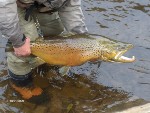
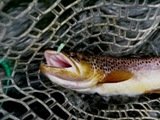
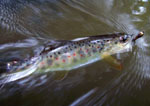
Fished below the gorge parking lot to the bridge from noon till about 5 PM. Water was slightly discolored. Didn't take a temp reading. The water is at a low level for this time of year. Started off with golden stones, black leaches, and pheasant tails with no hits. Saw very few risers so I stayed underneath. Tied on the Douple Worm and it was on. Landed double digits and lost at least 10. This is a pic of one of the better browns. This fly is the best subsurface fly I have ever used on the LJ.
 

Attachments

  • little J  June 2015 004.JPG
    little J June 2015 004.JPG
    28.9 KB · Views: 16
I'll be seeing Mr Douple next week and I'll let him know his inchworm still has its fans. I am a big fan and had very good success myself last week on some big Centre County waters.

Nice report.
 
May I ask what the difference is between a Double Worm and a Green Weenie ?
I was on the LJ in May and tried the Green Weenie with no luck.
 
I'll give you my differences which may differ from others but Don Douple was my mentor and taught me how to tie and fish them, so you decide. (Edit: Now tying this fly is simply wrapping chenille around a hook so how much did he need to teach me? Well when Don taught me curved hooks were not really on the market yet so he taught me how to bend the hooks to the proper shape.)

Three things differ and my added point.

First is the material which is hard to find but definitely important although may not be as important as 2 and 3 below. It is cotton chenille dyed Neon green. Don's theory is that the cotton feels more natural when the fish bite it and they "may" hold it a faction of a second longer.

Second, it should always be tied on a bent hook like a Tiemco 2457 in size 6.

Lastly, there is no tail.

Now my added point is never to weight the fly and only fish it with shot about 16 to 18 inches above the fly. I think weight takes away from the action of the fly which, in my opinion, needs to spin freely in the water. Now I base this on personal experience where I was fishing the same run with another guy who tried to improve the fly by using tungstun wire wrapped under the material. I hooked maybe 10 fish (give or take) in the run and he hooked 1. He switched to one without the tungstun and immediately started to hook fish. We are both capable nymph fisherman and the only difference was his added weight.

For what it's worth.

Also, like any fly confidence is key. I know the fly works and I'll fish it longer without switching because I know it's only a matter of time. This is true with any fly you've caught fish on not just the Inchworm or as Don now calls it, the "greenie worm". I know guys that excel with the traditional Green Weenie tied with weight and tails, so don't under estimate confidence in a fly pattern.

 
Another thought just occurred to me about the material. The cotton soaks up water more than synthetic material and may move more naturally in the water. But that's just my hair-brained theory.
 
Thank you for your detailed description on how to tie and fish the "Double Worm". I have never heard of it.
I have caught many fish through the years with what I have called a Green Weenie. When I have tied them I never put a tail on it. I have tried weighting the fly, also tried to get them to float. I can also remember bending the shaft of the hook at times to see what would happen.
I will definitely give your method a try !
Thanks Again !
 
Foxgap pretty much nailed it with the greenie worm. Fox say thanks for me to Mr. Douple. My fishing buddy learned to tie it from Don. So far, its the only fly I tie, can't buy it anywhere. I'm getting ready to dye a batch of chenniel this week. Since the neon green isn't available any more I am trying a mixture of two colors. I think that color is a big part of the success of the worm.
 
The green worm on a curved hook accurately mimics the Ryacophila larvae, the greenrock worm and really not the inchworm that falls from trees this time of year, just to clarify things a bit for some folks.
 
Im assuming that is Don Douple's honeybug inchworm? His magic fly as he decries magic flies. He said if there is one, this is it. I don't go through the process of dying my own cotton chenille. He told me it was "Chartreuse Lime" if I recall, that was the best color. I just use super vernille in the closest color. They work all the time but seem to REALLY work when fishing seems dead. Now that could be perceptual as Any fish on a dead day is a moment of joy. But I have gone on a tear upon switching to the inchworm when previously nothing was working. Some days it almost seems unfair, almost!
 
Biggie wrote:
.... I'm getting ready to dye a batch of chenniel this week. Since the neon green isn't available any more I am trying a mixture of two colors. I think that color is a big part of the success of the worm.

Oh, it's available.....

Rit #21 Neon Green

It's just not available in the little boxes anymore.

Just pony up the $30, and save yourself the headache. It'll give you religion. Been there, done that. We DID duplicate the color, but I have no idea what the proportions were. We started out with 4 parts mint green, and one part #1 yellow, but kept adding until it looked right. Took forever.....

FWIW, Don taught me how to tie the greenie worm before he started tying it on scud hooks. It worked well tied on a sz 12 2XL nymph hook too. I still use both variations, but the bigger hook gap of the scud hook is definitely an advantage.
 
blueheron wrote:
The green worm on a curved hook accurately mimics the Ryacophila larvae, the greenrock worm and really not the inchworm that falls from trees this time of year, just to clarify things a bit for some folks.

On a size 6 hook???
 
The 2457 is a short shank hook.

Trust da Fox. I'd say something smartazz like "Only his hairdresser knows for sure...", buuuttttt...... 😎
 
I will refrain from comment although I will say it takes me longer to tie the inchworm than for my barber get me out of his chair! :-D

I actually tie these in 3 sizes of the 2457 (although I do now use the Allen version since it's cheaper and offset). 6 and 8 for bigger waters and size 12 for streams like VC. I tie it halfway down the bend too and get that nice curved look. The other pointer I would give is to strip fibers off the end of the chenille so you are only tying the thread strands with no bulk to the hook shank. This way when you wrap it, you'll get a nice consistent body shape.

I do agree that most fish probably take these as the rockworm but in those very same streams I've had quite a few hook-ups just after it hits the water as I'm sure an actual inchworm would do. It's not really important to me what they think it is as long as they continue to see it as food! The other thing that I realized while reading this thread is that I don't think I've ever fished this fly on anything but limestone waters. Has anyone had success on freestones with it?
 
Yes, the rockworm is all over the Poconos. I was with Don Baylor when he did a kick survey and was surprised at the size of the Ryco larvae, easily a size 6 and I use the Mustad 37160, the English bait hook.
 
Foxgap239 wrote:

Has anyone had success on freestones with it?

They are murder on freestoner wild trout streams, during the period when the inchworms are out. Which is about mid-may to mid-October, about 5 months.

On smallish shallow streams, you can fish them with no weight it all. The fish hit it right on the drop, just like fishing other terrestrials.

If you come to a particularly deep pool, add a removable split shot to run it deep.

Then if you're back to shallower pools and pockets, just take the splitshot off again.


I also think at times the green weenie can imitate an inch worm. I was on honey creek at one point, and kept on finding inch worms stuck to me and hanging from trees. So I switched from the pheasant tail I was using to a weenie, and the fish were taking it immediately upon hitting the water! If I didn't get a take right after casting I didn't seem to get any takes on the drift.

I have also turned up some surprisingly large green rock worms! Easily as big as a #6 nymph with no tail, or a tailed green weenie tied on a #10 or 12 hook.
 
The first inchworm pattern I remember was from Charlie Meck, The Green Weenie. I have fished the pattern all over NW PA and even down into North Carolina, South Carolina and East Tenn. and it has always caught fish. Maybe not in great numbers but you could always pretty much count on it for a few fish. I actually won a trophy one time fishing the Green Weenie... Long story.
 
Back
Top