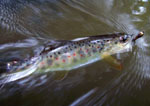
Nymphed from 8:45-11:30 AM. Water had the slightest cloudiness and was 63F. Caught 4 BT and lost 3 BT while being retrieved. Trout were captured on Copper Johns and black ants. Despite the warm weather for most of the preceding week and serious doubts on my part that trout would have survived it in the stretch that I fished, I intentionally selected that stretch over another that receives obvious springs and stays a bit cooler in hot weather (based on my longitudinal temp survey of the past) just to learn whether the trout were able to tolerate the warm spell.
Noteworthy was that despite the overwhelmingly high number of RT stocked vs BT, if one combines my recent string of reports with today’s fish, it’s obvious that most of the RT are gone. This is precisely what I describe in other cases when RT are stocked in other streams over Class A Wild BT populations located in urban/metro areas. Specifically, I’m referring to Monocacy and Ltl Lehigh. The pressure is high enough and the RT vulnerably great enough that they do not last long when harvest and C&R mortalities combine to take their toll. And even in the Jordan stocked trout only scenario, the stocked BT despite being stocked at low to relatively low rates depending upon the specific spring stocking we’re speaking about have survived the heavy April and early May pressure to the extent that my catch rates are still quite acceptable.
This also fits to an extent with my previous management of stocked Class C or Class B wild BT streams in York Co (with good physical habitat and not just some random wild trout stream) where I intentionally eliminated BT stocking in favor of 100% RT stocking (and in some cases reduced stocking frequency too) in order to give the wild BT pop the best chance to achieve Class A status. Choosing the right streams with appropriate habitat there was 100% success…3 streams, 4 sections, although in honesty one success might have occurred anyway.
Noteworthy was that despite the overwhelmingly high number of RT stocked vs BT, if one combines my recent string of reports with today’s fish, it’s obvious that most of the RT are gone. This is precisely what I describe in other cases when RT are stocked in other streams over Class A Wild BT populations located in urban/metro areas. Specifically, I’m referring to Monocacy and Ltl Lehigh. The pressure is high enough and the RT vulnerably great enough that they do not last long when harvest and C&R mortalities combine to take their toll. And even in the Jordan stocked trout only scenario, the stocked BT despite being stocked at low to relatively low rates depending upon the specific spring stocking we’re speaking about have survived the heavy April and early May pressure to the extent that my catch rates are still quite acceptable.
This also fits to an extent with my previous management of stocked Class C or Class B wild BT streams in York Co (with good physical habitat and not just some random wild trout stream) where I intentionally eliminated BT stocking in favor of 100% RT stocking (and in some cases reduced stocking frequency too) in order to give the wild BT pop the best chance to achieve Class A status. Choosing the right streams with appropriate habitat there was 100% success…3 streams, 4 sections, although in honesty one success might have occurred anyway.
Last edited: