Frustrating hatch last evening

NRD

Active member
Joined
Nov 20, 2021
Messages
135
City
Selinsgrove, PA
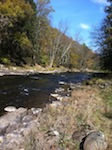
After sitting around all of September waiting for rain, I relented and went to Penns yesterday afternoon. From about 5:45 to 6:45 I fished over particularly aggressive feeding trout. Definitely more than 10% of the eats saw fish completely leaving the water, usually vertically. I never did figure out what they wanted.

My leader was roughly 12' from line to fly. The water was slow. I was getting long drag free drifts. There were at least two regular feeders withing 20' of where I stood. There was a light hatch of tan mayflies for maybe 20 minutes in the middle of this action.

I tried: Black Cricket, BWO, Caddis, Caddis Emerger, smallish Slate Drake, and a couple other random emerger patterns. I caught a couple small fall fish and a decent SMB, all on the BWO.

When I suspect I've only got an hour, should I change more often? I wanted to put a good drift over every fish I could reach, and that left me suspecting I lost a lot of time fishing the wrong flies. I though about midges, but was reluctant to believe fish would expend that much effort for such small food.

About 6:45 an otter joined me and completely put the fish down. It swam up to within about 30' of me to look me over. Even after I alerted it, it was still there swimming around 100 yards upstream as I left.
 

Attachments

  • Otter1.mp4
    3.3 MB
I you sure it was an otter? From the brief video, I think it's more likely that it was a beaver?

What size caddis did you use? With slow moving water, you generally do better with a small pattern (size 16) than a larger pattern.

The fact that you caught fallfish and a smallmouth probably indicates that Penns Creek got very warm during the drought and both the trout and warmwater fish shifted upstream.

I've seen that before. I've caught smallmouth near the PFBC cabin, and saw a smallmouth at the footbridge at the tunnel above Poe Paddy campground. In that same year someone told me they caught a smallmouth not far below Coburn.

During hot, dry weather Penns Creek sometimes goes over 80F.
 
I didn't see any caddis in the air or on the water, but I went there fairly quickly, because I've done well with caddis in my short 5 years of fly fishing. Both my tan caddis and dark green caddis emerger were size 16, I think. Why can't hooks be made to a measurable standard?

Next time I find myself in a similar situation, I'll go to a dropper rig as soon as I fail a first attempt at a surface hookup.

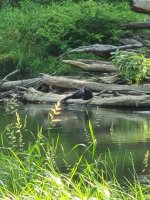
I was also asking myself if it was an otter or a beaver. My thin evidence for calling this an otter is:
1. I've seen a 100% certain otter about a mile from this spot.
2. This critter entered the creek about 100' upstream from me and slowly swam a 1/3 circle around me. At that point, it actually started swimming towards me, coming within about 30' before changing its mind. It returned about 1/4 circle and then turned to make another pass. Photos didn't bother it, but seconds after starting video it retreated. It never disappeared. It just kept swimming around upstream of me till I left. I felt like it was also going to do some fishing. I've not seen a lot of beavers, but they always seemed much more skittish than this creature.
3. I haven't noticed any chewed trees in this area.
 

Attachments

  • Otter.jpg
    Otter.jpg
    211.6 KB · Views: 168
I didn't see any caddis in the air or on the water, but I went there fairly quickly, because I've done well with caddis in my short 5 years of fly fishing. Both my tan caddis and dark green caddis emerger were size 16, I think. Why can't hooks be made to a measurable standard?

Next time I find myself in a similar situation, I'll go to a dropper rig as soon as I fail a first attempt at a surface hookup.

I was also asking myself if it was an otter or a beaver. My thin evidence for calling this an otter is:
1. I've seen a 100% certain otter about a mile from this spot.
2. This critter entered the creek about 100' upstream from me and slowly swam a 1/3 circle around me. At that point, it actually started swimming towards me, coming within about 30' before changing its mind. It returned about 1/4 circle and then turned to make another pass. Photos didn't bother it, but seconds after starting video it retreated. It never disappeared. It just kept swimming around upstream of me till I left. I felt like it was also going to do some fishing. I've not seen a lot of beavers, but they always seemed much more skittish than this creature.
3. I haven't noticed any chewed trees in this area.
How was the water temperature? I’m sure with all this rain in pa penns should fish better this weekend. As far as flies, I like a foamerger in size 18-22 but yeah hook sizing is very inconsistent. Big shout out to tactical fly fisher for posting every hook model and size in mm on their website.
 
I you sure it was an otter? From the brief video, I think it's more likely that it was a beaver?

What size caddis did you use? With slow moving water, you generally do better with a small pattern (size 16) than a larger pattern.

The fact that you caught fallfish and a smallmouth probably indicates that Penns Creek got very warm during the drought and both the trout and warmwater fish shifted upstream.

I've seen that before. I've caught smallmouth near the PFBC cabin, and saw a smallmouth at the footbridge at the tunnel above Poe Paddy campground. In that same year someone told me they caught a smallmouth not far below Coburn.

During hot, dry weather Penns Creek sometimes goes over 80F.
Penns creek angler posted today temps between 57-64. Can’t verify but probably a good chance Penns is okay temperature wise
 
I saw an otter in the Broadwaters on Penns in the spring. The ears on that critter in your video look more like a beaver. The still photo i would say is an otter. If you were fishing that slow water at this time of year i think you were really up against it regardless of the pattern you were using. That is just tough conditions especially on a stream like Penns.
 
If you were fishing that slow water at this time of year i think you were really up against it regardless of the pattern you were using.
This.

Fish the faster water until flows come up a bit. The slow water is too slow and too low right now. It makes it really tough.

I've seen numerous beavers and otters on Penns but only beavers this year.
 
If you changed flies at least six times in an hour you didn't fish very much at all. I prefer to select a known producer (of course try to replicate the insects on the water) and then stick to it at least 10 minutes. Were you above the rises making slack line downstream presentations? Were you using at least 5X? Sometimes we think we are getting perfect drifts but there may be micro drag issues we just can't see. I've been known to cast for at least half an hour, with maybe only one fly change, if I know the target is a big fish.
 
If you changed flies at least six times in an hour you didn't fish very much at all. I prefer to select a known producer (of course try to replicate the insects on the water) and then stick to it at least 10 minutes. Were you above the rises making slack line downstream presentations? Were you using at least 5X? Sometimes we think we are getting perfect drifts but there may be micro drag issues we just can't see. I've been known to cast for at least half an hour, with maybe only one fly change, if I know the target is a big fish.
+1 ^
 
I had a mink do that to me yesterday , was looking for craws in my next riffle . Couldn't even be mad was pretty neat .
 

Attachments

  • IMG_2056.png
    IMG_2056.png
    866.1 KB · Views: 128
After sitting around all of September waiting for rain, I relented and went to Penns yesterday afternoon. From about 5:45 to 6:45 I fished over particularly aggressive feeding trout. Definitely more than 10% of the eats saw fish completely leaving the water, usually vertically. I never did figure out what they wanted.

My leader was roughly 12' from line to fly. The water was slow. I was getting long drag free drifts. There were at least two regular feeders withing 20' of where I stood. There was a light hatch of tan mayflies for maybe 20 minutes in the middle of this action.

I tried: Black Cricket, BWO, Caddis, Caddis Emerger, smallish Slate Drake, and a couple other random emerger patterns. I caught a couple small fall fish and a decent SMB, all on the BWO.

When I suspect I've only got an hour, should I change more often? I wanted to put a good drift over every fish I could reach, and that left me suspecting I lost a lot of time fishing the wrong flies. I though about midges, but was reluctant to believe fish would expend that much effort for such small food.

About 6:45 an otter joined me and completely put the fish down. It swam up to within about 30' of me to look me over. Even after I alerted it, it was still there swimming around 100 yards upstream as I left.
I have a slightly different take on your evening. I’ve experienced the same thing, but when I start catching chubs, sunnies or a SMB- I know my fly is working and looks natural for the stream. I keep fishing a fly that’s working and often (not always) I eventually land the targeted trout.

Regarding the “otter” or “beaver”… I’ll add a third: it likes like a muskrat to me. It really doesn’t matter…that’s a very cool video and you saw it live and I’m sure over a longer time period than the video, so, otter is good to me. I’ve also seen a mink this year while fishing and agree with Streammajic237’s comment.
 
Last year, I had a similar situation on a river in Maine. Fish were eating, and I was not catching. Caddis were coming off, but the fish weren't taking the adult caddis flies. What I did was I ran a double dry setup with a adult caddis as a sighter, and a smaller emerger pattern that I found worked up there. Probably a size 20 emerger, which is quite difficult to see in the tannic waters I was fishing.

In the area I was fishing, the current was consistent enough that a double dry worked just fine, and ended up catching a bunch of brook trout.
 
Yo NRD - I would have tried a spinner. Mayfly spinners often come down upstream from you, and unless birds, bats and dragonflies are seen hunting them, you may not have anything easy to see in the late day. Black caddis that OO mentioned are more prevalent than folks realize - they are very hard to see in the air. Though the dancing motion is hard to imitate, I've often done well using it as a searching fly in the summer/fall.
 
The truth is, I struggle to catch wild pressured fish. I perfectly willing to target the easier ones in the riffels, but I also want to learn to catch the difficult ones in the flat water. All advice above will be taken into consideration.
Addressing some of the points above:

I was casting to fish directly upstream, directly across the stream, and quartering downstream. The water where I was standing was flowing very slowly. There was no wind at this time. I was never casting across faster currents which spoil a good drift. The bass was caught at the end of a downstream quartering drift just after the fly started to drag. Are trout smarter than bass?

Most casts were in the range of 20-40'. I was using my default 4x tippet on the end of a hand tied leader. The last 2' of this leader tends to collapse creating additional slack for drag free presentations. My flies were tracking along with the foam and leaves on the water for long drifts. I didn't see any other bugs on the water with enough light to see anything that wasn't black. Even during the brief tan mayfly hatch, I only saw them in the air.

I like the black caddis emerger theory, and will try to test it out next week. Unless I just drag streamers through this pool.

Thanks for all comments, including pointing out that my otter was probably a beaver : )
 
The truth is, I struggle to catch wild pressured fish. I perfectly willing to target the easier ones in the riffels, but I also want to learn to catch the difficult ones in the flat water. All advice above will be taken into consideration.
Addressing some of the points above:

I was casting to fish directly upstream, directly across the stream, and quartering downstream. The water where I was standing was flowing very slowly. There was no wind at this time. I was never casting across faster currents which spoil a good drift. The bass was caught at the end of a downstream quartering drift just after the fly started to drag. Are trout smarter than bass?

Most casts were in the range of 20-40'. I was using my default 4x tippet on the end of a hand tied leader. The last 2' of this leader tends to collapse creating additional slack for drag free presentations. My flies were tracking along with the foam and leaves on the water for long drifts. I didn't see any other bugs on the water with enough light to see anything that wasn't black. Even during the brief tan mayfly hatch, I only saw them in the air.

I like the black caddis emerger theory, and will try to test it out next week. Unless I just drag streamers through this pool.

Thanks for all comments, including pointing out that my otter was probably a beaver : )
In addition to my caddis emerger theory above I’d extend the following pointers if you’re hell bent on catching these “difficult fish”.

At these low water levels I’d start by extending that hand tied leader of yours with 15-20” of 5x and right on down to 24” of 6x (use good quality fluorocarbon like Cortland or Soldarini and there are very few Penns fish that will challenge its ~4lb test rating). You can always cut off the 6x, but I like running small flies in low water. Generally if the fly shop says to fish a 16-18, try a 20. You’ll very rarely be rejected for presenting a fly that is a bit too small, but almost always get rejected for presenting a fly that is too large.

In terms of your fly selection, I’d focus on patterns that either ride surface flush or better yet down a little into the film. The fish should not have to break the surface to consume the body of the fly. Keep patterns small and simple with fishy materials like CDC, dubbing (or even just thread), Z-Lon or Antron for trailing shucks, EP trigger point fingers, comparadun hair, and even a bit of XS wire for a bit of sink. Variations of puffys, smokejumpers (with a few wraps of XS wire to really sink them a bit) in olive and zebra midge colors, rusty and ginger spinners tied with CDC wings, half and half (PT) emergers, and CDC/elk caddis (or something like the F Fly) etc will be your best shot at tricky fish. Again, I’d be fishing size 20’s and smaller, 16 is huge for most anything this time of year.

The last item might very well be the most important:

Shift your approach to targeting these fish from upstream, fishing down to the trout. The more directly above them you can get in the same feeding lane (wading with stealth of course), the better chance you have of giving them a “fly first” drag free presentation. This way they don’t see the tippet or any other elements of your rig prior to seeing the bug. If you can’t get directly above them effectively, employ a reach cast and build the necessary slack into the drift with an aerial mend prior to landing the fly/flies. It takes some getting used to but IMO its the best way to target surface feeding trout on any river in the world. In many places (such as the Upper Delaware), it’s frequently the only way.
 
Last edited:
Shift your approach to targeting these fish from upstream, fishing down to the trout. The more directly above them you can get in the same feeding lane (wading with stealth of course), the better chance you have of giving them a “fly first” drag free presentation. This way they don’t see the tippet or any other elements of your rig prior to seeing the bug. If you can’t get directly above them effectively, employ a reach cast and build the necessary slack into the drift with an aerial mend prior to landing the fly/flies. It takes some getting used to but IMO its the best way to target surface feeding trout on any river in the world. In many places (such as the Upper Delaware), it’s frequently the only way.

+1 Although I'm not in favor of casting dry to rising fish directly below me. I only fish dry and only fish the WB, main stem Delaware, or the Missouri. No where else. I much prefer to be at an angle to the rise form. At least 15 degrees to either side of the rise form. I do this because the fish will never be disturbed when you do a pick up for the next cast. Your leader and fly line will never be in the trouts window of vision. All fly fishers who can embrace this technique will get better results. Sometimes when I am in my Hyde I have fish rise right off the boat and I can't get that angle so I have to cast at 90 degrees from the boat. Then let the fly/leader/line float past the rise form before picking up. I never throw up stream to a rising fish because on the waters I fish it's a waste of time. All the trout start laughing.
 
Shift your approach to targeting these fish from upstream, fishing down to the trout. The more directly above them you can get in the same feeding lane (wading with stealth of course), the better chance you have of giving them a “fly first” drag free presentation. This way they don’t see the tippet or any other elements of your rig prior to seeing the bug. If you can’t get directly above them effectively, employ a reach cast and build the necessary slack into the drift with an aerial mend prior to landing the fly/flies. It takes some getting used to but IMO its the best way to target surface feeding trout on any river in the world. In many places (such as the Upper Delaware), it’s frequently the only way.

+1 Although I'm not in favor of casting dry to rising fish directly below me. I only fish dry and only fish the WB, main stem Delaware, or the Missouri. No where else. I much prefer to be at an angle to the rise form. At least 15 degrees to either side of the rise form. I do this because the fish will never be disturbed when you do a pick up for the next cast. Your leader and fly line will never be in the trouts window of vision. All fly fishers who can embrace this technique will get better results. Sometimes when I am in my Hyde I have fish rise right off the boat and I can't get that angle so I have to cast at 90 degrees from the boat. Then let the fly/leader/line float past the rise form before picking up. I never throw up stream to a rising fish because on the waters I fish it's a waste of time. All the trout start laughing.
Yeah, our central PA limestone (and limestoner-adjacent) rivers usually have that wonderful greenish murk to them that makes upstream presentations more successful, but in these early fall pi*s low conditions, I suspect the Broadwaters probably are fishing more like the gin clear Catskill waters of Methodist or Junction pool - and techniques, fly selections and presentations successful on the latter will only help here as well.

Good news is we’re currently getting a decent shot of rain which should get everything stirred up a little. The next time he fishes it could very well be a totally different scene. Such is the joy of Penns. Get those streamers ready
 
Last edited:
I'll give the finer tippets a try, and I needed the reminder about setting up so the fly leads downstream. After throwing cicadas on Penns and hoppers in CO this summer, that detail was stuck somewhere in the back of my mind.
 
Back
Top