Alnitak
Member
- Joined
- Jan 6, 2014
- Messages
- 314
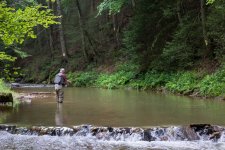
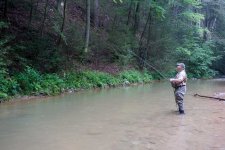
Yesterday I met up with englishprof and fadeaway263 to fish the lower portion of Fishing Creek in southern Lancaster County. Fishing Creek is a beautiful stream; we fished the property primarily owned by the Lancaster County Conservancy between Furniss Road (SR 434) and Fern Glen Drive (SR 444). Its an ATW water but it has a healthy population of wild brown trout. The PFBC stocks the stream with Rainbows and Browns.
The stream is in a heavily forested gorge and many of the areas bordering the stream--especially on the north-facing slopes--are covered in hemlocks. The stream is rated as an Exceptional Value stream by the PA DEP and has very good populations of macro invertebrates. It does receive fishing pressure from locals because of the ATW status, but that dies off by this time of year. The deep pools are also heavily used by locals for swimming on weekends, but only the ones near the road.
Speaking of the road, Fishing Creek Road parallels the stream through this section which stretches for almost exactly three miles. Its a gravel road full of potholes and it crosses the stream three times using concrete-lined fords. If you have a regular car make sure its got good clearance if you want to drive in here.
The weather called for "passing light showers" in the morning and a mostly cloudy afternoon. Unfortunately the showers were less "passing" than that, and for much of the first three hours of the day it rained on and off. The water rose and was silty although it was passable for fishing. It was also cold at 60.4F.
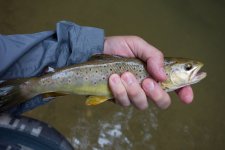
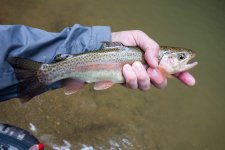
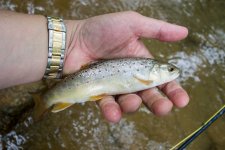
We started out fishing a variety of traditional patterns--I was using a BH flash hare's ear with a small inch worm dropper. After 30+ minutes of fishing without any bites, I switched out to BH flashback pheasant tail and dropped a hot pink San Juan which typically works well after a rain. That did the trick and I quickly landed three fish from one pool--the first a nice 12" wild brown and the next two were 13" and 14" stocked rainbows. I hiked down to where the other two were and sent them up to the spot I was at and told them what was working. Englishprof quickly had two wild browns.
We then took a brief break for lunch and fished a short section downstream of where we started. I believe fadeaway 263 had a wild brown or two in that stretch and englishprof caught a large wild brown in a fast run. After about 30 minutes we had hit the nearby pools so we moved upstream. I hooked a large wild brown and lost it and then landed a little 8" from the same pool. Upstream of me just a bit fadeaway lost a large rainbow and englishprof then managed to hook the same fish as fadeaway tied on a new rig.
At that point I had 8 fish total--six wild browns, mostly small, and two stocked rainbows. I believe englishprof had a similar number of fish and fadeaway had a smaller total. They had to head home, as did I, but I managed to find an area with cell signal and got permission from She Who Must be Obeyed to stay out for two more hours. 😀
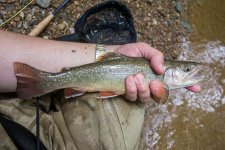
I moved upstream to the next set of promising pools and rolled a big brown and then followed that up with two nice rainbows in quick succession--one was 15" and the other 14". Further upstream I got into a nice patch and caught several small wild browns before coming to a nice pool that starts with a long fast run. I fished it from the back end and and hooked and lost a large brown; after a few rod-bending runs of the pool it broke my 5x tippet. Working further up that pool I followed up with a 13" stocked brown then two rainbows, one 14" and one 13". The last fish I pulled from that pool was a complete surprise--it was a 14" brookie, nice and fat and with a developing hook jaw. It must have managed to slip in with the rainbows and brown trout. It gave me a "stocker trifecta" in a single pool--that was a first.
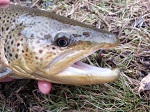
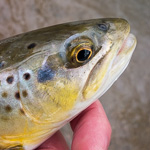
Upstream of that I rolled one more brown and then caught a little 6" wild brown to cap the day. Overall it wasn't a bad day, although the rain and subsequent cloudy water got it off to a weak start. I ended up with 16 fish, 8 wild browns, 6 stocked rainbows, one stocked brown and the misfit stocked brookie.
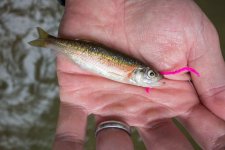
The last photo is a little Rosy-sided Dace. They are an uncommon fish in PA and this is one of only a few streams I've seen them in. They are aggressive and will hit a dry fly that's almost the same size as them--or try to eat a San Juan that's as long as they are. Fishing Creek is also home to another small fish that's quite rare--the Chesapeake Logperch. It's on the IUCN list of threatened species and is found only in the lower reaches of the Susquehanna and some tributaries on PA and MD.
Jeff
The stream is in a heavily forested gorge and many of the areas bordering the stream--especially on the north-facing slopes--are covered in hemlocks. The stream is rated as an Exceptional Value stream by the PA DEP and has very good populations of macro invertebrates. It does receive fishing pressure from locals because of the ATW status, but that dies off by this time of year. The deep pools are also heavily used by locals for swimming on weekends, but only the ones near the road.
Speaking of the road, Fishing Creek Road parallels the stream through this section which stretches for almost exactly three miles. Its a gravel road full of potholes and it crosses the stream three times using concrete-lined fords. If you have a regular car make sure its got good clearance if you want to drive in here.
The weather called for "passing light showers" in the morning and a mostly cloudy afternoon. Unfortunately the showers were less "passing" than that, and for much of the first three hours of the day it rained on and off. The water rose and was silty although it was passable for fishing. It was also cold at 60.4F.
We started out fishing a variety of traditional patterns--I was using a BH flash hare's ear with a small inch worm dropper. After 30+ minutes of fishing without any bites, I switched out to BH flashback pheasant tail and dropped a hot pink San Juan which typically works well after a rain. That did the trick and I quickly landed three fish from one pool--the first a nice 12" wild brown and the next two were 13" and 14" stocked rainbows. I hiked down to where the other two were and sent them up to the spot I was at and told them what was working. Englishprof quickly had two wild browns.
We then took a brief break for lunch and fished a short section downstream of where we started. I believe fadeaway 263 had a wild brown or two in that stretch and englishprof caught a large wild brown in a fast run. After about 30 minutes we had hit the nearby pools so we moved upstream. I hooked a large wild brown and lost it and then landed a little 8" from the same pool. Upstream of me just a bit fadeaway lost a large rainbow and englishprof then managed to hook the same fish as fadeaway tied on a new rig.
At that point I had 8 fish total--six wild browns, mostly small, and two stocked rainbows. I believe englishprof had a similar number of fish and fadeaway had a smaller total. They had to head home, as did I, but I managed to find an area with cell signal and got permission from She Who Must be Obeyed to stay out for two more hours. 😀
I moved upstream to the next set of promising pools and rolled a big brown and then followed that up with two nice rainbows in quick succession--one was 15" and the other 14". Further upstream I got into a nice patch and caught several small wild browns before coming to a nice pool that starts with a long fast run. I fished it from the back end and and hooked and lost a large brown; after a few rod-bending runs of the pool it broke my 5x tippet. Working further up that pool I followed up with a 13" stocked brown then two rainbows, one 14" and one 13". The last fish I pulled from that pool was a complete surprise--it was a 14" brookie, nice and fat and with a developing hook jaw. It must have managed to slip in with the rainbows and brown trout. It gave me a "stocker trifecta" in a single pool--that was a first.
Upstream of that I rolled one more brown and then caught a little 6" wild brown to cap the day. Overall it wasn't a bad day, although the rain and subsequent cloudy water got it off to a weak start. I ended up with 16 fish, 8 wild browns, 6 stocked rainbows, one stocked brown and the misfit stocked brookie.
The last photo is a little Rosy-sided Dace. They are an uncommon fish in PA and this is one of only a few streams I've seen them in. They are aggressive and will hit a dry fly that's almost the same size as them--or try to eat a San Juan that's as long as they are. Fishing Creek is also home to another small fish that's quite rare--the Chesapeake Logperch. It's on the IUCN list of threatened species and is found only in the lower reaches of the Susquehanna and some tributaries on PA and MD.
Jeff