Fishing Creek, Lancaster County 4/23

JeffP

Well-known member
Joined
Nov 21, 2007
Messages
1,398
City
Lititz, Pa
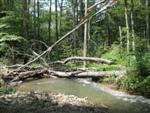
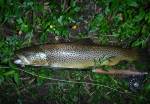
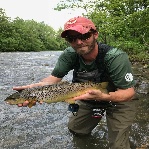
We stopped at Fishing Creek for an hour. I caught a native brown on a sulfur. I saw a few tiny risers. It was the first time I fished there. It was a bit smaller than I thought but a pretty stream.

 
Here is a picture of the Fishing Creek native.
 

Attachments

  • Fishing Creek Brownie.jpeg
    Fishing Creek Brownie.jpeg
    88.7 KB · Views: 21
Despite being a popular stocked trout stream, Fishing Creek’s wild trout population has very substantially expanded its range over the decades. Formerly it was pretty much limited to the upper end of Section 02. Now it extends from there to the mouth as best as I could tell from doing relatively recent surveys near the upper end of the section, a couple of miles downstream from there, and near the mouth. Objectively speaking, however, it is equally possible that the stretch in between lacks wild trout and that they only reappear near the mouth. Nevertheless, the wild trout population has improved in density at the upper end of Section 02 and the population’s range has expanded since the 1970’s and 1980’s.

Side notes : 1. Some tribs also support low densities of wild browns. 2. The upper portion of Section 02 plus three tribs are involved in the early stages of a multi-agency, including the PFBC, multi-farm study of various agricultural best management practices and their impact to the tribs and Fishing Ck. The PFBC is evaluating changes, if any, in the wild trout population above and below the Fishing Ck stretch that receives the three tribs. Obviously, the info generated should further inform the Chesapeake Bay restoration effort.
 
Mike wrote:
The upper portion of Section 02 plus three tribs are involved in a multi-agency, including the PFBC, multi-farm study of various agricultural best management practices and their impact to the tribs and Fishing Ck. The PFBC is evaluating the response of the wild trout population above and below the Fishing Ck stretch that receives the three tribs. Obviously, the info generated should further inform the Chesapeake Bay restoration effort.

Interesting!

Please keep us informed on this study.
 
Now Southcentral AFM, Bryan Chikotas, and I set up the PFBC portion of the study when he was working with me at the SE AFM Office. It will be up to my successor, whomever that will be, to complete the study. If I hear of the results in the future, I’ll let you know. I think it will be a long process, however, as quantifiable responses take time, as do the implementation of substantial BMP’s on multiple farms on multiple tribs.

This is pretty typical, as it is another one of those projects in which the PFBC is involved that can positively impact wild trout populations, but for the most part the public, other than perhaps the locals, may not hear about them. As I have said before, the staff is small and they are generally so busy doing the work that needs to be done that promotion is a time luxury that they often can’t afford.
 
That's great! I was impressed with the creek. Thought I saw a couple natives in with the 20 stockers at the bridge pool. Seemed to have a nice forage base of dace, chubs, and other minnow life.
 
Those streams that are tribs to the lower river have very good forage bases, even in fall, winter, and early spring, which most likely helps to maintain good body condition and growth rates. Tribs without natural or man-made barriers to spotfin shiner migration see a substantial seasonal influx of spotfin shiners sometime in fall. This adds to the already good forage base. This also occurs in the Schuylkill, at least from Reading downstream well into Montgomery and Chester Counties.
Recall also that much of the lower Susquehanna R is influenced by dams and that the water backed up by the dams also impounds the lower quarter mi to 1 mi of the larger tribs. Trout in the tribs don’t need to necessarily go to the river to find good winter forage; the river and its forage come to them.
 
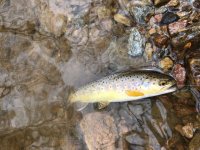
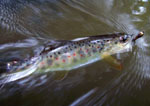
A non-fly fishing friend posted some pictures the other day of her and her BF trout fishing. They posted up pics of many stockers, but also of several wild browns that were brought to hand. I was curious and asked around a bit and found out that they were on Fishing Creek. Sad to see wild browns suffering the fate of stocked trout. Even sadder to see the stocking of fish over wild trout, but that's taking this thread completely off the rails... I didn't begrudge her at all, but instead pointed out the difference between stocked and wild fish. They were playing by the rules established by the PFBC and fishing in Approved Trout Waters.

93862279-3143605502319000-3584078177615478784-n.jpg


94023937-3143610705651813-160691081778823168-n.jpg
 
That's troubling. Then again the look like bridge sitters but I'm sure others could do some damage.
 
That bleeding trout is wild, but it is also still alive based on the pupil position. I believe, but by no means certain, that I recognize that location. If I am right about the location, it has a short section of narrow, deeper channel above and below the bridge, but in general the wild trout are not particularly abundant when measured over a much longer stretch in that area away from the bridge. It stays cool enough to attract anglers periodically in the spring and summer, however, and wild trout are present throughout the summer, although not as abundant as they are farther upstream in the stocked section.
 
I still feel as though some real nice habitat could be installed in the lower reaches very easliy via the access road that parallels it.

Not as sexy a project due to the fact the stream is in good health there. But it could be a very very good fishery IMO if the trout had more habitat and regulations to grow fish and keep them.
 
Btw guys thank Mike and this forum for the protection it does get.

It was a tip from here that got the whole creek labeled what it is, if i remember correctly.
So kudos to that.
 
The improved sections in the park used to have decent fish....before the were improved.
 
I recall hearing about a proposed habitat project yrs ago in the segment that I think you may be referring to as “the park.” The segment that I am thinking of was managed by the Conservancy I believe. How do you believe that the improvements impacted the habitat such that there are fewer larger fish? Bear in mind that I never saw the end product of the habitat work.
 
I dunno his answer Mike but the habitat in the Conservancy property has many dead areas for shallow water.
The creek needs a few things that could really benefit the fish population.
 
There is a Big Spring Ck between Strasburg and the village of Willow Street.

As for Sal’s comment about the habitat in that lower Fishing Ck stretch, his description matches my memory, so I don’t know how it could be worse for bigger trout.
 
The little park down the hill. I think it's Drumore Park. I was really interested in the improvement project and even documented before and after with video. It seemed like a decent plan. I spoke with the guy running back hoe a few times too. That section had some deep holes around trees etc. I believe some of that structure remains. As for trout, I wouldn't say it had large ones but a number in the 13" range and many smaller. I fished it fairly often. I went back at least 4 times about a year after improvement was done and could not find any trout. Not a single flash or strike. Why? I do not know. There are sections on the Conowingo that had improvement done and I would give them mixed reviews. I had caught several up to about 18" in there a few yrs ago. After improvement certain sections including improvement areas held more small fish but no bigger ones. Talking wild fish here. Overall I am neither for or against these projects but think we need to be careful and study just what happens after doing them. Data I have found online also seems mixed as far as how much it helps trout.
 
Back
Top