Donegal Creek, Lancaster Co., 3/25/2018

salmonoid

Well-known member
Joined
Jun 19, 2007
Messages
2,777
After a few years of hiatus of fishing this creek, and hitting early season FFO areas for that matter, my buddy, his son and I made it out for a bit Sunday afternoon. We arrived around 3:30PM, with an air temp in the mid-40s. The red barn (which had a bit of a debacle surrounding it, with respect to the owner chasing off anglers) now appears to be converted to a house. We opted to park a bit further up the road, steering clear of the area, but it looked like a few anglers had driven down the lane and parked near the gate.

Water was not too far off the temp it comes out of the ground, about 50 degrees. There were a few bugs hatching, probably BWOs, and I did see one or two risers. But given the relatively fresh stocked rainbows, I opted for a sucker spawn. My buddy fished a wooly bugger and so did his son. It was his son's first time fly-fishing. There were a mess of fish were we started and after catching a few, I decided it was time to move a bit and give the newbie a chance to catch a few. I did some walking and rolled three or four fish in other locations but ended up catching all my fish from essentially one spot. We only found a concentration of fish in two locations, and my buddy's boy got his first eight fish on the fly, which was neat. All told, we caught about thirty fish between the three of us.

We encountered four or five anglers; each said it was slow. I thought I overheard one angler talking about a small brookie he had caught and the other angler responding back that he had also caught a small wild brown. For the second time at that creek, I watched a mink run along the bank. Last time I managed to capture the mink on camera. This time, he must have spotted me and disappeared as I pulled my phone out. Could be one of the reasons for the ebb and flow of fish life in that stream. Still puzzled how it went from whatever, to Class A to meh.
 
salmonoid wrote:

For the second time at that creek, I watched a mink run along the bank. Last time I managed to capture the mink on camera. This time, he must have spotted me and disappeared as I pulled my phone out. Could be one of the reasons for the ebb and flow of fish life in that stream. Still puzzled how it went from whatever, to Class A to meh.

I'm curious about the explanation of that also. If anyone knows, please share.

 
The last few summers the Donegal has been running very low. I have seen certain areas where the stream bed was exposed. This has also been followed by massive flooding in the fall and spring.
Not ideal conditions for any trout to be able to survive in let alone have a successful spawn.

I suspect that there may be other factors at play here given that stream runs though about 90% agricultural land. Herbicides, nitrates from manure, erosion and runoff, anyone of these could be contributing factors to the rise and fall of the Brown trout population. Nothing that Salmonid has not already considered I'm sure.
 
The developments in Mount Joy are surely not helping the water levels. Also, add poaching to Hopback's list.

 
HopBack wrote:
The last few summers the Donegal has been running very low. I have seen certain areas where the stream bed was exposed. .

this was true of much of SEPA the last two years, but we also missed the heavy fall and winter storms, so this very wet spring has been a godsend.

if you look at the water map bottom right - that's the first time we've been green since the spring of 2016.
 
All of the above and you can add landowners pumping water out of the creek in the headwaters.
 

Landowners pump water out of most creeks everywhere.
 
Hook: Please explain your point as not all pumping has the same impact. The percentage of the avg daily flow that is pumped can vary considerably from stream to stream and can make a big difference on the pumping impacts.
 
Ya I'd like clarity to his point also.
From what I saw years ago, it's VERY significant and near one of the spring sources.
 
There always has been Andy. That creek got pressure before the class a population formed as well as after.

There are many factors at play here but that one is at the bottom of the list IMO
 
Ok. I really don't know much about the stream, but now that I live close to it, I'm trying to pay more attention. Didn't know about traffic in the past.

Today I fished it a bit. Not a single take. But I was thinking through certain things, and a few questions came to mind.

1-What were the stocking practices of the local conservation group when the stream began hitting Class A biomass? Did they continue as normal, scale back, cease all together, and what was their thinking behind their decision concerning stocking? General question.

2-If my memory serves me correctly (and it doesn't always), wasn't it hitting class A right around the time the State tried that rainbow fingerling program and dumped like, 3,000 7" rainbows in the stream? What happened to those fish as well? I seem to remember the follow-up surveys showing extremely low survival rates.

3-If history repeats itself and the stream would hit Class A biomasses again at some point in the future, what could/would be done differently to try and sustain and grow the population of wild trout?

 
If I remember:

1) the club never changed its stocking practices.

2)yes it was hitting class a biomass during the rainbow experiment. (What a dumb experiment by the way. Pick a stream that gets warm in the summer, with low flows and poor habitat and the wonder which way did they go George. They wanted to end the "fingerling fisheries are better" arguement, while also having an excuse to cut them from tje budget.They did so by doing a slanted study. Let's put those fingerlings in Clarks creek, with cold water and good habitat and see what happens. Each case study they chose for that experiment was a stream with problems.) But yes that's when they discovered the browns.

3) stop allowing large withdrawals in the headwaters, fix the stream banks that are caving in and allow some good physical habitat.
 
a farmer, keeping his crop going during the summer.
 
Can we be certain that it ever really was Class A?

When a stream has a low population for many years, then suddenly it's Class A for 2 years, then it's back down to a low population again, that is a very unusual situation.

When there are such odd anomalies, you should carefully check out the various possibilities that could lead to such survey results.

Club stockings were mentioned. Often trout raised in small hatcheries have good fins and coloration and are difficult to distinguish from wild trout.

Is it possible that the surveys mistakenly counted hatchery trout stocked by the club?
 
Very Very doubtful and no.

The "club" is the Donegal Fish Conservation Association. Some board members here belong. As far as I know,the majority of those fish were rainbows but some browns would be stocked. That said those fish were much larger than the wild browns and much uglier too.

It is an unusual situation for sure, but I believe Mike K, myself and anyone else who saw those fish and fish regularly, know the difference.

All of the sudden *poof* they were gone.
It had to be something or various things but it certainly wasent mistaken identity.
 
Normal Wild brown from Donegal during that time:

27346043338_515d7c2cdb_b.jpg


LARGER wild brown from that time:
41175612992_df60482606_b.jpg


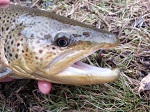
stocker from that time:

39409965070_bb8fd9ee70_b.jpg


NO way your confusing those
 
Good photos and comparison, Sal.

The DFCA meets every third Monday in the back room of Shanks Tavern in Marietta. We'd love to have more people come out and help with stream restoration, etc.

If you're interested in learning more about the organization or the stream, check out our website - www.donegalfish.weebly.com


Best,
Michael

 
salvelinusfontinalis wrote:
a farmer, keeping his crop going during the summer.

There's way more pressure on the local water table from all the development around Mount Joy than one farmer pulling some water out for crops..
 
Back
Top