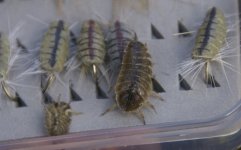
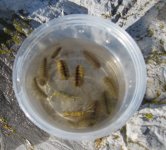
Nice cress bugs. That takes a lot of time to tie.
Another tie/refinement to really making these things look very realistic to the trout is by using a very similar technique to what you describe except instead of using a solid base (felt) for the body use antron strands. Not a pretty looking or durable fly but very effective.
Lay out the antron strands (colors of white, light/medium/dark gray, light/medium olive, tans, etc., you need them all) in a thin, flat layer up to 1 inch wide and 6” long with the strands all going the same way (use a small comb to straighten them out), coat 3-4 inches of one end with a thin coating of clear hard head cement using a dubbing needle, tape the uncoated end to a coat hanger and let them dry where you don’t mind if some of the cement drips off (hanging them allows gravity to draw off excess cement so you get a smoother and more uniform coating). Once dry cut to a rough oval shape across the threads (you want the length to be a little bit longer than the hook shank length), wrap the hook shank with dark thread to create the darker center vein (and also provide a base for the super glue to adhere to) and then carefully dap a little bit of glue on the top side of the hook shank and glue the top piece on and let dry.
Here’s where a rotary vice and fine tweezers come in handy. Turn the fly upside down and dap a few drops of glue on the shank and a few small drops on the antron and then lay the second piece on the shank making a sandwich. You don’t want to apply a lot of glue to the antron just enough to hold it together. Too much glue will add too much weight and the fly won’t float, roll and tumble right. Well, actually you can add more glue along the shank to provide a more durable fly but don’t soak the edges with glue because if done right the antron sandwich should be firm/solid along the shank but the edges should be a little soft so the fly “breathes” in the water and the edges move and wiggle a bit simulating life. Once the fly is complete, let it dry and then trim the fly to the final shape. You may need to touch up some loose fibers here and there with a little bit of glue (if it looks like it really won’t hold shape) but don’t worry about a few loose fibers because that will help create the illusion of life even if it looks ugly.
To create the illusion of the segmented or darker areas take your dubbing needle and heat it to red hot with a lighter and then lay it across the body scorching a light dark line into the antron (my experience is lighter lines work far better that darker lines). While you can use a fine pen for this, I personally don’t like ink only because ink is absorbed by the fibers and makes a well defined solid line that is too sharp and pronounced. I don’t even bother with legs. Now for a real secret, instead of using all one color antron and making the segments/darker areas with a heated needle alternate lengths of say light olive antron and then a thinner length of a lighter antron (white or light gray), and repeat (darker should be slightly wider than ligher – notice the real ones). While much more time consuming, this will really give a realistic contrast/segmentation appearance.
This is not a difficult fly to tie but it takes some time to get the feel for it and when you first start be prepared to glue antron to your fingers and mess up the first dozen or so flies you attempt. These can be tied on straight or curved hooks. Tie them on both if you can in sizes 10 through 16. Anything smaller becomes a major nuisance.
Once again, this fly is not at all durable and it is a “one and done” fly so you can easily go through many of them in one day if you hit upon the right color(s).
What people don’t fully realize is all aquatic insects have some degree of translucency to them (even black stoneflies) and because of this the sight pattern that the fish sees (perceived color, strength of silhouette, contrast, etc.) all depends on how the fish is feeding in the water column relative to the insect, the clarity and depth of water, and ambient light conditions.
So when tying a fly you are not trying to create a perfectly realistic looking fly that looks real to you out of the water but unfortunately doesn’t show the correct sight pattern to the trout in the water under actual feeding conditions but rather a fly that may not look fully realistic out of the water but exhibits the correct sight pattern that the trout in the water sees under actual feeding conditions. This also is applicable to dry flies.
Once you figure out how these variables interact and you start tying flies that create the correct illusions and know when to user them, you will start catching substantially more trouts.