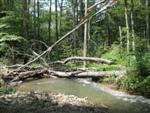
Big Fishing Creek, Clinton Co., 12/27-28/2022

The reason is probably related to maintaining floodwater conveyance. It's a channelized section of stream, done to try to reduce flooding. During big floods, trees can jam up at the bridges and back up the water, causing flooding, blowing out bridges, etc.
Well the closest bridge is rumored to be getting removed in the near future. If the reason you say is true I'm just not accepting that answer as a good enough reason.
 
Troutbert, if this was an actual flood control system that prevented flooding and provided local property owners relief from flood insurance I may agree with you. While this is a channelized section, there is virtually no flood protection from this "levy" except for perhaps the community pool and ball fields. The trees cut appear to be living Sycamore, not dead trees in the creek.

One of the primary issues for flooding there is a old railroad bridge with inadequate hydraulic capacity for larger storm events aside from the obvious that much of Mill Hall proper is built in a highly floodprone area.
 
Last edited:
Troutbert, if this was an actual flood control system that prevented flooding and provided local property owners relief from flood insurance I may agree with you. While this is a channelized section there is virtually no protection from flooding from this "levy" except for perhaps the community pool and ball fields. The trees cut appear to be living Sycamore, not dead trees in the creek.

One of the primary issues for flooding there is a old railroad bridge with inadequate hydraulic capacity for larger storm events aside from the obvious that much of Mill Hall proper is built in a highly floodprone area.
mill hall, coudersport, Lebanon, and many others couldn’t have been built in worse places. Now its a done deal even if the municipalities every come to their senses about failing or dysfunctional infrastructure/dams then buckle up your helmet because here come the historical societies that “protect” abandoned dams that serve no purpose, areas of the community underwater every two years, and cherish all other sort of environmental skid-marks in humanity’s underwear.
 
If they could find a way to loop all those concrete ditches together with a log-shaped boat riding on a rail system they could sell tickets for the ride and maybe raise enough money to dynamite the whole operation.
 
Fishsticks, I hope we never see another concrete jungle constructed like the one in Coudersport on the Allegheny River... one can only imagine what the upper river system would be like without that atrocity.
Have you ever read James Bashline’s night fishing the Final frontier? Since I am really into night fishing with a fly rod and seeing as it is the only dedicated printed text on the subject I got it 5 or 6 years ago. The guy talks about learning to night fish with wet flies from a local who was pioneering it. They met up extremely frequently and swung wets at a pool called the “goodsell” hole which is what used to be the confluence of mill creek and the Allegheny.

He writes he went over seas fought for his country in either Nam or korean war. Came home and went to go fish the goodsell hole in the stream he learned to fly fish and night fish on as a young boy from his mentor and it was all concrete……no one told him
 
Fishsticks, I hope we never see another concrete jungle constructed like the one in Coudersport on the Allegheny River... one can only imagine what the upper river system would be like without that atrocity.
Also that rainbow paradise up stream that has been ponded up and deforested has potential to as a restoration one day. I keep paying the tax on stupid and buying my lone powerball ticket once every 6 months
 
Rumor has it that the Clinton County Conservation District will be doing a restoration project down in Mill Hall from the Fire Hall down to the next bridge. They are going to make an announcement at the Fisherman's Breakfast at the Mill Hall Fire Building on Opening Day April 1st.
 
Rumor has it that the Clinton County Conservation District will be doing a restoration project down in Mill Hall from the Fire Hall down to the next bridge. They are going to make an announcement at the Fisherman's Breakfast at the Mill Hall Fire Building on Opening Day April 1st.
Thats great news! The water from just below the fire hall down to the 150 Bridge is kind of worthless water. It gets too wide and shallow. That would be a good area to do a stream improvement project!
 
Rumor has it that the Clinton County Conservation District will be doing a restoration project down in Mill Hall from the Fire Hall down to the next bridge. They are going to make an announcement at the Fisherman's Breakfast at the Mill Hall Fire Building on Opening Day April 1st.

Inside information on a stream habitat project? Looking forward to improved habitat, if only folks could stop cutting trees!
 
Penndot cut all the trees on the bank along Sr 64 just above where it meets sr150 a few years ago.

Then on the upper end of town Floating Feathers cut down all the trees along their property.
 
Thats great news! The water from just below the fire hall down to the 150 Bridge is kind of worthless water. It gets too wide and shallow. That would be a good area to do a stream improvement project!
It was made wide and shallow there with heavy machinery, as part of a flood control project.

A quandary about doing a habitat structure project in a flood control project area is that adding structures will raise flood water elevations.

But maybe they can do some modest project that will help fish habitat, without raising flood water elevations very much.
 
Yes the stream was bulldozed and small earthen berm was built, but I do not believe the small section of levee by the ball fields is actually recognized as a flood control project. There is no relief from flood insurance for the homes behind it in Mill Hall, there are large trees growing on it in some locations, etc.

I think low profile rock structures could be installed to help narrow the channel during lower flows while having a negligible impact on water elevations across the entire stream. These structures could also help stabilize the toe of slope along Sr 64 up to behind the firehall.
 
It won't result in the raising of flood water elevations. The project was designed by the PFBC Stream Habitat team after careful review and the idea is to both add habitat and narrow and deepen the stream. By narrowing the stream using log framed deflectors/log-faced stone deflectors, the forced water will push away from the banks and into the center. This will actually deepen the stream because that forced water will slowly erode the stream bed, similar to how a dam/waterfall creates a plunge pool. So the loss of horizontal area is accounted for through the gain of vertical area, if that makes sense.

And yes, the toe will be stabilized throughout the section along 64 and behind the fire hall. This should result in further armoring of the section and an ultimate reduction in sediment to the stream, which is also really nice for fish and their gills.

over 100 large boulders are going to be placed in the thalweg randomly as well. This should create some scour behind each of them and a place for fish to hold out of the current. the hope is to draw fish to this section and allow them to have what they need to stay there throughout the year. Habitat is probably one of the most limiting factors for fish population in that section of stream.

Also, the hope is to help educate those who are doing all the cutting of trees along the stretch. That is clearly a huge issue as well. There will be a nice planting of over 400 native trees/shrubs up on the floating feather property this April/May.

 
It won't result in the raising of flood water elevations. The project was designed by the PFBC Stream Habitat team after careful review and the idea is to both add habitat and narrow and deepen the stream. By narrowing the stream using log framed deflectors/log-faced stone deflectors, the forced water will push away from the banks and into the center. This will actually deepen the stream because that forced water will slowly erode the stream bed, similar to how a dam/waterfall creates a plunge pool. So the loss of horizontal area is accounted for through the gain of vertical area, if that makes sense.

And yes, the toe will be stabilized throughout the section along 64 and behind the fire hall. This should result in further armoring of the section and an ultimate reduction in sediment to the stream, which is also really nice for fish and their gills.

over 100 large boulders are going to be placed in the thalweg randomly as well. This should create some scour behind each of them and a place for fish to hold out of the current. the hope is to draw fish to this section and allow them to have what they need to stay there throughout the year. Habitat is probably one of the most limiting factors for fish population in that section of stream.

Also, the hope is to help educate those who are doing all the cutting of trees along the stretch. That is clearly a huge issue as well. There will be a nice planting of over 400 native trees/shrubs up on the floating feather property this April/May.
Thats all good news!
 
Back
Top