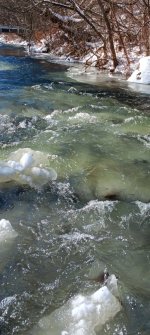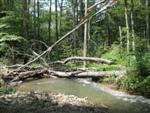
Anchor ice is coming.

TimMurphy

Well-known member
Joined
Sep 9, 2006
Messages
4,449
Dear Board,

Has anyone checked the long-term forecast? This week in Harrisburg will feature lows around zero every night. In more northerly regions of the State below zero will definitely happen. I looked to mid-February and Harrisburg will have 2 days in that span projected to be over 32 degrees.

With flows so low, anchor ice may really do a number on a lot of small streams. If you've never seen it happen it is most definitely not a joy to behold.

We'll see what happens, but I worry about this year's spawn, regardless of whether they are brook trout or brown trout.

Regards,

Tim Murphy
 
Anchor ice, other natural environmental conditions and variations thereof would no longer produce a brook trout 60-70% total annual mortality rate with a 9” length limit.🤣. The trout would be “protected.” Yes, sarcasm.

Tim, You’re right. Frazil ice that later becomes anchor ice can raise a stream right out of its channel and uproot areas of stream substrate, dislodging macroinvertebrates, fish eggs, and depending upon the time of year, possibly even some fry. Then there is the snow melt itself, which is trending toward being considerable this year if we continue to have a “real winter.” Sudden drops in pH, slowly falling pH, and activation of naturally occurring aluminum can also have substantial negative impacts on eggs and/or fry.
 
Last edited:
One winter I was walking along a small stream in New Hampshire when the weather was really cold. Most of the stream was ice covered, but there were some openings where the current was swift. There you could see that the bottom was covered with anchor ice. So much of the stream had ice on the top and the bottom with water flowing in between.

That would be a harsh environment for trout. Way up north, like Maine, Canada, even the Adirondacks,, maybe most of the brook trout drop down from the brooks into larger waters such as lakes and rivers to survive the winters.
 
We get it yearly out here in the vale. The natives and non natives got bigger problems IMHO. Certainly not ideal in PA, but the fish are pretty good at living in rivers.

Sucks at ice out, though. At least for the richies that built on the banks.
 
Could the snow cover help insulate this from happening as I'm not really familiar with this subject
 
Probably lots of 'what ifs', variables, etc specific to each stream. Some streams might have more going on with springs, local geology , etc to make it less of an issue,.while others, not so much. So much of our trout water out here is so heavily spring influenced, I suspect that anchor ice is not a huge problem, despite how cold we get here in Iowa, in a 'normal for Iowa winter'.

Joe
 
Last year at about this time...on bills creek.i actually caught a couple that day .. didnt notice any fallout out of the ordinary this year from the anchor ice event last year...although i think jun t may have fished before i did that day. Briging my totals down lol !!!
 

Attachments

  • Screenshot_20260126_100226_Photos.jpg
    Screenshot_20260126_100226_Photos.jpg
    184.2 KB · Views: 100
Anchor ice, other natural environmental conditions and variations thereof would no longer produce a brook trout 60-70% total annual mortality rate with a 9” length limit.🤣. The trout would be “protected.” Yes, sarcasm.

Tim, You’re right. Frazil ice that later becomes anchor ice can raise a stream right out of its channel and uproot areas of stream substrate, dislodging macroinvertebrates, fish eggs, and depending upon the time of year, possibly even some fry. Then there is the snow melt itself, which is trending toward being considerable this year if we continue to have a “real winter.” Sudden drops in pH, slowly falling pH, and activation of naturally occurring aluminum can also have substantial negative impacts on eggs and/or fry.
My comment above foretold the week. Today as I snowshoed along a stream it became evident since my venture three days ago that anchor ice had lifted much of the water to an elevation higher than the established ice in many places, allowing the stream to flow over the ice. Where there was snow on the ice covering a 3 ft deep, long pool the other day there was now freshly frozen water and frozen slush on top of that original ice. There were other places where established ice in riffles, runs, and pocket pools had apparently risen and then when no longer supported by water had collapsed onto the formerly submerged substrate. This is the under ice stream world in which trout and other adult and juv fish become trapped in cold, temporarily waterless pockets or crushed under the weight of rising and falling ice. Both lead to substantial natural mortality. One can picture larger fish logically having a more likely chance of becoming trapped in a wet or waterless cavern, moribund, or frozen. Present lower winter flows may make it worse…easier to freeze, less water/habitat to function as a refugia.
 
Last edited:
My comment above foretold the week. Today as I snowshoed along a stream it became evident since my venture three days ago that anchor ice had lifted much of the water to an elevation higher than the established ice in many places, allowing the stream to flow over the ice. Where there was snow on the ice covering a 3 ft deep, long pool the other day there was now freshly frozen water and frozen slush on top of that original ice. There were other places where established ice in riffles, runs, and pocket pools had apparently risen and then when no longer supported by water had collapsed onto the formerly submerged substrate. This is the under ice stream world in which trout and other adult and juv fish become trapped in cold, temporarily waterless pockets or crushed under the weight of rising and falling ice. Both lead to substantial natural mortality. One can picture larger fish logically having a more likely chance of becoming trapped in a wet or waterless cavern, moribund, or frozen. Present lower winter flows may make it worse…easier to freeze, less water/habitat to function as a refugia.
This doesn't sound promising, regardless of how long it's been happening. This prolonged extreme cold is rare in our region.
 
My comment above foretold the week. Today as I snowshoed along a stream it became evident since my venture three days ago that anchor ice had lifted much of the water to an elevation higher than the established ice in many places, allowing the stream to flow over the ice. Where there was snow on the ice covering a 3 ft deep, long pool the other day there was now freshly frozen water and frozen slush on top of that original ice. There were other places where established ice in riffles, runs, and pocket pools had apparently risen and then when no longer supported by water had collapsed onto the formerly submerged substrate. This is the under ice stream world in which trout and other adult and juv fish become trapped in cold, temporarily waterless pockets or crushed under the weight of rising and falling ice. Both lead to substantial natural mortality. One can picture larger fish logically having a more likely chance of becoming trapped in a wet or waterless cavern, moribund, or frozen. Present lower winter flows may make it worse…easier to freeze, less water/habitat to function as a refugia.
Yet another reason why beaver ponds are important in small freestone streams. They would provide a more stable environment to survive the harsh winter conditions than the stream channels. (And they provide refuge in summer droughts also.)
 
This is akin to me worrying about heat waves, rainfall, and everything else out of my control. I can't do anything about it, so I'll try not to worry about it. I'm sure it can do some damage to the trout, but they've been surviving these situations for millennia, so...
I don’t worry about it. The desire is to inform, educate, and better allow anglers to conceptually understand how in addition to predation, disease, displacement, and delayed C&R mortality, total annual wild trout mortality from age 1 onward can be so high in Pa when angler harvest is so low.
 
Last edited:
I’m probably in way over my waders and as a biologist I make a pretty good lawyer. I’m sure that the extremes of this winter with have impacts on wild trout populations. Other species will be affected also. I can only guess that our resident Canada Goose population; or at least I hope so. Benke in his book on brook trout let me know that Brookies survived the Ice Age, acid rain, fishing with worms, acid mine drainage and my sloppy handling as a younger man. As the population of Canada geese declines, the population of foxes will be impacted. As the actor Jeff Goldbloom once said “Uh … life will find a way.”
 
This is akin to me worrying about heat waves, rainfall, and everything else out of my control. I can't do anything about it, so I'll try not to worry about it. I'm sure it can do some damage to the trout, but they've been surviving these situations for millennia, so...
Dear jifigz,

The survival part of your statement when measured in millennia is true. But this will be a banner year for fat raccoons too.

They're just fish.

Regards,

Tim Murphy 🙂
 
I’m probably in way over my waders and as a biologist I make a pretty good lawyer. I’m sure that the extremes of this winter with have impacts on wild trout populations. Other species will be affected also. I can only guess that our resident Canada Goose population; or at least I hope so. Benke in his book on brook trout let me know that Brookies survived the Ice Age, acid rain, fishing with worms, acid mine drainage and my sloppy handling as a younger man. As the population of Canada geese declines, the population of foxes will be impacted. As the actor Jeff Goldbloom once said “Uh … life will find a way.”
Dear salmo,

To be sure, life will find a way. But it will be altered, to no one's real detriment because most of us buy food at the store.

But just once before I expire, I'd like to see somewhat normal year of weather compared to my youth. Dry years, wet years, and most with little to no snow have become the norm in the last 25 years. The Earth will certainly survive regardless of reminiscences.

Regards,

Tim Murphy 🙂
 
  • Like
Reactions: CRB
I don’t worry about it. The desire is to inform, educate, and better allow anglers to conceptually understand how in addition to predation, disease, displacement, and delayed C&R mortality, total annual wild trout mortality from age 1 onward can be so high in Pa when angler harvest is so low.
I was never implying that you worried about it, Mike. It was just a general statement. I used to worry about stuff like this.
 
Yet another reason why beaver ponds are important in small freestone streams. They would provide a more stable environment to survive the harsh winter conditions than the stream channels. (And they provide refuge in summer droughts also.)

Not all beaver ponds are created equal, on all types of streams.

Out here in the upper midwest, I have heard some fisheries managers/biologists raise concerns about beaver ponds in winter on streams with low spring/ground water input influence, for fear of hypoxia resulting from the ice cover, water stagnation.

To your point, I guess if fish have access to water, even water with severely low or lethal reduced levels of oxygen, its better than no water.
This is an interesting study on beaver ponds:

https://www.fs.usda.gov/pnw/pubs/journals/pnw_2022_stevenson001.pdf
 
I’m probably in way over my waders and as a biologist I make a pretty good lawyer. I’m sure that the extremes of this winter with have impacts on wild trout populations. Other species will be affected also. I can only guess that our resident Canada Goose population; or at least I hope so. Benke in his book on brook trout let me know that Brookies survived the Ice Age, acid rain, fishing with worms, acid mine drainage and my sloppy handling as a younger man. As the population of Canada geese declines, the population of foxes will be impacted. As the actor Jeff Goldbloom once said “Uh … life will find a way.”
I can almost guarantee that this weather will have little to no impact on the goose populations. As someone who hunts them and watches them often, I'll say they're tough and intelligent birds. They'll fly to where they need to. Even though the local Canada geese are residents and don't migrate in the traditional sense, they will see migrate to find hospitable environments.

I can tell that most of my local geese are currently not where I live, and I have some visiting geese around.
 
Up here in Erie county the harsh winters usually cause a great deal of injury to the steelhead populations. This year will be the same. It has been in the single digits or below zero for 2.5 weeks so far this January. Yesterday some parts of the area were-25 not wind chill temp but actual temp.
Lots of ice is made at these temps.
Warm temps bring increased PH along with increase salts from roads from snow melt. Lots of micro life is effected.
The waters of the northern tier are not affected quite so much due the the lower population and less salt that gets spread on the secondary roads.
 
Im gonna go out now and take some pics. Kinda cool to see what these fish have to go through...just like us on land in this cold weather... it was so cold my teeth were chattering on the night stand 🤣🤣
 
Back
Top